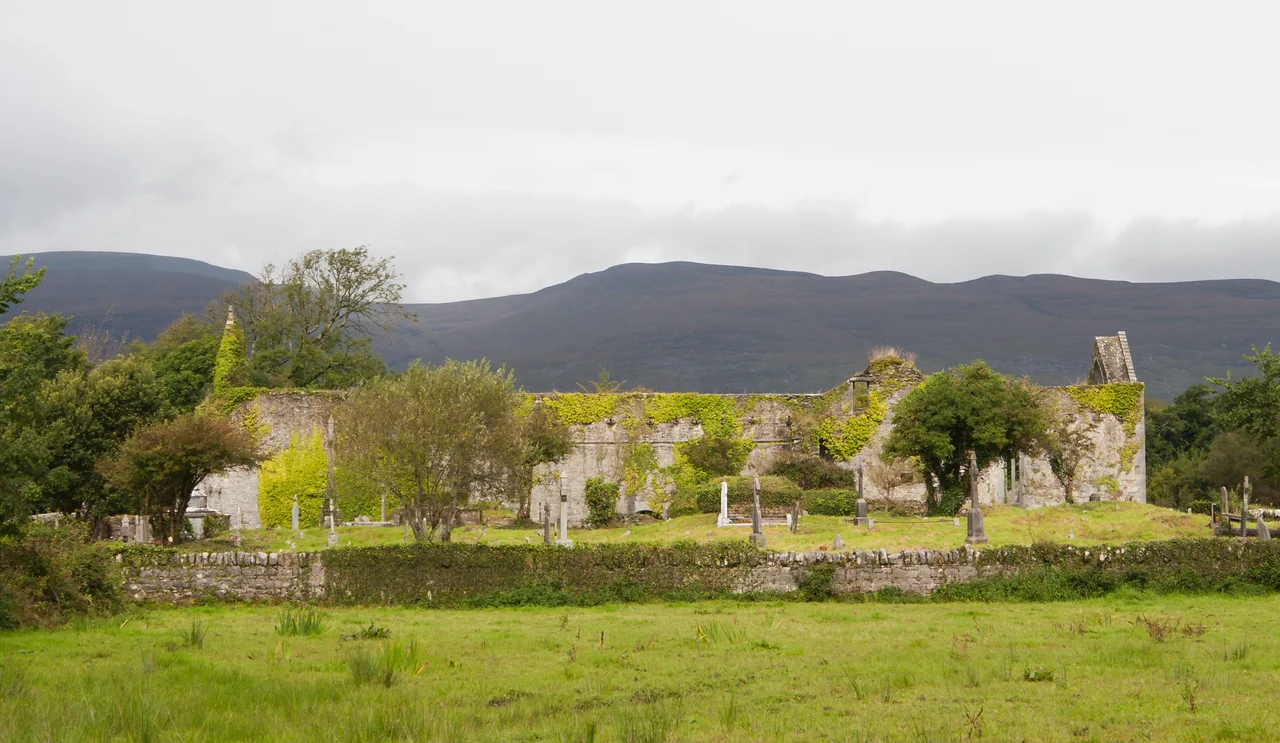

Killagha Abbey
Killagha Abbey of Our Lady of Bello Loco - 'Our Lady of the Beautiful Place' - took its Latin tag because the setting near the River Maine was, even by twelfth-century Irish standards, lovely enough to remark upon. Pilgrims came for it. The Augustinian canons who lived there grew wealthy enough that their Prior held a seat in the Irish House of Lords and the abbey paid the third-highest tax rate in the Diocese of Ardfert in 1302. Its remoteness from Dublin saved it, briefly. When Henry VIII began dissolving the monasteries, Killagha survived longer than most because the long road into Kerry made it inconvenient to suppress. But the same proximity that had once made it valuable - its closeness to the strategic fortress at Castle Maine - eventually drew the Crown's attention. The order to close came in 1576.
Founded by an Anglo-Norman Justiciar
The abbey was founded around 1216 by Geoffrey de Marisco, Justiciar of Ireland - the chief royal administrator - on the site of an earlier monastery established by Saint Colman. That earlier foundation gave the abbey its alternative name, Kilcolman, meaning Church of Colman. Geoffrey de Marisco was an Anglo-Norman nobleman who had received substantial grants of land in Munster from John, King of England. The new abbey, dedicated to the Virgin Mary, was occupied by Canons Regular of the Order of St. Augustine. It became wealthy. Its Prior sat in the Irish House of Lords. It owned lands across Munster. It maintained a leper house and a hospital - the abbey was not just a place for prayer, but a working institution providing what passed for medical care in medieval Ireland. The large east window, added in the fifteenth century, signalled both architectural ambition and money to spend on it.
Distance From Dublin
When Henry VIII began the Dissolution of the Monasteries in the 1530s, the wave of confiscations rolled west more slowly than it rolled east. Killagha's distance from Dublin meant the Crown's enforcement officers had farther to ride. The abbey continued in use longer than most Irish monasteries. But the Desmond Rebellions of the 1570s changed the calculus. The abbey lay close to Castle Maine - the strategic fortress in the middle of a bridge over the River Maine - and during the rebellions, Castle Maine was contested ground. The proximity that had once made Killagha a useful local centre now made it a security concern. The Crown gave orders for the establishment to be closed in 1576.
The Spring Family Takes the Abbey
After the seizure, the buildings and land were briefly leased to Thomas Clinton, one of Queen Elizabeth I's officers in Kerry, and then in 1583 to Sir William Stanley. On 12 December 1588 - the year of the Spanish Armada - the Crown transferred the abbey and its estate to Captain Thomas Spring of Castlemaine, a Protestant nobleman who had distinguished himself during the Desmond Rebellions. He was a grandson of Thomas Spring of Lavenham, the wealthy English clothier. The grant came with a clause requiring the Spring family to rebuild the abbey's domestic buildings in a castle-like form, so the structure could serve a defensive purpose. The Springs did so. Captain Spring's son Walter became High Sheriff of Kerry in 1609. The abbey had become a manor house. Then Walter Spring's grandson, another Walter, was raised as a Roman Catholic and fought in the Irish Rebellion of 1641. The fortified abbey became, for Cromwell's army during the Irish Confederate Wars, another target. Cannon fire demolished the domestic buildings. The church itself was damaged but not destroyed. Walter Spring lost almost all his lands and was given the bitter nickname 'The Unfortunate'.
A Cromwellian Soldier and Three Centuries of Burial
Killagha Abbey was granted to Major John Godfrey, a Cromwellian soldier. The Restoration of Charles II in 1660 readjusted many Irish land grants, but Major Godfrey's was confirmed in the Act of Settlement 1662. The Godfreys held the property thereafter, but with the manor house destroyed, the abbey was no longer used as a dwelling. In 1772 the family built a new stately home nearby in Milltown, naming it Kilcolman Abbey - also known as Bushfield House. That house, in turn, was abandoned and demolished in 1977. Some of the original abbey stones were carried off for nearby houses and the new manor. The abbey church gradually slid into ruin. The land immediately around it became a cemetery, and remained one for more than 300 years. The abbey ruins are now protected as the Kilcolman Burial Ground. Inside the broken walls, headstones cluster among the medieval foundations. The Beautiful Place is still a place, and people are still buried in it.
From the Air
Located at 52.15 N, 9.73 W, about 1 km northwest of Milltown in County Kerry, near the River Maine. Nearest airport: Kerry (EIKY) at Farranfore, about 8 km north. The abbey ruins sit in flat country near the river, with the Slieve Mish Mountains visible to the north. Castle Maine bridge ruins lie about 4 km east at Castlemaine village. Both sites can be seen on the same low-altitude approach. The interior of the ruined church now holds a modern cemetery, recognizable from above by the cluster of headstones inside the medieval walls.
Nearby Stories
- Emlagh East Ogham Stone 2 km away
- Carrignacurra Castle 2.6 km away
- Uragh Stone Circle 5.2 km away
- Ballinskelligs 6.2 km away
- Eurovision Song Contest 1993 8.2 km away
- Newcastle West 9.6 km away
- Ballyheigue Castle 11 km away
- RMS Carinthia (1925) 98 km away