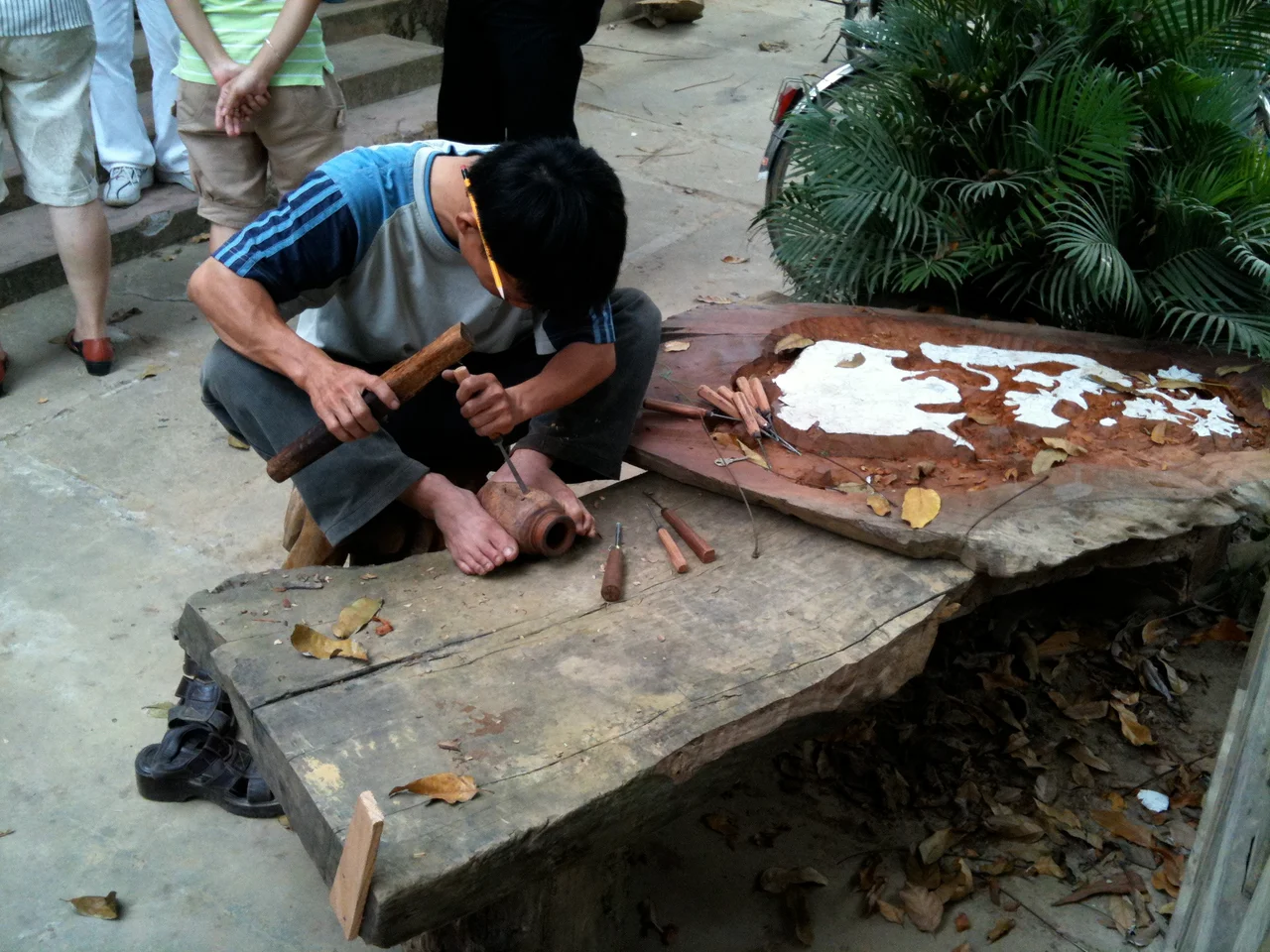

Kim Bồng woodworking village
Cross the Thu Bon River from Hội An's famous old town and you leave tourists behind almost entirely. Kim Bồng village, on the Cẩm Kim commune side, has been working wood since the 15th century — not as a curiosity for visitors, but as a living trade that helped build the imperial capital at Huế and continues to restore the ancient town across the water. The smell of sawdust and lacquer drifts through the lanes, and the sound of a mallet against a chisel is as ordinary here as birdsong.
Five Centuries at the Workbench
Kim Bồng's craftsmen first gained wide renown in the 18th century, when the village's artisans were called north to contribute to construction at Huế — then the seat of the Nguyễn lords and later the Nguyễn dynasty emperors. The detail work they produced in those imperial buildings still stands. More recently, the same hands have shaped timber for Ho Chi Minh's mausoleum in Hanoi. That a village of a few hundred families has left its mark on both the imperial past and the revolutionary present says something about the depth of the craft here. The techniques have been refined and passed down through generations, not preserved under glass but used every day: mortise-and-tenon joinery without nails, wood selected and seasoned to outlast its makers.
Rebuilding the Ancient Town
When the old town of Hội An was inscribed as a UNESCO World Heritage Site in 1999, the question of who would restore its 200-year-old shop-houses and assembly halls had a ready answer. Kim Bồng craftsmen had been the builders; Kim Bồng craftsmen would be the restorers. Some of the buildings they now work on had not been touched, structurally, in centuries — which means the repair requires not just skill but historical detective work, reading grain patterns and joinery methods to understand what the original builders intended. Restoration projects have also taken Kim Bồng artisans to Da Nang and as far as Quảng Ninh Province in the north, spreading a tradition rooted in this small river-bend commune across the country.
The Endangered Art of Master Carvers
For all its renown, the trade nearly died out in the 1990s. Woodworking offered hard work for modest returns — around VND 1.5 million (roughly US$85) a month on average — and young people left for factory jobs or city work. By the time the UNESCO designation revived interest in the old town's heritage, few master carvers remained in Kim Bồng. To stop the skill from vanishing entirely, Cẩm Kim commune built a program offering free training to young residents, including a monthly stipend of VND 150,000 and a set of tools. It was a small intervention, but it slowed the erosion. The master carver Huynh Ri became one of the faces of that survival, his workshop a place where technique was shared rather than hoarded.
Ships and Cabinets, Then and Now
Kim Bồng was never only about decorative carving. The village built boats — fishing vessels and river craft suited to the Thu Bon's shifting channels — alongside the cabinet-making and architectural joinery for which it is best known. Shipbuilding has declined as fiberglass hulls replaced wooden ones, but the tradition of working at multiple scales, from the curve of a prow to the inlay on a cabinet door, shaped a versatility that still defines the village's craftsmen. Today visitors can watch carvers at work in open-fronted studios, and workshops sell furniture and decorative pieces. The commercial side is real, but it sits alongside work that is genuinely ancient: the proportions, the joinery, the choice of timber all carry the fingerprints of centuries.
From the Air
Kim Bồng village sits at approximately 15.867°N, 108.314°E on the south bank of the Thu Bon River, directly across from Hội An old town. From the air at 1,500–2,000 ft, the river's broad S-curve is the dominant landmark, with the dense grid of Hội An's tile-roofed old town clearly visible on the north bank and the flatter, greener Cẩm Kim commune to the south. Da Nang International Airport (VVDN) lies about 25 km to the north-northeast. Chu Lai Airport (VVCA) is roughly 50 km to the south. Visibility over the coastal plain is generally good outside the northeast monsoon season (September–January).
Nearby Stories
- Bach Ma National Park 7.4 km away
- Tam Kỳ 9.1 km away
- 1968 Kham Duc C-130 Shootdown 27 km away
- Lý Sơn Island 33 km away
- Hue–Da Nang Campaign 33 km away
- Hải Vân Pass 35 km away
- Operation Masher / White Wing 153 km away
- Battle of the Paracel Islands 285 km away