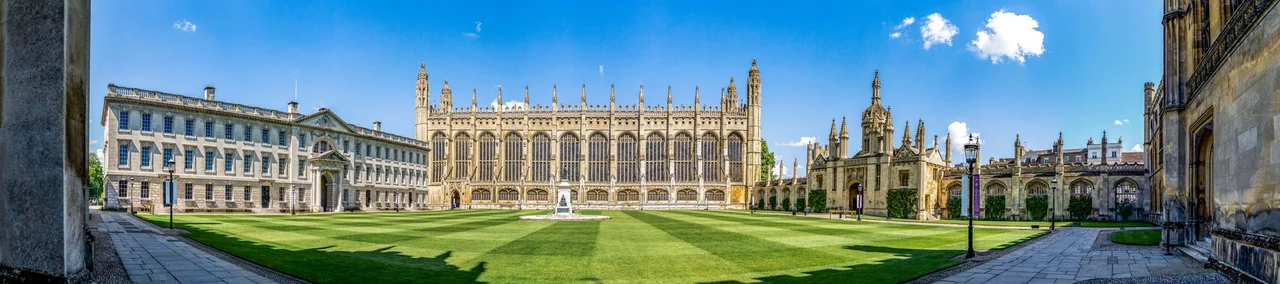

King's College, Cambridge
On Christmas Eve, the Choir of King's College begins to sing. The service — the Festival of Nine Lessons and Carols — broadcasts from the chapel to millions of listeners around the world, as it has for decades. During the Second World War, the college removed all the ancient stained glass from the windows and hid it in cellars across Cambridge. The windows were covered with tar-paper that rattled in the wind. The broadcast continued, though the name of the college could not be announced over the airwaves for security reasons. The chapel stood in darkness but the singing did not stop.
Three Kings and a Hundred Years of Building
Henry VI founded King's College on 12 February 1441, initially imagining a modest institution of a rector and twelve scholars. Within two years his ambitions had grown considerably: he expanded the plan to 70 fellows and scholars headed by a provost, founded Eton College to feed it, and signed a formal agreement with the wardens of New College Oxford and Winchester College to support one another legally and financially. Then the Wars of the Roses intervened. By the time Henry was deposed in 1461, the chapel's east end had been raised 60 feet high; the west end had reached only 8 feet. That building line is still visible today in the contrast between the lighter stone below and the darker stone above. His nephew Henry VII eventually completed the shell. Henry VIII's craftsmen finished the interior by 1544. The chapel took nearly a hundred years to build, and it remains the only part of Henry VI's original vision that was actually realised.
The Chapel the World Knows
King's College Chapel is considered one of the finest examples of late English Gothic architecture. Its fan vault ceiling is the largest in the world. Twenty-six stained-glass windows fill the interior with colour; twenty-four of them date from the 16th century and were carefully photographed, cleaned, and restored during the wartime years when they were hidden in cellars. The altarpiece is Peter Paul Rubens's Adoration of the Magi, a painting gifted to the college in 1961 by property millionaire Alfred Allnatt. Installing it required levelling the raised floor of the chapel's east end. Twenty fellows and the novelist E.M. Forster signed a letter urging the college to admit its mistake; the floor was levelled anyway. The newly refitted east end opened in 1968. The Architects' Journal called it 'motivated not by the demands of liturgical worship but by those of museum display.'
Alumni: Turing, Keynes, and a Spy
Time magazine, compiling its list of the hundred most influential people of the 20th century in 1999, awarded two spots to King's alumni: Alan Turing and John Maynard Keynes, both of whom were students and fellows at the college. Turing developed the theoretical foundations of computer science here. Keynes reshaped the world's understanding of economics. Francis Walsingham, spymaster to Queen Elizabeth I, also studied at King's, as did Robert Walpole — Britain's first Prime Minister — Frederick Sanger (the only Cambridge affiliate ever to win two Nobel Prizes), novelist Zadie Smith, comedian David Baddiel, and Geoffrey Hinton, who received the Nobel Prize in Physics in 2024 for work that laid the foundation of modern machine learning. The college has nine Nobel laureates in total.
Radical King's
King's has a reputation for political radicalism that stretches back decades. Students have organised rent strikes, demonstrations, and debates. Unlike other Cambridge colleges, King's held its own annual celebration — the King's Affair — rather than a traditional May Ball, featuring concerts by the Stranglers, Fatboy Slim, and Clean Bandit in a fancy-dress format that occupies the Front Court, the bar, the hall, and the chapel itself. The college was among the first three previously all-male colleges to admit women in 1972, a decision made under the provost Edmund Leach. Today King's consistently records among the highest proportions of state-school students of any Cambridge college, and with 420 undergraduates and more than 100 fellows it maintains one of the highest fellow-to-student ratios in the university.
From the Air
King's College lies at 52.204°N, 0.117°E in the heart of Cambridge, immediately adjacent to the River Cam. The chapel's distinctive fan vault roof and perpendicular Gothic pinnacles are unmistakable from low altitude, standing at the head of King's Parade. Cambridge City Airport (EGSC) is approximately 2 nautical miles to the northeast. The college and the open meadow of The Backs along the River Cam are best viewed at 1,000–2,000 feet in clear conditions. The Gibbs Building and the long line of the Front Court screen are clearly visible.
Nearby Stories
- Kentwell Hall 2.5 km away
- Thetford Hoard 2.8 km away
- King's Ely 6 km away
- Bedford 7.8 km away
- White House Farm murders 13 km away
- Oundle 14 km away
- Hemel Hempstead 14 km away
- North Weald Airfield 15 km away