
King's Theatre, Edinburgh
In February 2025, builders working on the auditorium of Edinburgh's King's Theatre lifted away a decorative gold crown above the stage and found a sealed bottle behind it. Inside was a list of the architects and plasterers who had worked on the building in 1905. They had hidden their names for someone to find. A hundred and nineteen years later, someone did. That gesture, modest and almost tender, sums up the King's: a theatre built with a young industry's swagger, sustained by audiences who turned up week after week through wars and television and the long retreat of live variety, and rebuilt again in our own decade by people who knew the names of the ones who came before.
Carnegie Lays the Stone
Robert Buchanan of the Edinburgh Building Company already ran a string of provincial variety houses, but the King's was his most ambitious project. He wanted a rival to the Royal Lyceum, which had a twenty-year head start. Andrew Carnegie himself laid the foundation stone on 18 August 1906, with newspapers and coins buried underneath. Buchanan ran out of money before the curtain rose. The contractor William Stewart Cruikshank ended up a major shareholder, and Buchanan tried to clear the debts by selling to the variety empire Howard & Wyndham. The sale failed. The Cruikshank family decided to run the place themselves. Cruikshank's son, A. Stewart Cruikshank, took over as managing director in June 1908, and the King's settled into a long, profitable run as a touring house. Drama, opera, pantomime, revue: whatever filled seats, the King's would book it.
Cinderella First
The first audiences walked in on 8 December 1906 to a festive Cinderella, with Violet Englefield as the Prince and Phyllis Dare in the title role. The foyer they entered was a deliberate spectacle: heavy mahogany door frames, carved pilasters, stained glass, marble, parquet underfoot. The auditorium originally held 2,500, with tip-up seats in the stalls and circles and upholstered benches with metal armrests in the topmost balcony. The boxes were tiered three levels high. The architects had less experience with sight lines than they did with ornament, and some of the boxes had abysmal views; the balcony looked at the plasterwork above the proscenium rather than the stage itself. Audiences didn't seem to mind. Carl Rosa Opera came. Richard D'Oyly Carte's company came. The bill of fare widened to include drama, musicals, large-scale pantomime, revue, opera, whatever the touring circuit offered.
Reshaped for Sight Lines
A. Stewart Cruikshank sold the theatre to Howard & Wyndham in 1928 and became managing director of the whole group; by 1944 he was chairman. In 1948 he was killed in a car accident at 72. The show went on. By 1950 the King's needed work. The glass canopy was replaced. The uppermost balcony was demolished. The rake of the Upper Circle was steepened and extended back. Sight lines improved dramatically. Capacity dropped to 1,350, just over half the original. The theatre opened partially for the 1951 Edinburgh Festival with the Dress Circle closed off, then reopened fully on 14 December 1951 with the pantomime Puss in Boots. Variety thrived through the 1950s and 60s. In 1960 the Edinburgh Gang Show began: over 100 Boy Scouts in a Ralph Reader production, and the annual show continues today with over 200 young people from Scouting and Girl Guiding taking part.
The Bottle Behind the Crown
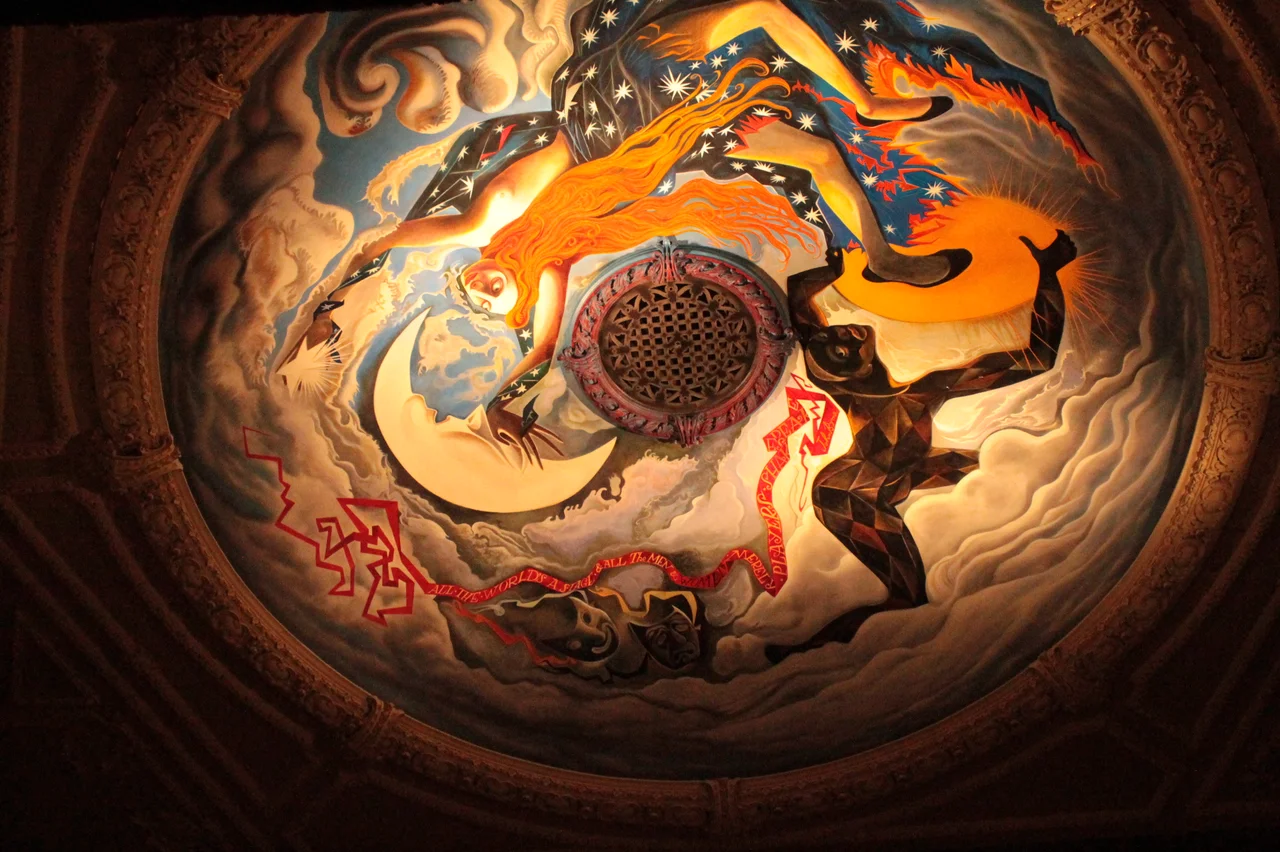
Television was killing variety by the late 1960s. Stars' fees rose past what unsubsidised theatres could pay. In 1969 Howard & Wyndham sold the King's to Edinburgh City Council to secure its future as a Festival venue and a Scottish Opera house. By then the Empire had become a bingo hall and the Playhouse a cinema; the King's was the most prominent theatre in the city. In 1970 it was Category A listed. In 2013 the playwright John Byrne painted a new mural in the central ceiling roundel to cover cracked plasterwork. The major rebuild of 2020-2021 stripped the auditorium for access and facilities improvements. That is when the bottle was found, behind the gold crown above the stage. Inside, in 1905 handwriting, were the names of the men who had built the theatre. The plasterers had reached forward through more than a century. The renovators reached back.
From the Air
55.94 N, 3.20 W, in the Tollcross district of central Edinburgh just south of the Castle. From the air the building is best located relative to Edinburgh Castle (about 700 m to the north) and the Meadows (about 500 m east). Edinburgh Airport (EGPH) is 9 km west. Recommended altitude for spotting central Edinburgh landmarks: 2,500-3,500 ft. Watch for low cloud and the haar that drifts in from the Forth, particularly in spring and autumn.
Nearby Stories
- Ardoch Roman Fort 2.2 km away
- Craignethan Castle 3.1 km away
- Haddington 3.8 km away
- Balvaird Castle 4.3 km away
- Battle of Kilsyth 9.4 km away
- Siege of St Andrews Castle 9.9 km away
- Neidpath Castle 11 km away
- Melrose Abbey 15 km away