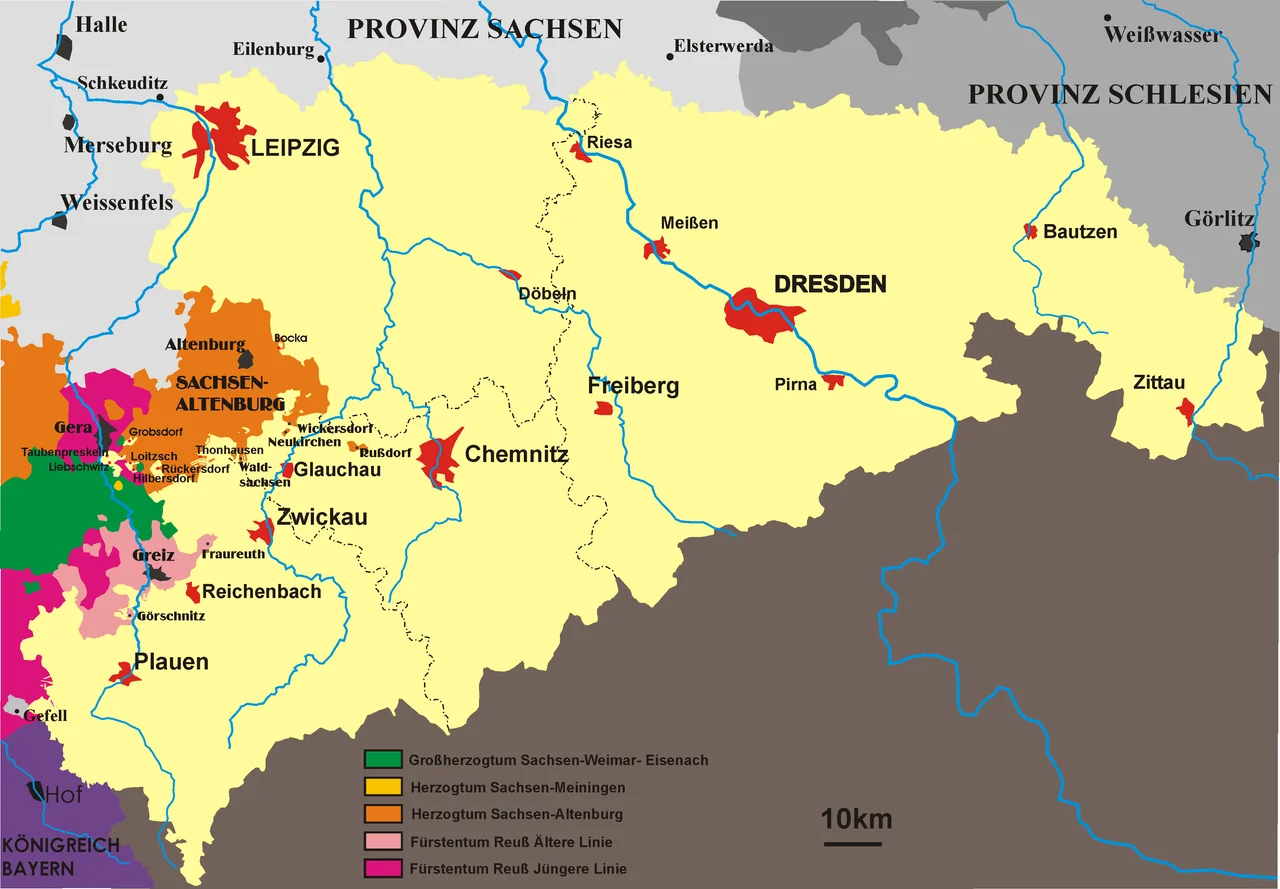

Kingdom of Saxony
If you want to understand why Saxony still feels like its own country inside Germany, start with the wrong bets. In 1813 the Kingdom of Saxony was the only German state still fighting alongside Napoleon when the French were crushed at the Battle of Leipzig — on Saxon soil, with the Saxon king watching from a tower. In 1866 Saxony bet again, this time on Austria against Prussia. Wrong both times. And yet the kingdom survived: stripped of 60 percent of its territory after 1815, swallowed into Bismarck's German Empire after 1871, but never abolished. Saxony was too prosperous to dismantle, too cultured to insult, and too useful to the new arrangements not to keep around. The Wettin dynasty kept the throne in Dresden until 1918.
From Elector to King
Before 1806 Saxony was an Electorate of the Holy Roman Empire, ruled by the House of Wettin, one of the seven states whose princes elected the Holy Roman Emperor. The Wettins were old, wealthy, and Catholic by political conversion — they had switched faiths in 1697 to qualify for the elective Polish crown, and ruled the Polish-Lithuanian Commonwealth for most of the 18th century while their Saxon subjects remained 95 percent Protestant. In December 1806, after Napoleon's annihilation of Prussia at Jena, Frederick Augustus III of Saxony joined Napoleon's Confederation of the Rhine and was rewarded with the title of King Frederick Augustus I. He also got to rule the new Duchy of Warsaw on the side. For seven years, Saxony bet on France.
The Battle on Saxon Ground
The Battle of Leipzig in October 1813 — the Battle of the Nations — was the largest battle fought in Europe before the First World War. Roughly 560,000 troops from across the continent collided around a single Saxon city for four days. Napoleon lost. Frederick Augustus, who had stayed loyal, was taken prisoner by the Prussians and treated as a defeated enemy. At the Congress of Vienna in 1815 Prussia wanted to annex all of Saxony as a punishment. Russia and Austria, alarmed at the prospect of Prussia growing so large, blocked it. The compromise gave Prussia 60 percent of Saxon territory — including Wittenberg, the city where Luther had nailed his theses, the historical core of the Saxon Reformation — but left a much-reduced Kingdom of Saxony in place around Dresden and Leipzig, with Frederick Augustus restored to a smaller throne.
Industrial Saxony
What survived was the rich part. Leipzig had been hosting Europe's most important book and trade fairs for centuries. Chemnitz became one of Germany's first industrial cities, called "Saxon Manchester" by the late 1800s for its textile mills, locomotive works, and printing presses. The Erzgebirge mountains along the Bohemian border produced silver, tin, and the silver mining tradition that had funded Saxon courts for centuries. By 1900 the Kingdom of Saxony had Germany's densest railway network and one of its most literate populations. Politics shifted with the demographics: by 1909, with universal male suffrage at the imperial level, Saxon Social Democrats were taking 27 percent of Landtag seats, fighting for industrial workers' rights against Conservatives and National Liberals at roughly even shares.
Wrong Bet, Round Two
When Prussia and Austria fought their decisive war for German leadership in 1866, Saxony joined Austria. The Royal Saxon Army marched south to fight alongside the Austrians in Bohemia rather than defend Saxony itself. Prussia won the war in seven weeks. Other Austrian allies — Hanover, Hesse-Kassel, Nassau, Frankfurt — were annexed outright. Saxony escaped, partly because the Austrians and French insisted that this old kingdom must be spared as a point of honour, and partly because Bismarck calculated that an independent but cooperative Saxony was more useful than a sullen new province. Saxony joined the Prussian-led North German Confederation the next year, and entered Bismarck's German Empire in 1871. King John kept his crown. He just had to acknowledge the Hohenzollern Kaiser as primus inter pares — first among equals.
The End and the Memory
King Frederick Augustus III abdicated in November 1918 in the wake of Germany's defeat in the First World War, after workers' and soldiers' councils took the streets in Dresden, Chemnitz, and Leipzig. The Kingdom of Saxony was reorganised as the Free State of Saxony within the Weimar Republic on 1 November 1920. The Nazis abolished its autonomy in 1934, the Soviets dismantled it again after 1945, the East Germans dissolved it into smaller districts in 1952. But after reunification, Saxons voted overwhelmingly to bring the state back. Today the Free State of Saxony exists again, with capital at Dresden — its parliament called the Sächsischer Landtag, its constitution dating in spirit to 1831. The kingdom is gone. The cultural memory it preserved — the Dresden museums, the Leipzig fairs, the Meissen porcelain works founded in 1710 — runs the modern state's identity.
From the Air
The historic Kingdom of Saxony centred on Dresden at 51.05°N, 13.73°E, with Leipzig 100 km to the northwest at 51.34°N, 12.37°E and the Erzgebirge mountains forming the southern border with Bohemia. Dresden Klotzsche (EDDC) is the main airport, with Leipzig/Halle (EDDP) serving the kingdom's northwestern reaches. From altitude, follow the Elbe River as it cuts northwest through the kingdom from the Czech border at the Saxon Switzerland sandstone canyons, through Dresden's curving valley, and on toward the Magdeburg plain. Look for the dramatic baroque skyline of Dresden — the Frauenkirche dome, the Zwinger, the Semper Opera — as the principal visual landmark.
Nearby Stories
- Ústí Massacre 19 km away
- Colditz Castle 39 km away
- Lichtenburg Concentration Camp 48 km away
- Czocha Castle 62 km away
- Lutherhaus 104 km away
- Battle of Kunersdorf 113 km away
- Krzeszow Abbey 117 km away
- Salzburg 333 km away