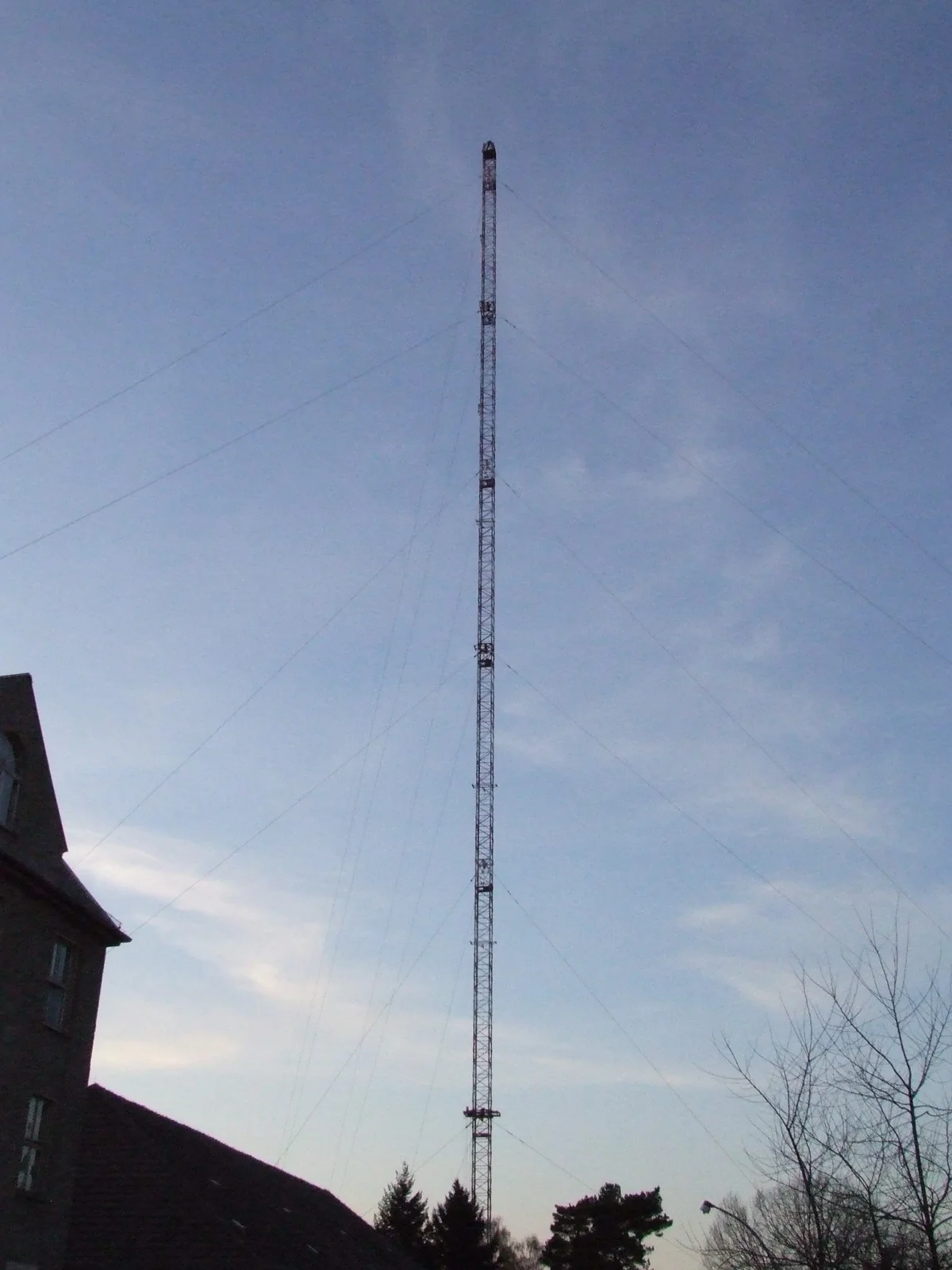

Königs Wusterhausen radio transmitter
On the evening of 22 December 1920, a few employees of the German post office climbed the Funkerberg carrying instruments they had brought from home. They played, they sang, they read poems aloud into a microphone wired to an arc transmitter borrowed from C. Lorenz AG, and the signal went out across Germany on a wavelength of 1,300 metres. Hardly anyone heard it. Private radio reception was illegal in Germany that Christmas and would remain illegal for nearly three more years. The first broadcast of speech and music in German history was, in effect, a concert performed for an audience that was not permitted to exist.
Balloons Over the Windmill Hill
The hill had been in the radio business for a decade already. From 1911 the German army ran experiments here on the Windmühlenberg, northwest of the small town of Königs Wusterhausen — mobile stations bolted to horse carriages, aerials hauled into the air by captive balloons. From 1913 the signal corps began putting up something permanent: a large antenna system and a cluster of functional buildings on the sandy rise. The military transmitting station, later known as Senderhaus 1, went into operation in 1916 with the war two years old and the call sign LP.
When the war ended, the equipment outlived its purpose. The Reichspost took over the barracks with effect from September 1919 and put the aerials to work on weather reports, financial news and telegrams — the internal traffic of a state, sent to nobody in particular. That was the arrangement the Christmas concert interrupted.
The Man Who Wanted an Audience
Hans Bredow had spent part of the war on the Western Front testing tube transmitters and feedback receivers alongside Alexander Meißner and Egbert von Lepel, and he had come away with an idea that most of his colleagues considered a distraction: that radio was not only a way of moving official messages but a way of reaching ordinary people at home. He was a post official, not a visionary in the theatrical sense. He simply kept arranging for music to be sent out until the argument became unanswerable.
A law of 1923 finally authorised private reception, and the thing Bredow had been rehearsing for turned into an industry almost overnight. The Funkerberg could not keep up. A second station building, Sendehaus 2, was inaugurated that same year, and by 1925 something like twenty transmitters were running on the hill at once. Germany calls the place the cradle of its broadcasting, and for once the phrase is not inflated.
Der Dicke
What went up next was meant to be heard by the entire country. The nationwide Deutschlandsender was erected here in 1925, its signal carried on a forest of masts ranging from 100 to 210 metres. At the centre of them, built in 1924–25, stood a free-standing steel tower of triangular cross-section, 243 metres tall, formally the Central Tower and locally known as der Dicke — the fat one.
The hill kept spreading. A longwave transmitter followed at Zeesen, five kilometres to the southeast, and in August 1929 Telefunken inaugurated the first public shortwave transmitter for international broadcasting there, the Weltrundfunksender, aimed at listeners on other continents. Germany could now speak to the world from a patch of Brandenburg heath. After 1933 the Nazi state discovered exactly what that was worth, and the transmitters that had carried carols carried propaganda instead. The aerials did not change. The voice on them did.
The Storm That Took the Tower
In 1945 Königs Wusterhausen fell inside the Soviet occupation zone. Several masts came down by order of the military government, but the station itself was too useful to lose, and it went on broadcasting for East Germany for another four decades.
The Central Tower survived the war and did not survive the weather. On 13 November 1972, Cyclone Quimburga tore across northern Germany, and der Dicke went down with it, taking the T-aerial it had been holding up. By the time of reunification in 1990 the hill was down to a single 210-metre mast carrying a longwave aerial, two masts supporting a mediumwave T-aerial, and a scatter of smaller towers. The remaining longwave, mediumwave and shortwave transmitters were switched off one by one between 1992 and 1999. The last of them fell silent seventy-nine years after the carols.
Mast 17
The site was not cleared, which is the unusual part. Instead the Funkerberg became a museum of itself, with Senderhaus 1 preserved and the machinery left where it stood, and the surviving 210-metre mast — Mast 17 — kept as a technical monument and restored in 2009. Three squat 29-metre steel lattice counter-towers, built to take the strain of the antenna leads, still stand beside it.
The only serious transmitting on the hill now comes from a 67-metre free-standing concrete tower put up in 1994 for mobile telephony and low-power FM — a stub next to the mast it replaced. In July 2016 the IEEE recognised the 1920 broadcast as a technical milestone, which is a formal way of saying that a group of postal clerks with a borrowed arc converter and their own instruments did something that afternoon that has not stopped happening since.
From the Air
The Funkerberg sits at 52.2917 N, 13.625 E, on the southeastern edge of Königs Wusterhausen, about 30 km southeast of central Berlin and just east of the Dahme river and the chain of lakes running down toward Zeesen. From the air the single 210-metre lattice mast is the whole navigation problem solved: it is the only tall structure for miles, standing on a low wooded rise above a town of red roofs, with the Notte canal and the Zeesener See to the south. Berlin Brandenburg (EDDB) is roughly 12 km northwest, close enough that its airspace shelf governs anything you do here — coordinate before descending. Schönhagen (EDAZ) lies about 33 km west-southwest and makes a better base for a slow look. Plan a pass at 1,500–2,500 ft AGL, and give the mast and its guy-wire footprint generous lateral clearance; a 210-metre obstruction on a hill is taller than it looks against flat Brandenburg pine forest. Best light is late afternoon, when the lattice throws a long shadow across the trees and the smaller counter-towers separate visually from the main mast. Winter haze over the lake district can flatten the whole scene to grey, in which case the Dahme and the lakes are the more reliable references.
Nearby Stories
- Caputh 5.9 km away
- Schönhausen Palace 9 km away
- Battle of Nauen 11 km away
- Oderbruch 20 km away
- Falkenhagen Bunker 25 km away
- Wendish-German double church 28 km away
- Lutherhaus 31 km away
- Spreewald 34 km away