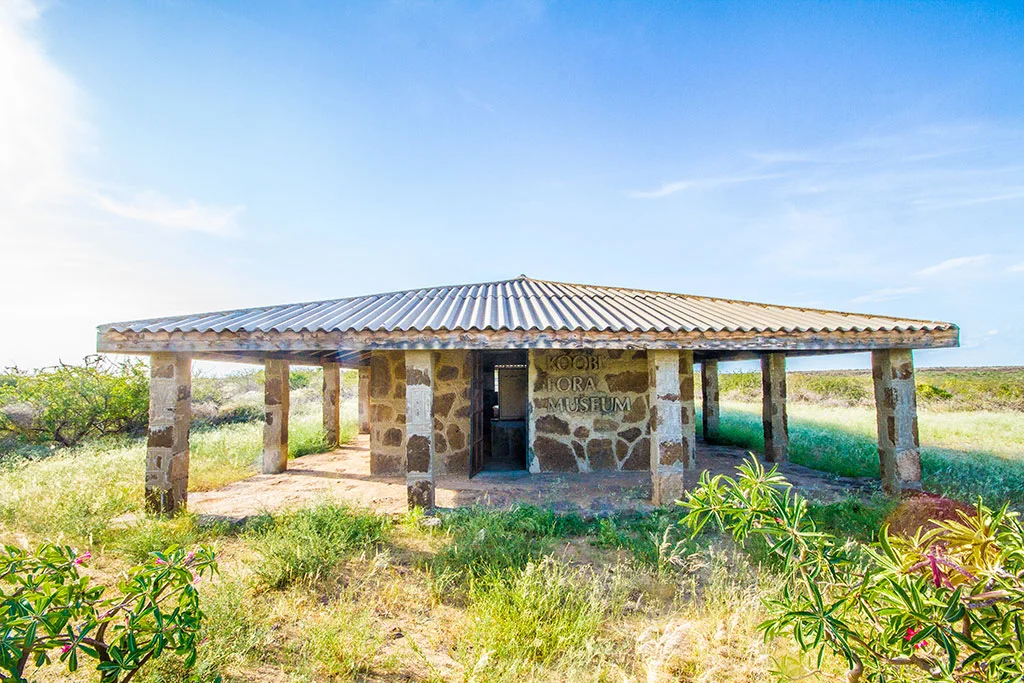

Koobi Fora
Bernard Ngeneo almost walked past it. In 1972, sweeping a fossil-strewn slope on the eastern shore of Lake Turkana, he stopped at a mound of bone fragments that others had already dismissed. One piece carried the faint sutures of a skull - and not just any skull. Reassembled, the fragments became KNM-ER 1470, a roughly 1.9-million-year-old cranium that would help redraw the family tree of early humans. This is Koobi Fora: a ridge of eroding sediment in the territory of the nomadic Gabbra people, and one of the richest archives of human origins anywhere on Earth.
The Ridge of Bones
Koobi Fora Ridge is an outcrop of Pliocene and Pleistocene sediments - claystones, siltstones, and sandstones laid down over millions of years and now being torn open by seasonal rivers draining into Lake Turkana. The erosion is the point. As the badlands wear away, they surrender fossils of ancient mammals and, threaded among them, the remains of our own lineage. In 1968 the paleoanthropologist Richard Leakey established a base camp on a sandspit jutting into the lake, the Koobi Fora Spit. Five years later, Kenya set the region aside as Sibiloi National Park, and the National Museums of Kenya planted its headquarters on that same spit. Today the name Koobi Fora can mean a single site or the whole reserve, and researchers increasingly call the larger area East Turkana.
The Hominid Gang
Finding fossils across such a vast, broken landscape is brutally hard work, and Richard Leakey's solution changed the field. Rather than sweep the ground with whoever happened to be present, he assembled and trained a dedicated search team of Kenyans who came to be known as "the hominid gang," led by the gifted fossil-finder Kamoya Kimeu. Their trained eyes found the majority of the 200-plus hominin fossils recovered here to date. Ngeneo, who spotted Skull 1470, was one of them. These men were not assistants in the margins of the story - they were the ones who actually found the bones that filled the museum cases and the textbooks, and the science would not exist without them.
The Skull That Named a Species
KNM-ER 1470 came out of Area 131, discovered by Ngeneo and painstakingly reconstructed by Meave Leakey from shattered pieces. Its larger braincase and flatter face set it apart from other early fossils, and it stirred debate that has never fully settled. Richard Leakey saw it as an early member of our own genus, Homo. Later researchers concluded it represented a distinct species, and in 1986 the name Homo rudolfensis was proposed - drawn from Lake Rudolf, as Lake Turkana was then known, before Kenya renamed it in 1975. The accession code itself tells the lake's colonial history: the ER in KNM-ER stands for East Rudolf. Whatever its precise label, 1470 remains one of the most argued-over skulls in the study of human origins.
Layers Like a Calendar
Koobi Fora's deeper gift is its sense of time. The basin filled with nearly 600 meters of sediment spanning roughly four million to one million years ago, and that sediment is interleaved with tuffs - layers of volcanic ash, each a snapshot of an eruption. Because ash can be dated with precision, the tuffs work like a geological calendar, fixing the age of every fossil and tool found between them. The contested dating of one ash bed, the KBS Tuff, became so heated in the 1970s that it helped drive the refinement of modern argon-based dating methods. The marriage of that geology with the parade of fossils above it has made the Koobi Fora Formation a master reference for reading the whole sweep of Pliocene and Pleistocene Africa.
Two Lineages, One Shore
Koobi Fora is famous for its specimens of Homo, but the older genus Australopithecus appears here too, and the two seem to have shared this corner of Africa for several hundred thousand years - perhaps living on different foods. The stone tools tell their own story of growing skill, from the simpler Oldowan to the more refined Acheulean, with hominins learning to coax more cutting edge from each gram of rock. Some sites preserve traces of butchery and bone-marrow feasting; one complex has yielded evidence of fire use about 1.5 million years ago. Walk this ridge and you are walking a shoreline where more than one kind of ancestor once stood, looking out at the same restless lake.
From the Air
Koobi Fora lies at roughly 3.95 degrees N, 36.19 degrees E, on the northeastern shore of Lake Turkana within Sibiloi National Park, Kenya. The signature landmark is the broad sandspit projecting into the lake near the National Museums of Kenya field station, with eroded badlands fanning inland. Recommended viewing altitude is 5,000-9,000 feet above ground; the dry, hot air offers excellent visibility but breeds strong winds and abrupt storms over the water. There is an airstrip at Sibiloi serving the park and research station; Lodwar (HKLO) on the west side of the lake is the nearest town airfield, roughly 75 nautical miles southwest. Watch for heat haze and sudden gusts near the lake surface.
Nearby Stories
- Central Island 21 km away
- Omo remains 65 km away
- Kakuma 76 km away
- Ilemi Triangle 88 km away
- Chalbi Desert 114 km away
- Lower Valley of the Omo 130 km away
- Konso 177 km away
- Cherangani Hills Forest 266 km away