
Köpenick
The receipt gives the whole thing away. On the afternoon of 16 October 1906, a man in a Prussian captain's uniform emptied 4,002 marks and 37 pfennigs from the treasury of the Cöpenick town hall and then, because paperwork matters, wrote out a receipt for it. He signed it with the name of his former prison warden. He was not a captain. He was Wilhelm Voigt, fifty-seven years old, a shoemaker who had spent much of his adult life behind bars and had assembled the uniform piece by piece from second-hand shops. On his way out to Cöpenick he had stopped four grenadiers and a sergeant outside a barracks and told them to come with him. They came. He collected six more at a shooting range. Nobody asked to see an order, because the uniform was the order.
The Uniform Was the Order
What Voigt understood about Imperial Germany was not complicated: a man who looks like an officer does not get asked questions. He marched his borrowed squad into the town hall, posted them on the exits, and announced that the mayor was under arrest for corruption. Mayor Georg Langerhans did not think to challenge him, and neither did the treasurer, von Wiltberg. Voigt instructed the local police to hold all telephone calls to Berlin for an hour, sent the mayor off under guard, took the cash, signed the receipt, dismissed his soldiers, changed his clothes and disappeared into the city.
He lasted ten days. A former cellmate recognised the description and told the police, and Voigt was arrested on 26 October. On 1 December a court gave him four years for forgery, impersonating an officer and false imprisonment. By then the joke had already gone around the world.
Pardoned in Twenty Months
The story landed at a moment when Germans were more than ready to hear it. Wilhelm II pardoned Voigt on 16 August 1908, after less than two years inside. Voigt promptly made a career of himself: waxworks, a 1909 memoir called How I Became the Captain of Köpenick, foreign tours, and finally Luxembourg, where he worked as a waiter and a shoemaker and died of flu on 3 January 1922.
Carl Zuckmayer turned the episode into a play, filmed and televised many times since; the figure has long outlived the man. Every summer, the Köpenicker Sommer street festival sends a parade through the old town led by the Captain of Köpenick, complete with squad. It is an unusual thing for a town to celebrate - an afternoon when its own municipal government was taken over by a con artist in a costume - unless you notice that the target of the joke was never Köpenick. It was a whole society that had learned to obey a jacket.
Older Than Berlin
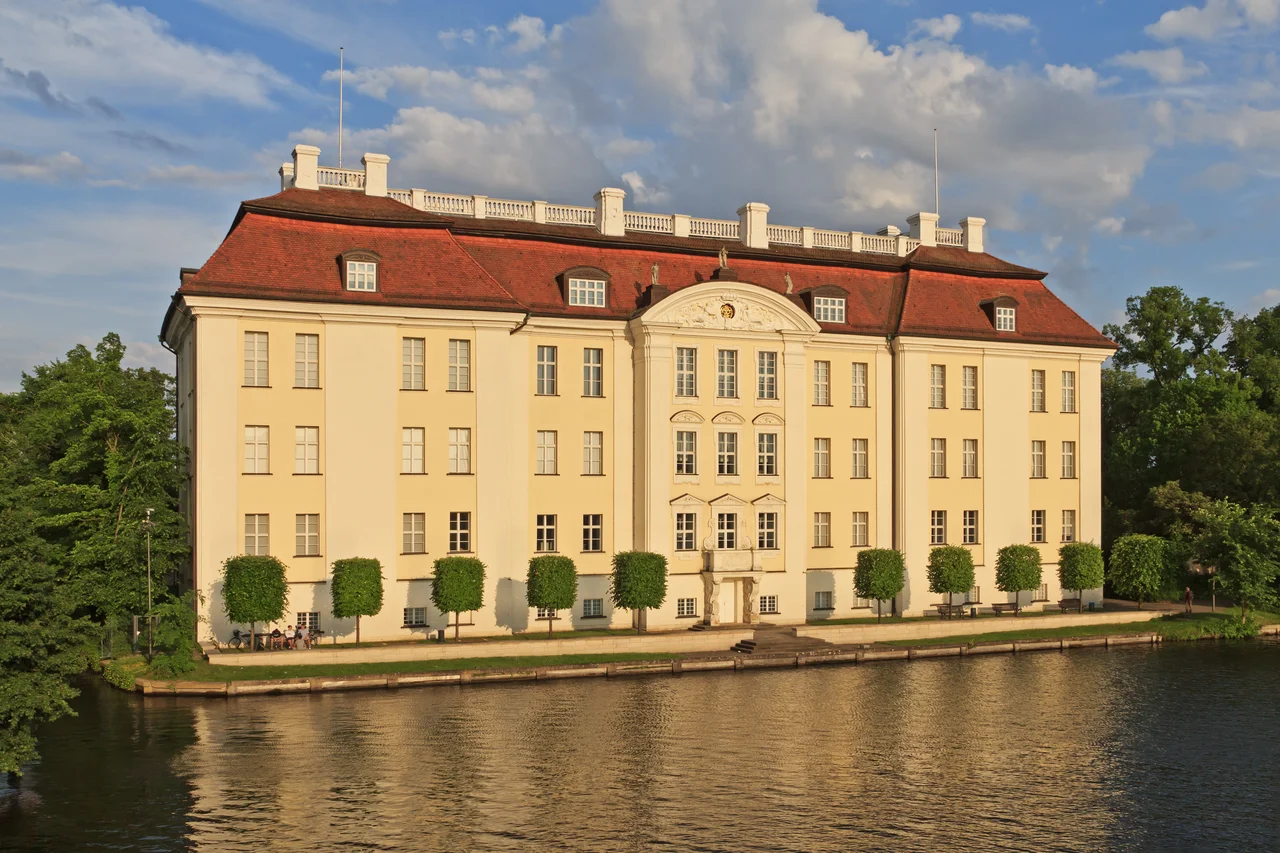
Köpenick has been underestimated for a long time. It sits where the Dahme runs into the Spree, on what was once a single island, since cut by two channels into three: Baumgarteninsel, the Old Town, and the Schlossinsel with the palace on it. In the twelfth century this was the seat of a Slavic prince named Jaxa, whose coins carry the legend Iaczo de Copnic. The place first appears in writing on 12 February 1210 and had town privileges by 1232, which makes it older on paper than Spandau, Berlin or Cölln.
For centuries the old town was three separate communities around a bend in the Dahme: the castle with its garrison, the German town of artisans and merchants, and the Kietz, a fishing hamlet whose people went on speaking a Slavic language long after everyone around them had stopped. The palace, built in 1558 as a hunting lodge for Joachim II Hector, has absorbed a lot of history for a country house: the Elector died in it, Gustavus Adolphus of Sweden made it his headquarters in 1631 while pleading in vain with his brother-in-law for help, and in 1730 the crown prince who became Frederick the Great faced a court-martial here with his friend Hans Hermann von Katte. It is now a museum of decorative art.
The Week of Blood
In the months after the Nazis took power in 1933, SA storm troopers in Köpenick began dragging neighbours out of their homes - Social Democrats, Communists, trade unionists, and others whose politics simply did not fit. In June the violence peaked in what became known as the Köpenick Week of Blood. At least twenty-four opponents of the new regime, from across the political spectrum, were killed; many more were left maimed. These were not casualties of some distant event. They were local men, tortured within walking distance of their own front doors. One of the sites, the prison annex behind the district court on Mandrellaplatz, is a museum today.
The war brought a subcamp of Sachsenhausen concentration camp to Köpenick, holding mostly Polish women along with Czechoslovak, French, Greek, Belgian and Soviet prisoners, including Romani women. Afterwards the district fell inside the Soviet sector and spent forty years as part of East Berlin.
The Green Lungs
Modern Köpenick is mostly trees and water, which is why Berliners call it the city's green lungs. Pine forest covers a great deal of it; the Müggelsee spreads across the east; the Müggelberge rise to 115 metres, the highest natural ground in Berlin. The rivers still work: the Spree runs west to the Havel and eventually the North Sea, the Dahme links via the Oder-Spree Canal to the Baltic.
Absorbed into Berlin under the Greater Berlin Act of 1920, Köpenick came in as the largest borough at 128 square kilometres; in 2001 it merged with Treptow. Grünau, at its southern edge, hosted the Olympic rowing regatta in 1936. Mellowpark is the biggest outdoor skatepark in Europe. And on match days the Stadion An der Alten Foersterei - the old forester's house - fills with supporters of 1. FC Union Berlin, a Bundesliga club in a borough that has never much cared what the rest of the city expected of it.
From the Air
Köpenick sits at 52.4458 N, 13.5772 E in southeastern Berlin, at the confluence of the Dahme and the Spree. From the air the old town is unmistakable: a small island core wrapped in dark water, with the Müggelsee opening as a broad lake 4 km east and the wooded Müggelberge rising behind it to 115 m. Berlin Brandenburg (EDDB) lies only about 10 km south-southwest, so the district sits close to that airport's airspace and is often visible from arriving and departing traffic. Schönhagen (EDAZ) is roughly 30 km southwest. The lakes and river bends give the best orientation in any light; on a clear morning the water throws the island street pattern into sharp relief.
Nearby Stories
- E11 hiking trail 3.4 km away
- Bogensee 4.3 km away
- Maybach I and II 4.9 km away
- Treuenbrietzen 15 km away
- Battle of Fehrbellin 18 km away
- Falkenhagen Bunker 20 km away
- St. Mary's Church, Chojna 35 km away
- Eisenhüttenstadt 39 km away