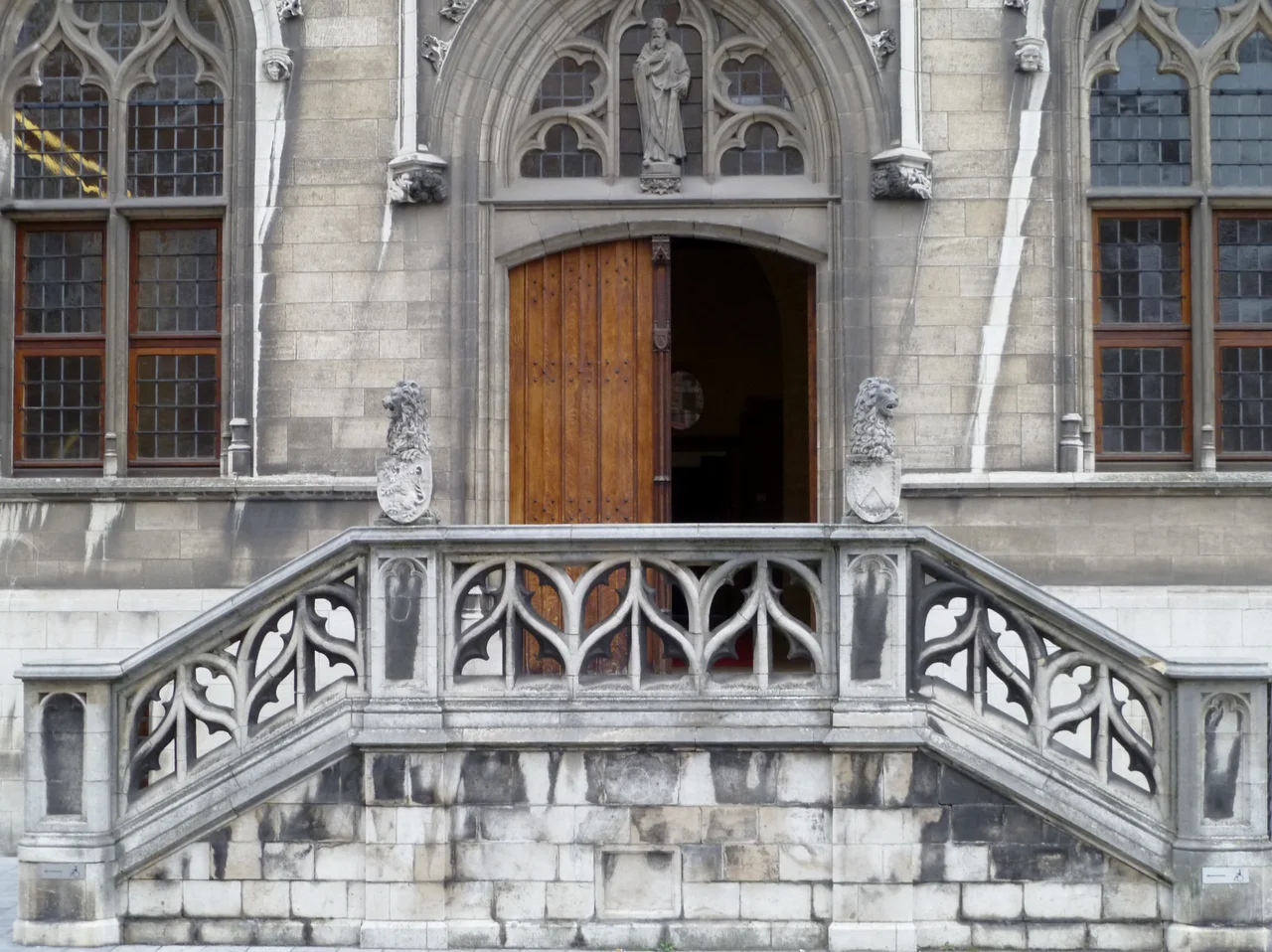

Kortrijk City Hall
Inside the council room of Kortrijk City Hall, a stone mantelpiece carved like lacework shows the Seven Vices on horseback. Lust rides a goat, being embraced by a man. Greed rides a toad. Envy straddles a dog with a bone in its jaws. Wrath sits on a bear, a sword across her lap. They are women, except for Sloth at the end, who is a man on a donkey. Below them, the consequences play out in tiny carved scenes - adultery boiling in a cauldron, a devil pumping bellows into the fire. The fireplace was finished in the early 16th century. It was meant to remind the magistrates what they were guarding the city against. You can stand in front of it now, in the same room, and read it like a comic strip.
A Town Hall Burned, Rebuilt, Burned Again
The first town hall here was built in the 14th century and burned to the ground by the French army after the Flemish defeat at the Battle of Westrozebeke in 1382 - one of the long string of punishments inflicted on Kortrijk for siding with the wrong cousin in a French dynastic quarrel. A larger High Gothic replacement went up in 1420; the pointed arches downstairs and upstairs are all that remains of it. The present city hall was raised around 1520 in a mixed Gothic-Renaissance style, gilded and painted in the way Brussels' town hall still is. In 1526 statues of the Counts of Flanders were placed in the niches where prophets had stood. In 1616 it was enlarged again. The 17th and 18th centuries added a pillory and other mutilations. In 1807, under French occupation, the statues came down and the facade was flattened in the spirit of the age.
The Counts on the Front
Between 1856 and 1875 the architect Pierre Nicolas Croquison restored the front to something like its 16th-century self. The statues now ranged across the facade tell the dynastic story of medieval Flanders in stone. On the far left stands Baldwin Iron Arm, the 9th-century strongman who founded the line by eloping with the daughter of the Frankish king Charles the Bald. Then Thierry, Diederik, Philip van de Elzas - the count who gave Flanders its black lion on gold. Countess Beatrice of Brabant, lady of Kortrijk Castle. Baldwin IX with his cross, who went east on the Fourth Crusade and ended up briefly Latin Emperor of Constantinople. Joan and Margaret of Constantinople, his daughters. Guy of Dampierre, who lost the war that led to the Golden Spurs. Then Philip the Good of Burgundy with the chain of the Golden Fleece around his neck. Charles V. Albert and Isabella of the Spanish Netherlands. The whole dynasty in a row, looking down on the market.
The Aldermen's Hall and Lady Justice
Until 1787 the Aldermen's Hall on the ground floor was the city's tribunal - the vierschaar, where a panel of citizens passed civil and criminal judgements. The mantelpiece, completed in 1527, is a sermon in stone. On the left, Moses strikes the rock and water flows for the people in the desert. On the right, doubting Thomas reaches into Christ's wound. Faith and tangible evidence, the two pillars of just decision. Above, Lady Justice carries a mirror because authority must judge itself first. She holds jugs of compassion that she offers to a beggar in rags, to a pilgrim, even to a jester in a fool's cap with donkey's ears. She asks a king to remove his crown in humility. She crowns an ordinary man with a backpack and gives him a sack of money, making him an administrator. It is, in carved limestone, an unusually radical theology of governance for the 1520s.
The Council Room's Seven Vices
Up the stairs, past a wooden portico carved with sirens, you enter the council room with its four Gothic arches and the lacework mantelpiece. Charles V stands at its centre with his sword and his cross-bearing orb. The Seven Vices ride their animals to the left and right. Above, in wood, stand Faith and the Seven Virtues - humility, kindness, chastity, charity, temperance, patience, diligence. On the ceiling beams, in a popular Renaissance motif, women humiliate their lovers: Eve tempts Adam, Phyllis rides Aristotle like a horse, Virgil dangles in a basket where his lover left him hanging, Delilah cuts Samson's hair. The lesson cuts both ways - women have power, men should stay alert - and any modern reader will draw their own conclusions about whose advice it really was. The stained-glass windows show the coats of arms of the 13th-century craft guilds, mostly textile workers, the people whose looms paid for the building.
Cellars That Served Beer
Below the hall, six old cellars run together, the largest one twenty-one metres long, dating from the early 15th century. They belonged to vanished houses with names like The Swan, The Horse-Trader's Son, The Boss, The Black Lion. For centuries the cellars were a tavern. The last catering establishment, the Raadskelder, closed in 2006. The restoration of the building to its 16th-century state was first planned in 1938 and finally carried out from 1958 to 1961 under the architects Jos and Luc Viérin. The result is a city hall that wears its history outside and tells its lessons inside, a working civic building where weddings still happen in the room where executions were once decided. A textile town's parliament, still standing on the same square where Manten and Kalle strike their bell.
From the Air
50.828°N, 3.265°E, on the Grote Markt in central Kortrijk, West Flanders, almost touching the Belfry of Kortrijk on the same square. From altitude the long Renaissance facade reads as the south side of the market. Cruise at 1,500-2,500 ft for a clear view of the medieval centre. Nearest airports: Kortrijk-Wevelgem (EBKT, ~5 km west) and Lille-Lesquin (LFQQ, ~28 km southwest).
Nearby Stories
- Battle of Beverhoutsveld 2.9 km away
- Battle of Nieuwpoort 5.2 km away
- Westvleteren Brewery 6.4 km away
- Le Paradis Massacre 12 km away
- Aalst, Belgium 13 km away
- Zaamslag Castle 18 km away
- Courrieres Mine Disaster 39 km away
- Belgium 47 km away