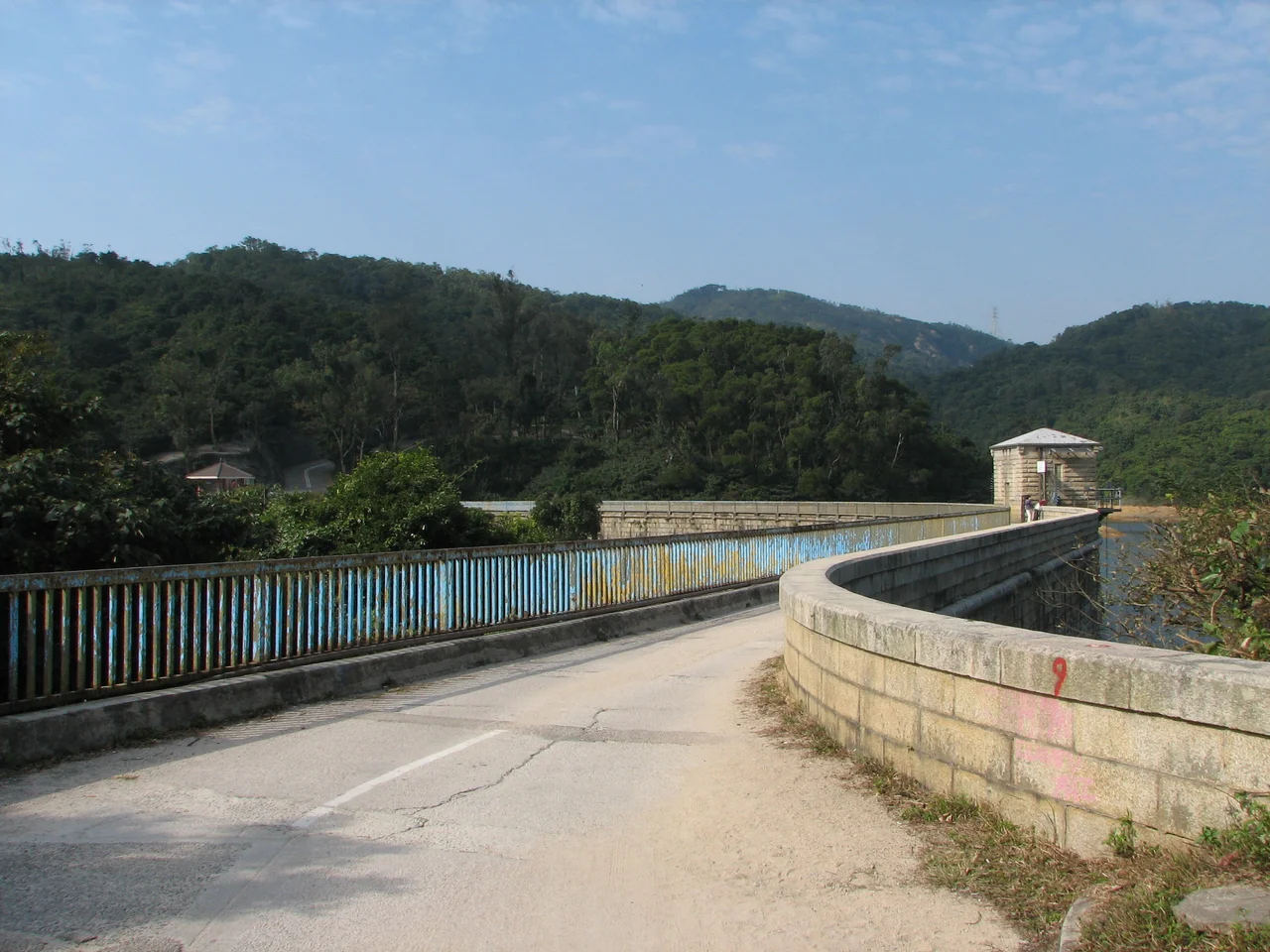

Kowloon Group of Reservoirs
The macaques got there first. Or rather, they never left. In Kam Shan Country Park, where the Kowloon Group of Reservoirs lies tucked into forested hills north of the city, long-tailed macaques have lived alongside the reservoir infrastructure for so long that visitors often encounter them before they notice the water. The animals are bold. The dams, by contrast, are quietly extraordinary — stone and brick structures built between 1901 and 1931 that made modern Kowloon possible. Five of the original historic structures have been declared monuments by the Hong Kong government, recognized as engineering achievements that shaped the city as much as any skyscraper.
The First Reservoir in the New Territories
Construction on the Kowloon Reservoir began in 1901. When it was completed in 1910, it became the first reservoir in the New Territories — a distinction that reflects how quickly Kowloon was growing and how urgently the colonial administration needed to secure a reliable water supply. The total cost came in at $619,000. At completion, its capacity was 1.42 million cubic meters. That was not enough for long. The surrounding hills collected rainfall efficiently, but the population it served kept expanding. The Shek Lei Pui Reservoir followed in 1925, with a capacity of 440,000 cubic meters. The Kowloon Reception Reservoir was completed in 1926. The Kowloon Byewash Reservoir — designed to capture overflow and route it into the main system — was finished in 1931, adding another 700,000 cubic meters. Together, including the Shek Lei Pui, the group holds approximately 2.9 million cubic meters.
Five Monuments Above the City
The main dam of the Kowloon Reservoir, its valve house, the spillway dam, the spillway dam recorder house, and the recorder house have all been declared monuments under Hong Kong law — a rare designation that protects them from alteration. The structures date from the period 1901 to 1910, a moment when colonial engineers were building across Asia with a confidence in stone and brick that produced buildings of genuine beauty. Golden Hill Road runs along the top of the main dam, giving anyone who drives or walks it an unobstructed view across the reservoir surface to the wooded hills beyond. The valve house sits just off the road, its period details intact. These structures were built to last, and they have.
Connecting the System
A century after the Kowloon Reservoir opened, engineers returned to the same hills to solve a different problem. The reservoir group had a tendency to overflow — excess rainwater spilled through the Lai Chi Kok Transfer Scheme and ultimately discharged into the sea, representing water that could have been used. Beginning in 2019, construction started on the Inter-reservoirs Transfer Scheme: a water tunnel 2.8 kilometers long and 3 meters in diameter connecting the Kowloon Byewash Reservoir to the Lower Shing Mun Reservoir. The project was completed in January 2023. It was not glamorous infrastructure — a tunnel beneath the hills is invisible to anyone not specifically looking for it — but it made the reservoir system more efficient, reducing overflow and capturing water that had previously been lost.
The Country Park That Grew Around Them
The reservoirs did not remain in isolation. As Kowloon urbanized through the twentieth century, the hills where the reservoirs sat became increasingly valuable as open space. Kam Shan Country Park was established around them, protecting the forested watershed and offering a green escape from the density below. Hikers follow trails past the dam walls and through stands of trees where the macaques move through the canopy overhead. The juxtaposition is striking — Edwardian-era colonial engineering, declared monuments, set inside a working country park full of wildlife. Neither element diminishes the other. The reservoir group is both infrastructure and landscape, functional and historic, all at once.
From the Air
The Kowloon Group of Reservoirs lies at approximately 22.354°N, 114.153°E, tucked into the Kam Shan hills north of the Kowloon urban area. From the air, the reservoir surfaces show clearly as irregular patches of open water set against densely forested hills — a marked contrast to the built-up urban grid immediately to the south. The Lion Rock ridge is a prominent navigation landmark to the southeast. The urban edge of Kowloon is visible just downhill to the south, making the transition from city to country park strikingly abrupt. The nearest airport is Hong Kong International Airport (VHHH) on Lantau Island, approximately 32 km to the west-southwest. Recommended viewing altitude is 3,000–5,000 feet for a clear view of the reservoir cluster and the surrounding country park terrain.
Nearby Stories
- Chapel of St. Francis Xavier 3.5 km away
- Cuiheng 4.1 km away
- 2015 Shenzhen Landslide 16 km away
- Shunde 31 km away
- Wanshan Archipelago 37 km away
- Nanxiong Formation 96 km away
- Heyuan 149 km away
- Checheng Fu'an Temple 629 km away