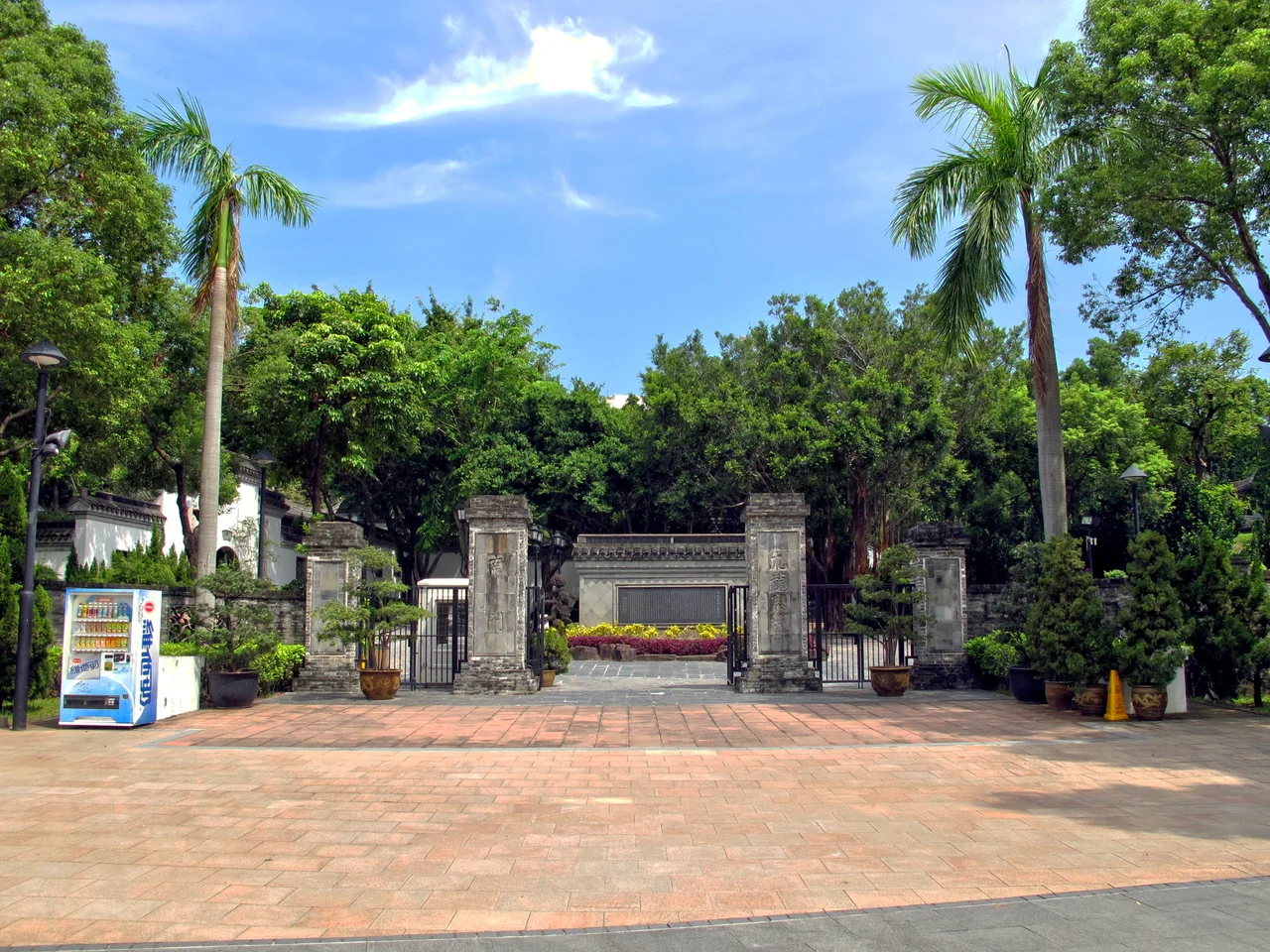

Kowloon Walled City Park
The park opened in December 1995, just twenty months after demolition crews finished their work. What had been one of the most densely populated places on earth — a six-and-a-half-acre enclave housing an estimated 33,000 people — was replanted with osmanthus and chrysanthemum, its perimeter walls replaced by the quiet geometry of a Jiangnan-style garden. The speed of the transformation was startling. But the park did not erase what came before it. If anything, it made room for it.
The Garden Built on Complexity
Kowloon Walled City Park covers 31,000 square metres in Kowloon City and is divided into eight themed landscape zones — the Garden of Four Seasons, the Garden of Chinese Zodiac, the Chess Garden, the Eight Floral Walks, and others — all designed to evoke the style of an early Qing dynasty garden. The design won a Diploma at the International Garden Exposition in Stuttgart in 1993, even before construction was complete. Walking through it today, the classical archways and pebbled paths feel genuinely peaceful. What distinguishes this park from others in Hong Kong is not its design but what it sits on — and what it chose to preserve.
What the Soil Kept
The Antiquities and Monuments Office conducted archaeological examinations as the Walled City was demolished, and what they found is now visible at the park's south end. The original stone walls had been torn down by Japanese occupying forces during World War II to obtain material for expanding the nearby Kai Tak Airport — but fragments were buried rather than destroyed, preserved under the soil for decades. Excavations revealed flagstone pavement, building cornerstones, a drainage channel, and two granite plaques bearing Chinese characters for "South Gate" and "Kowloon Walled City." The site of the original South Gate is now a declared monument, and a bronze miniature model of the former Walled City stands at the entrance, showing the settlement's extraordinary vertical density before demolition.
The Yamen: One Building Across Four Centuries
At the centre of the park stands the Yamen — the only original Qing dynasty building to survive the entire arc of the site's history. Built in 1847, it served as the headquarters of the Commodore of the Dapeng Brigade and the Kowloon Assistant Military Inspectorate, reflecting the site's original purpose as a military fortification. After British forces found the garrison abandoned in 1899, the Holy Trinity Church converted the Yamen into an old people's home and almshouse. During the decades when the Walled City grew up around it, the Yamen was absorbed into the tangle of interconnected buildings. It survived demolition, and today it is a declared monument in Hong Kong, housing six exhibition rooms that document the settlement that grew — and ended — around it. Its walls are granite and brick, its roof covered in traditional cylindrical and flat tiles.
Living Memory in a Quiet Garden
Since April 2009, the park has included a permanent exhibition about the Walled City's history — one outdoor display area near the South Gate and six rooms inside the Yamen. The indoor rooms use interactive imagery and sound to reconstruct the daily texture of life inside: the narrow alleys, the factories making jook-sing noodles or candy or textiles, the unlicensed dentists and doctors who operated there because the absence of formal jurisdiction also meant an absence of licensing fees. The exhibition does not shy away from the hardships of overcrowding or the criminal activity that the enclave's legal ambiguity enabled. But it insists, in the way that careful curation can, that the people who lived there were not defined by those conditions. They built a community — fragile, complicated, sometimes violent, and entirely real.
From the Air
Kowloon Walled City Park is located at approximately 22.332°N, 114.190°E in the Kowloon City district. From the air at 2,000–3,000 feet, the park appears as a dense rectangle of green within the closely packed urban grid of Kowloon, clearly distinct from surrounding rooftops. The former Kai Tak Airport site, now under redevelopment, is immediately to the southeast. Hong Kong International Airport (VHHH) is approximately 25 km to the west-southwest on Lantau Island. Lion Rock can be seen to the north, and Victoria Harbour opens up to the south. The park's compact rectangular outline, surrounded by residential towers, is recognizable from altitude.
Nearby Stories
- Chapel of St. Francis Xavier 3.5 km away
- Cuiheng 4.1 km away
- 2015 Shenzhen Landslide 16 km away
- Shunde 31 km away
- Wanshan Archipelago 37 km away
- Nanxiong Formation 96 km away
- Heyuan 149 km away
- Checheng Fu'an Temple 629 km away