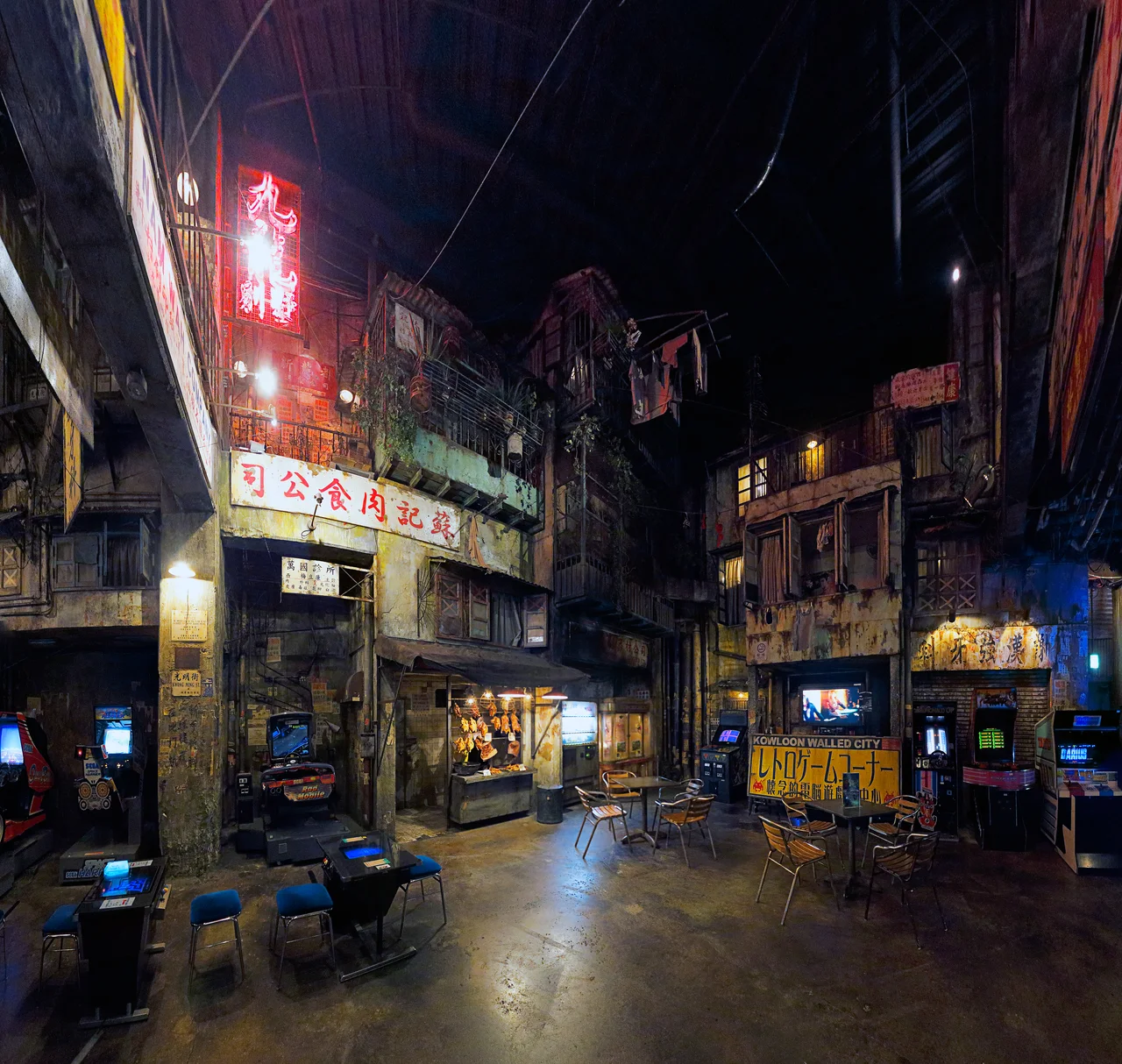

Kowloon Walled City
The paperwork was never sorted out. When Britain leased the New Territories from Qing dynasty China in 1898, the negotiators carved out an exception: a small walled military fort in Kowloon, housing roughly 700 people, would remain under Chinese jurisdiction. Within a year, British forces had moved in anyway, finding the garrison empty. But neither side ever formally resolved who governed the place. That ambiguity — one square kilometre, two governments, zero clear authority — opened a door that tens of thousands of ordinary people would eventually walk through, not because they sought lawlessness, but because they needed somewhere to live.
Refugees and the Logic of Necessity
The Walled City's population exploded after 1945. Refugees fleeing the renewed Chinese Civil War poured into Hong Kong, and the enclave — already legally undefined — became a destination for those who had nowhere else to go. By 1947, an estimated 2,000 people had settled there. The British attempted to clear them out in 1948 and abandoned the effort. After that, a de facto policy of non-interference took hold, and the population kept climbing. By the late 1980s, a government survey counted approximately 33,000 residents packed into an area barely six and a half acres in size — a population density that has few parallels in recorded history. These were not people who chose difficult conditions for abstract reasons. They were laborers, factory workers, and families who had been displaced by war and political upheaval, and who found in the Walled City a place where they could settle, work, and build something resembling stability.
The City Within the City
What grew inside those walls was, in many respects, a fully functioning community. Buildings rose twelve, thirteen, fourteen stories, connected by a web of narrow alleys — some less than a meter wide — that rarely saw direct sunlight. Small factories produced jook-sing noodles, candy, and textiles. Unlicensed dentists, doctors, and practitioners of traditional medicine operated openly; their fees were lower than regulated clinics, and for residents without access to Hong Kong's formal healthcare system, they provided genuine care. Residents organized groups to manage daily life, maintain common spaces, and support neighbors in need. The Walled City had no official municipal services, no building codes, and no recognized government. What it had instead were the informal arrangements that communities develop when formal institutions are absent — arrangements that were imperfect and sometimes inadequate, but real.
Crime and Complexity
None of that is to deny the genuine hardship or the criminal activity that flourished in the same space. From the 1950s through the 1970s, triad gangs controlled significant parts of the Walled City, and rates of drug use, prostitution, and gambling were high. The police were known to cooperate with the triads operating there, and the enclave's legal ambiguity made sustained law enforcement difficult. Between 1973 and 1974, a series of more than 3,500 police raids resulted in over 2,500 arrests and the seizure of more than 1,800 kilograms of drugs. Those raids, sustained over years and supported by the younger residents who had grown up in the Walled City and wanted something different, gradually eroded gang control. By 1983, the district police commander declared that crime rates were under control. The people who drove that change were not outsiders — they were people who lived there and fought for the community they had built.
Demolition and What It Meant
In January 1987, the British colonial government announced the Walled City would be demolished. The Sino-British Joint Declaration of 1984 had created the framework for Hong Kong's 1997 handover, and resolving the enclave's ambiguous status became part of that larger process. Resettlement began after 1987; evacuations started in earnest in 1991 and the last residents were removed by early 1993. The Hong Kong Housing Authority's compensation plan distributed funds to an estimated 33,000 residents and businesses. The eviction process was described at the time as arduous, which is an understated way of describing the displacement of a community that had existed for decades. Demolition began in March 1993 and was completed in April 1994. The evangelist Jackie Pullinger, who had worked inside the Walled City treating drug addicts since the 1960s, wrote about her experiences in a memoir. Photojournalists documented the final months. What they captured was not only decay and disorder — it was also people who had lived there for twenty or thirty years, leaving places that had become home.
Afterlife in Memory and Culture
Kowloon Walled City Park opened on the site in December 1995. The legal ambiguity that defined the place for nearly a century ended with the wrecking ball. But the Walled City's cultural presence has not diminished. It appears in video games, films, novels, and architecture. In Japan, a recreation of the Walled City's aesthetic became a popular entertainment venue. In Shenzhen and Guangzhou, themed restaurants and commercial spaces borrowed its neon-lit, layered visual language. The City of Darkness — a 1993 photographic study published just before demolition — documents the physical texture of the place with enough precision that researchers still use it. What the culture keeps returning to is something the dystopian framing often misses: the sheer human ingenuity required to build a functioning community in a space that every official structure had declined to govern. The Walled City was chaotic and violent and squalid in places. It was also, for the people who lived there, simply the place where they lived.
From the Air
Kowloon Walled City occupied a site at approximately 22.332°N, 114.190°E, now the location of Kowloon Walled City Park in Kowloon City district. From the air, the park is a notable green rectangle surrounded by dense residential towers. The former Kai Tak Airport runway — now undergoing redevelopment — extends into Kowloon Bay immediately to the southeast; its distinctive narrow strip into the harbor is visible from altitude. Hong Kong International Airport (VHHH) is approximately 25 km to the west on Lantau Island. For the best view of the park and the surrounding Kowloon grid, fly at 2,500–4,000 feet heading south over Lion Rock before descending toward Victoria Harbour.
Nearby Stories
- Chapel of St. Francis Xavier 3.5 km away
- Cuiheng 4.1 km away
- 2015 Shenzhen Landslide 16 km away
- Shunde 31 km away
- Wanshan Archipelago 37 km away
- Nanxiong Formation 96 km away
- Heyuan 149 km away
- Checheng Fu'an Temple 629 km away