.jpg)
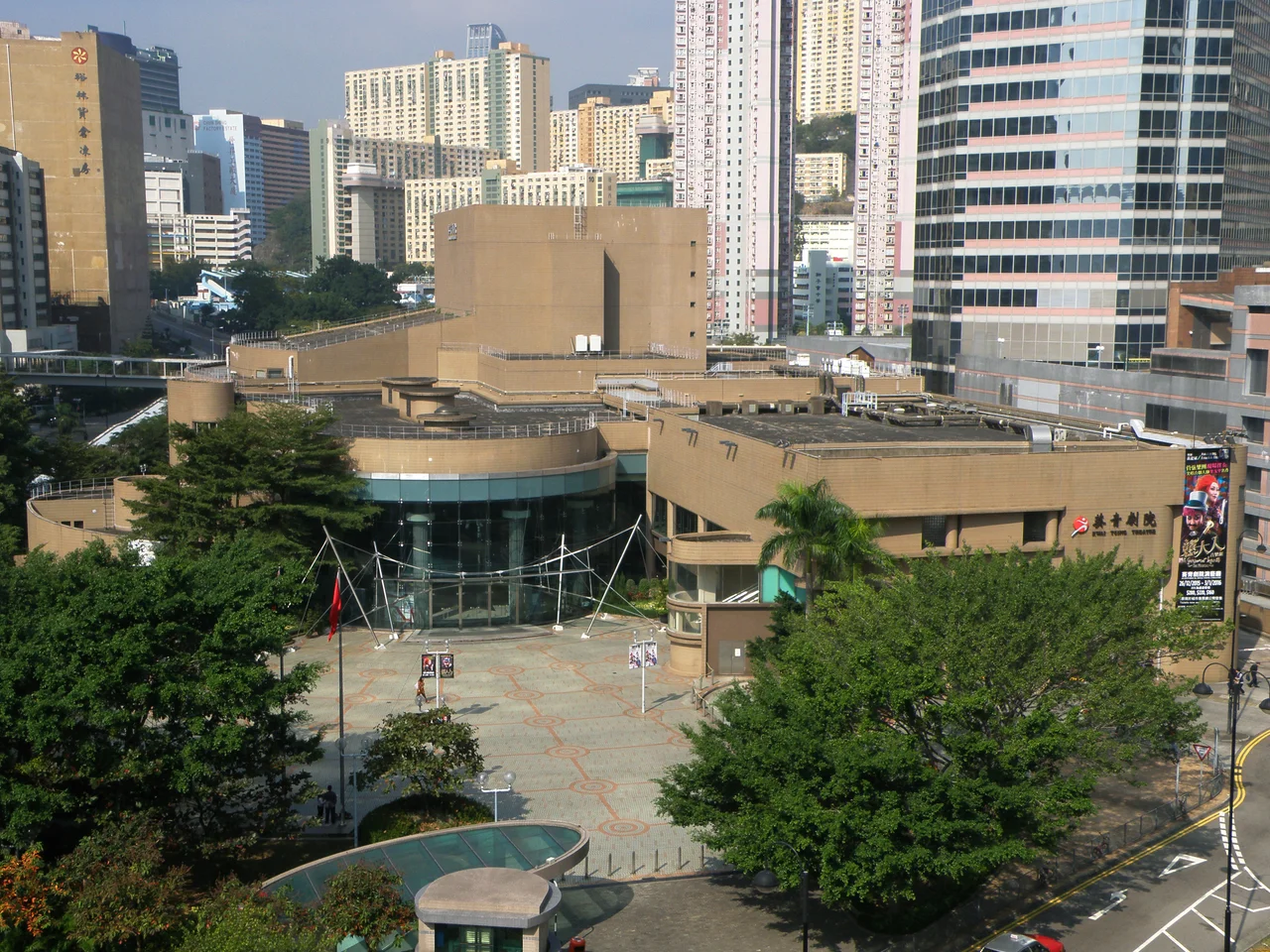
Kwai Tsing Theatre
In 1989, a working group put it plainly: Kwai Tsing District had no proper performance venue. The report used the word "dearth" — an old-fashioned word for a severe shortage — and the Regional Council took it seriously. Ten years of planning, design, and construction followed. On 18 November 1999, Kwai Tsing Theatre opened its doors, and a neighborhood that had long been defined by container ports and public housing estates had a place to host orchestras, dance companies, and the quieter drama of community life.
A Decade in the Making
The road to opening night was methodically slow, as civic projects in Hong Kong often were. The Recreation and Culture Select Committee commissioned its working group report in 1989. A year later, the Regional Council approved the idea in principle. Another four years passed before construction began in 1994. The Architectural Services Department drew the plans; the engineering firm Ove Arup & Partners handled the structural work; China International Water & Electric Corporation built it. The final cost reached HK$468 million. By the time Lau Wong-fat, chairman of the Provisional Regional Council, cut the ribbon, Hong Kong had already been handed back to China for more than two years. The theatre opened into a changed city, but its mission remained local: give Kwai Tsing a cultural home it had never had.
What the Building Holds
The auditorium seats 899 — large enough for a full symphony but intimate enough that the back row doesn't feel distant. A lecture room can hold 98, with removable seating for flexibility. A dance studio and rehearsal room give resident companies somewhere to work, not just perform. Outside, a plaza extends the theatre into the street, blurring the boundary between formal culture and everyday public life. Then in 2008, something more experimental arrived: the exhibition gallery was converted into the Leisure and Cultural Services Department's first black box theatre, seating between 130 and 160. The conversion came directly from lobbying by local arts groups who needed smaller, more adaptable spaces. The black box changed what kind of work the building could support — fringe productions, experimental staging, immersive performances that a proscenium arch would swallow.
A Memorial in an Unexpected Moment
Theatres host many things. On 2 September 2010, Kwai Tsing Theatre hosted grief. The Manila hostage crisis had ended days earlier with the deaths of eight Hong Kong tourists on a hijacked bus in the Philippine capital. Among those killed was tour leader Tse Ting-chun. Hong Thai Travel Services, his employer, organized a public memorial service at the theatre. The government later awarded Tse the Medal for Bravery (Gold) posthumously, recognizing his courage during the standoff. The theatre became, for a morning, the place where a city gathered to acknowledge what had happened and who had been lost.
Kwai Fong and Its Stage
Kwai Tsing is not the Hong Kong that tourists visit. It is the industrial and residential backbone of the New Territories — container terminals, elevated highways, tower blocks arranged in long rows up the hillsides. Kwai Fong MTR station sits directly opposite the theatre, and that adjacency matters. This is not a venue that requires a journey; it arrives at the end of a train ride home. The Leisure and Cultural Services Department has managed the building since 2000, programming it with the pragmatism of a public institution serving a broad community: Cantonese opera shares the calendar with Western classical music, youth performances, and touring productions. The theatre doesn't ask the neighborhood to come to culture. It plants culture in the middle of where people already are.
From the Air
Kwai Tsing Theatre sits at approximately 22.3569°N, 114.126°E, in the Kwai Fong area of Kwai Chung, New Territories, Hong Kong. From the air at 3,000–5,000 feet, the dense tower-block landscape of Kwai Tsing is immediately identifiable to the northwest of Kowloon, bordered to the west by the Kwai Chung container port — one of the busiest in the world. The nearest airport is Hong Kong International Airport (VHHH) on Lantau Island, approximately 15 nautical miles to the southwest. Approach corridors for VHHH pass south of this location. The MTR Kwai Fong station is the ground-level landmark directly adjacent to the theatre.
Nearby Stories
- Chapel of St. Francis Xavier 3.5 km away
- Cuiheng 4.1 km away
- 2015 Shenzhen Landslide 16 km away
- Shunde 31 km away
- Wanshan Archipelago 37 km away
- Nanxiong Formation 96 km away
- Heyuan 149 km away
- Checheng Fu'an Temple 629 km away