
Lakanal House fire
Catherine Hickman was thirty-one years old and on the phone with the London Fire Brigade. She was a fashion designer; she lived on the eleventh floor of Lakanal House in Camberwell. The smoke had thickened to the point where she could not find the door. The operator told her, as the brigade then advised, to stay in her flat. The compartmentation that separated one flat from another was supposed to hold fire back for at least an hour. Hers held for less than five minutes. By the time the crews reached her floor, she and five neighbours were dead: Dayana Francisquini, twenty-six, and her two children Thais, aged six, and Felipe, three; Helen Udoaka, thirty-four, and her three-week-old daughter Michelle. The fire began on 3 July 2009. Eight years later, in Kensington, the same kind of fire would kill seventy-two people in Grenfell Tower. The names of Lakanal should have been read aloud in time to prevent it. They were not.
A Tower Named for a Schoolteacher
Lakanal House is named after Joseph Lakanal, a French Revolutionary politician who helped found the modern French primary school system. The twelve-storey block, completed in 1959 as part of the Sceaux Gardens Estate, was built when British architects were experimenting with the interlocking maisonette: two-storey flats stacked so cleverly that one tenant's living room sat directly above another's bedroom. The arrangement was praised at the time for its ingenuity. It also meant that a fire in any one flat had at least two ceilings, two floors, and two adjoining rooms it could spread into before it ever reached the corridor. The block had one central staircase, no central fire alarm, and aluminium cladding panels around the exterior that nobody had tested under real fire conditions.
Sixteen Minutes
At about ten past four on a hot Friday afternoon, a faulty television set in Flat 65, on the ninth floor, caught fire. Within sixteen minutes the flames had broken through the cladding and started climbing the outside of the building. Smoke filled the only stairwell. The London Fire Brigade arrived with eighteen pumps and began evacuating residents floor by floor, but the configuration of the building defeated them. People who had been told to remain in their flats - the official "stay put" advice for high-rise fires - found that the fire was already in the walls. Six died inside their homes. Twenty more were injured. An operational command was set up on the seventh floor. By nightfall the block was a hollow tower of broken windows, with families watching from the school across the road, unable to learn whether their neighbours had got out.
The Inquest That Was Heard
Four years passed before the coroner returned narrative verdicts. The inquest found that substandard renovation work had removed fire-stopping material from between flats, breaking the compartmentation the building was meant to depend on. Safety inspections by Southwark Council had not caught the failure. There was no central fire alarm. The cladding had burned through in under five minutes. The 'stay put' advice, the coroner said, had not been wrong in principle but had been catastrophically wrong here. The Fire Brigades Union, Harriet Harman MP whose constituency contained the tower, and the London Assembly all called for a full public inquiry. None was granted. In 2017, Southwark Council pleaded guilty to four breaches of fire safety regulations and was fined £270,000, with £300,000 in costs. The council expressed "sincere regret for the failures that were present in the building."
The Warning No One Acted On
The Lakanal inquest produced a series of formal recommendations, sent to the government in 2013, including a call to review the fire safety of high-rise residential blocks and to consider sprinklers in older buildings. The recommendations were acknowledged. They were not enacted. On 14 June 2017, a fire that began in a fridge-freezer in Grenfell Tower in north Kensington spread through the building's aluminium cladding in much the same way as Lakanal's had, and killed seventy-two people. The Grenfell Inquiry would later refer repeatedly to Lakanal, treating it as the warning that should have been heeded. For the families of Catherine Hickman, of Dayana Francisquini and her children, of Helen Udoaka and her newborn daughter, this gave the deaths a second weight. They had not just been lost. They had been ignored.
The Tower Now
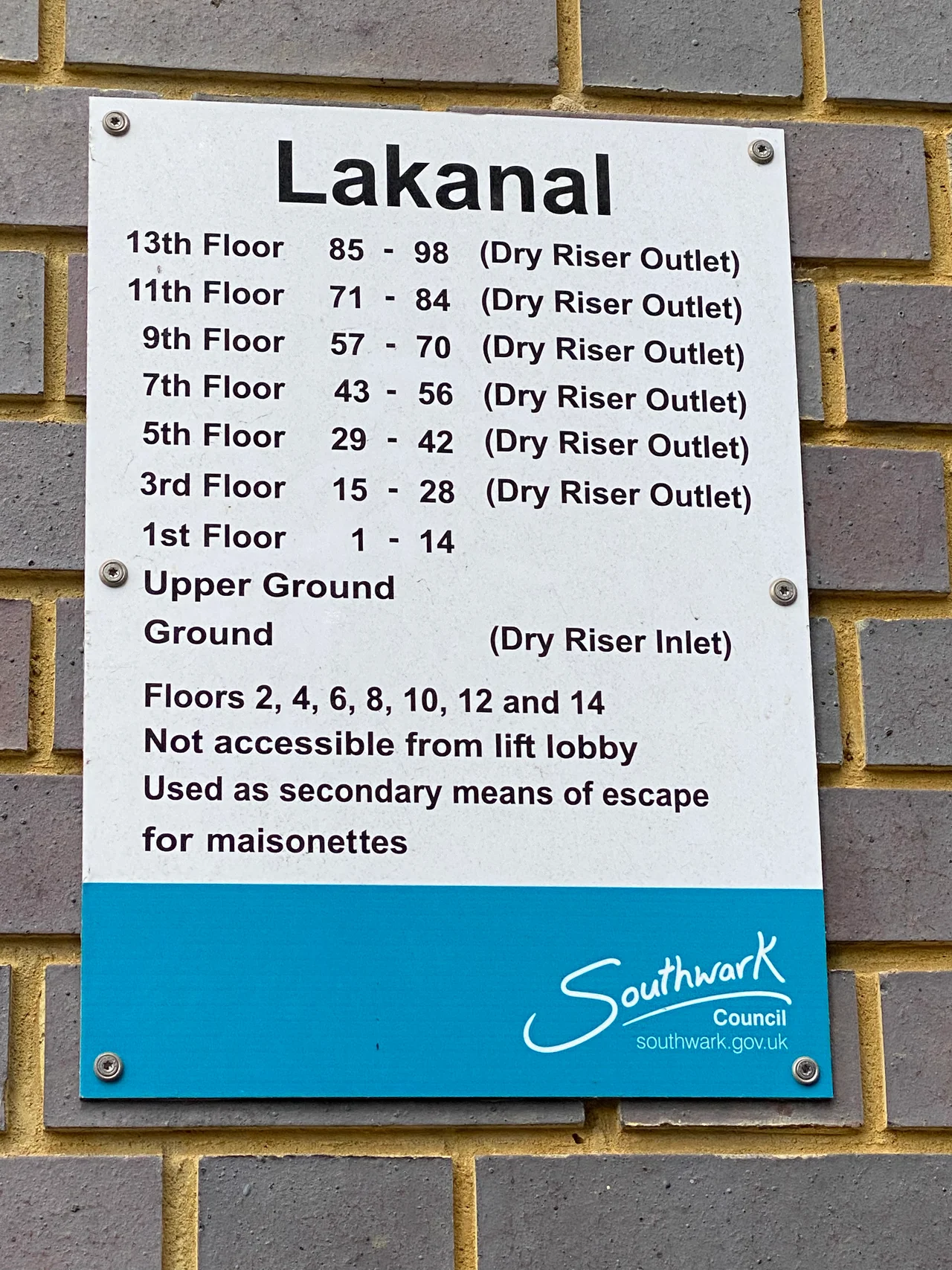
Residents were rehoused. Lakanal House was boarded up for six years. In 2015 refurbishment work began, and the block reopened in 2017 with new compartmentation, new fire alarms, sprinkler systems, and an external fire escape. Nearby Marie Curie House, an identically designed block, was finally given the same upgrades after Grenfell forced national action. The Sceaux Gardens Estate still stands, surrounded by gardens that give the place its French name. The plaque outside Lakanal does not bear the victims' names. A campaign to install one continues. The families know who they were. They walk past the building sometimes, on the way somewhere else, and look up. It is right that the rest of us know too: Catherine Hickman, Dayana Francisquini, Thais Francisquini, Felipe Francisquini, Helen Udoaka, Michelle Udoaka.
From the Air
51.4749 N, 0.0799 W in Camberwell, south of the Thames between Peckham and Brixton. The tower sits within the Sceaux Gardens Estate, one of several mid-rise blocks visible from low altitude approaches over south London. Nearest airport: London City (EGLC) 5 nm northeast; London Heathrow (EGLL) 14 nm west.
Nearby Stories
- Battle of Britain, Northfleet 1.1 km away
- Bayham Old Abbey 5.4 km away
- Catharine Macaulay 6.4 km away
- Hatfield rail crash 8.8 km away
- Chequers 8.9 km away
- Chelmsford Cathedral 10 km away
- Queen Victoria Hospital 13 km away
- Fishbourne Roman Palace 36 km away