.JPG)
Lam Tsuen Wishing Trees
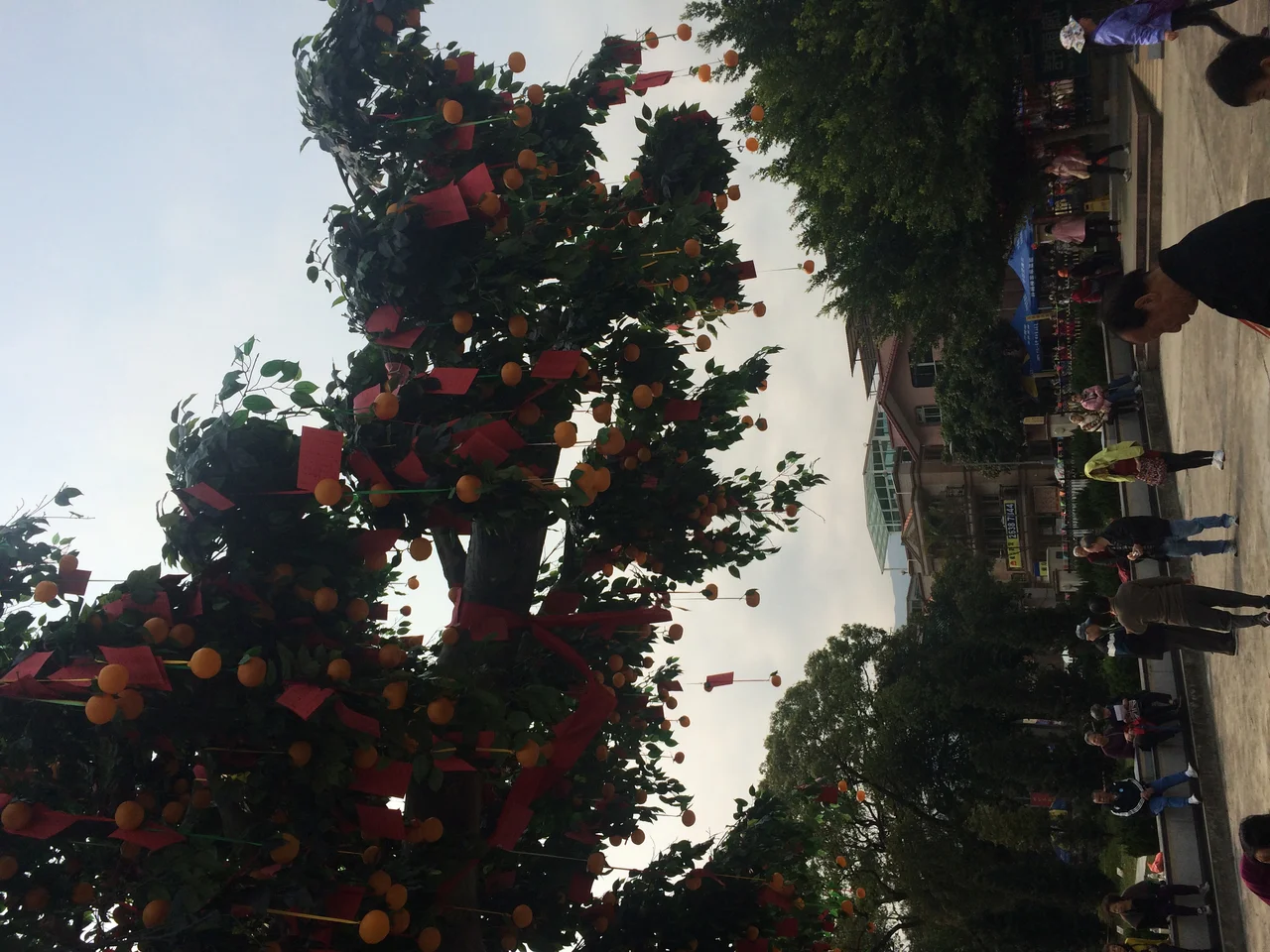
The wish was simple enough: write it on yellow joss paper, tie it to an orange, and throw. If the paper caught in the branches of the great banyan tree overhead, your desire would find its way to heaven. If it fell, the legend said your wishes were too greedy — but the folk wisdom also counseled persistence: try again. For generations, that transaction — a piece of paper, a piece of fruit, a throw into the canopy — has defined the Lam Tsuen Wishing Trees, two venerable banyans standing beside a Tin Hau temple in Fong Ma Po Village, in the quiet valley of Lam Tsuen north of the city.
A Temple, a Tree, and a Dream
The Tin Hau Temple beside the trees was built in 1768, during the reign of the Qianlong Emperor, to honor Tin Hau, the goddess of the sea revered by fishing communities throughout coastal China. Lam Tsuen itself had been settled since at least 1287, and the valley's relationship with the sacred predates the temple by centuries. The wishing tree tradition grew from an older story: a woman fell gravely ill and dreamed a god instructed her to visit Lam Tsuen and throw a piece of joss paper into a great tree. She did, she recovered, and the practice spread. Over time the ritual formalized. Worshippers would burn joss sticks, write their name, date of birth, and wishes on paper — called a 'Bao Die' — tie it to a mandarin orange for weight, and hurl it toward the canopy. A successful throw meant the wish was granted. Failure meant desire outran wisdom. Either way, people came back.
The Day a Branch Fell
On February 12, 2005 — the fourth day of Chinese New Year, when the trees were at their most loaded with offerings — a branch gave way under the accumulated weight of thousands of oranges and sheets of paper. A 62-year-old man and a four-year-old boy were injured. The accident prompted authorities to ban the traditional throwing practice. For some, it felt like the end of something irreplaceable. The trees were roped off for conservation, their canopies cleared of the papery burdens they had borne for so long. What followed was a pragmatic Hong Kong compromise: wooden racks went up nearby so offerings could be hung without stressing the living trees. In late 2009, authorities added an artificial fibreglass tree imported from Guangzhou — complete with branches designed to hold plastic mandarin oranges — so that visitors could still participate in the symbolic act of a throw. The tradition continued. The trees began, slowly, to recover.
The Weight of Wishes
There is something instructive in the story of those two banyans. They became so beloved, so central to Hong Kong's Lunar New Year calendar, that the sheer accumulation of faith nearly destroyed them. Tens of thousands of visitors arrived during the New Year period, each hoping their paper would catch. Each one added a small weight to branches that had grown strong over centuries but were not designed to bear this particular kind of love. The Well-Wishing Festival that grew around the trees now encompasses float exhibitions, food stalls, lotus lantern making, and lion dance performances — a full carnival built around the memory of a simpler ritual. Every year on May 1, a morris dancing team called Hong Kong Morris dances at the trees to celebrate the arrival of summer, a tradition that adds a quietly unexpected thread of English folk practice to an otherwise distinctly Cantonese gathering.
Banyan Deep Time
Banyan trees are not passive presences. They spread by dropping aerial roots that thicken into secondary trunks, slowly expanding until a single tree can occupy the space of a forest. They are among the most sheltering trees in the world — a banyan in India famously covers more than four acres — and in many Asian traditions they are considered home to spirits precisely because of how alive they feel, how insistently they grow. The Lam Tsuen trees, though no longer bearing the weight of thousands of oranges, remain living things at the center of a living faith. The wooden racks nearby hold the same prayers that once hung from real branches. Some visitors still go through the full ritual of writing name and birthdate and wish, and then hang the paper carefully, quietly, in a place where it can stay. The gesture is smaller. The hope is the same.
Finding the Trees
The wishing trees sit in Fong Ma Po Village within Lam Tsuen valley in Tai Po District, about an hour from central Hong Kong by MTR and bus. The valley itself is tucked between low forested hills, a rural pocket that New Territories expansion has not fully absorbed. The Tin Hau Temple and trees are on the valley floor, easy to reach and clearly marked. The atmosphere shifts during Lunar New Year when the carnival fills the surrounding area, but on quieter days the site has a different quality — the paper offerings rustling on the wooden racks, the temple incense drifting through the canopy, the two old banyans standing in the shade of the years.
From the Air
The Lam Tsuen Wishing Trees sit at approximately 22.456°N, 114.143°E in the Lam Tsuen Valley of Tai Po District, New Territories, Hong Kong. From the air at 3,000–5,000 feet, the valley is a narrow green corridor running roughly north–south between the hills east of Tai Po town. The Lam Tsuen River is visible threading through it. The nearest major airport is Hong Kong International Airport (VHHH) on Lantau Island, approximately 35 km to the southwest. Tolo Harbour opens to the east. Approach from the west over Tai Po at low altitude for the best valley view; visibility is typically good outside typhoon season, though summer humidity can reduce clarity.
Nearby Stories
- Chapel of St. Francis Xavier 3.5 km away
- Cuiheng 4.1 km away
- 2015 Shenzhen Landslide 16 km away
- Shunde 31 km away
- Wanshan Archipelago 37 km away
- Nanxiong Formation 96 km away
- Heyuan 149 km away
- Checheng Fu'an Temple 629 km away