
Lam Tsuen
The name 'Lam Tsuen' means something like Forest Stream, but it is a small irony of this place that most of its residents do not bear the surname Lam. The majority are Chong. A smaller number are Hakka families from the hills. The 26 villages scattered through Lam Tsuen Valley arrived from different directions, settled at different times, and brought different dialects — yet they have functioned for centuries as a single community, bound by shared temples, shared markets, and a shared determination to govern their own affairs. That cooperative instinct, old and practical, is as much a part of Lam Tsuen's story as the famous wishing trees.
Two Peoples, One Valley
Lam Tsuen is not a village in any administrative sense. It is a union: specifically, a grouping of 26 villages spread across the valley floor and surrounding hills, divided historically between five indigenous Punti settlements and eighteen Hakka ones. The Punti — sometimes called Cantonese-speaking local peoples — arrived first, establishing themselves in the fertile lowlands. The Hakka, a distinct ethnic and linguistic group from inland southern China, came later and often settled higher on the hillsides where land was less contested. The two communities coexisted uneasily in many parts of the New Territories, but in Lam Tsuen they developed a workable arrangement, sharing the Tin Hau Temple and participating together in the rituals that defined valley life. Today the valley has expanded to 26 villages. The ancestral halls still stand in several of them, stone-and-timber structures with curved rooflines that mark which family built and held each plot of ground.
Breaking the Monopoly
During the Qing dynasty, Lam Tsuen was part of a larger inter-village alliance called Tai Po Tsat Yeuk — the Seven Leagues of Tai Po. The old Tai Po Market, founded by the powerful Tang Clan of Lung Yeuk Tau, held a monopoly over local trade that the other villages found burdensome. In 1892, the alliance struck back by establishing Tai Wo Market, a rival trading post that gave smaller clans and villages a place to buy and sell outside the Tang Clan's grip. It was a quiet act of economic self-determination, characteristic of the New Territories' complex web of clan politics. Markets were not just places to trade; they were declarations of power. By building their own, the Lam Tsuen villages and their allies asserted that no single clan could define the terms of commerce in the district.
The Temple at the Center
Tin Hau Temple was built in 1768, financed in part by a wealthy patron named Tang who stepped forward when the villagers could not raise enough capital on their own. In gratitude, they placed his memorial tablet inside for worship alongside the goddess — an unusual honor that speaks to the practical theology of these communities, where benefactors and deities coexist in the same sacred space. Tin Hau is the goddess of the sea, venerated across coastal southern China as the protector of fishermen, and her presence in an inland valley like Lam Tsuen reflects the origins of many of its settlers. The temple hosts the Bun Festival every nine years and regular ceremonies throughout the year. The Da Jiu Festival — a Taoist purification rite held every decade — runs for five days and six nights, drawing participants from across the valley to pray for good weather, health, and peace.
The Well-Wishing Carnival
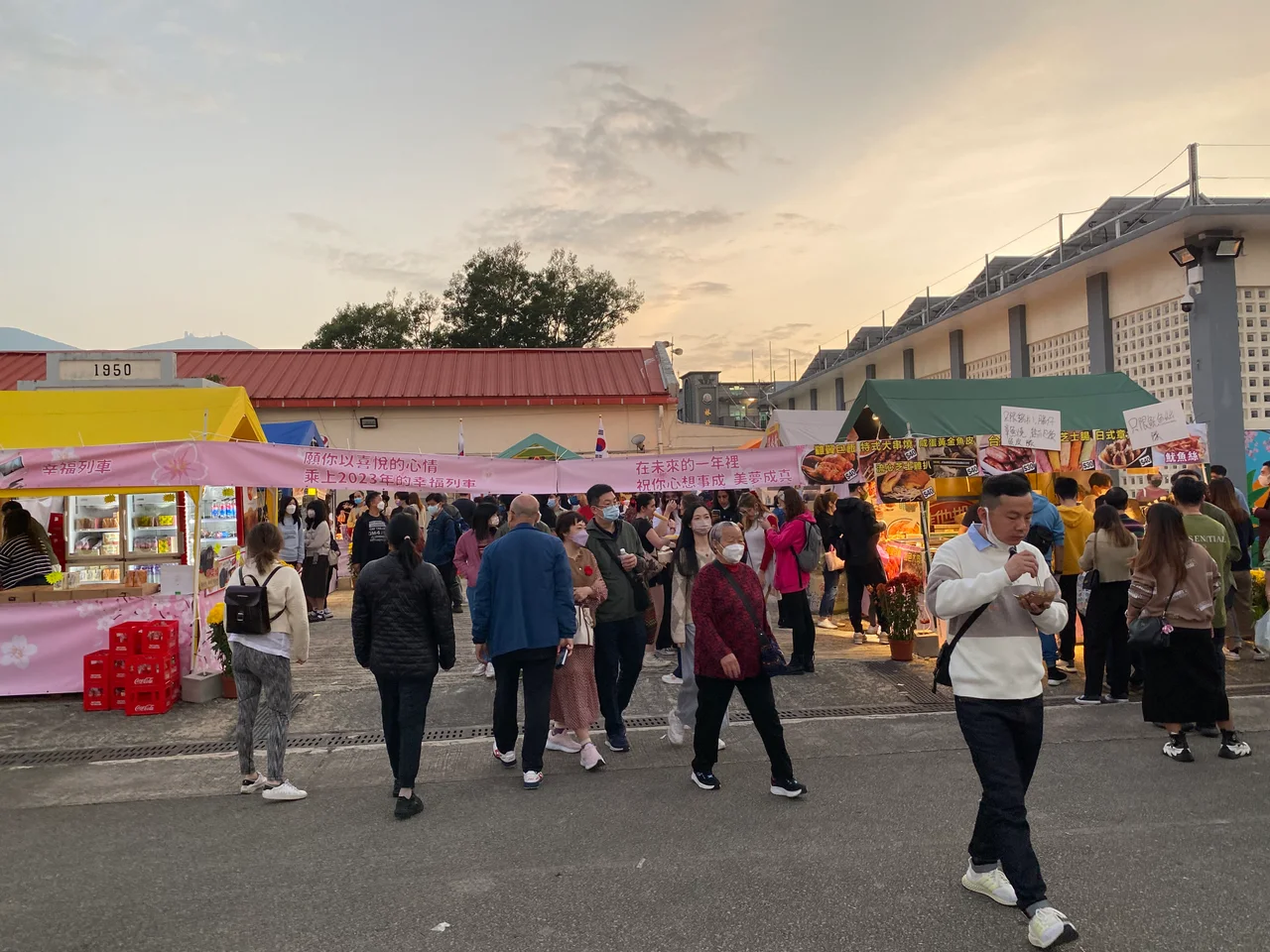
Every Lunar New Year, Lam Tsuen transforms. The Well-Wishing Festival, which grew from the private devotional practice at the famous wishing trees, has become the valley's largest annual event and one of Hong Kong's most distinctive seasonal traditions. Visitors come by the thousands — by minibus from Tai Po Market MTR, on foot from surrounding areas — to toss joss paper offerings, light lotus lanterns, and wander a carnival that has accumulated food stalls, game booths, and lion dance performances around the ritual core. The festival runs through the first two weeks of the new year. What began as an act of personal prayer has expanded into a communal celebration, absorbing the energy and commerce of Hong Kong's festival calendar without entirely losing the quieter intention that started it.
A Valley that Holds
Lam Tsuen sits in a green corridor between forested hills in Tai Po District, separated from the denser development of Tai Po town by the Lam Tsuen River, which empties eventually into Tolo Harbour. The valley has not been entirely spared by Hong Kong's relentless development — new roads reach in, and public housing towers mark the skyline at its edges — but it retains a quality of enclosure, of being somewhere slightly apart. The ancestral halls, the temple, and the wishing trees anchor the space. Villages that have stood since the Song dynasty still stand. Families whose surnames appear on centuries-old land records still farm here. Lam Tsuen is a place where the weight of continuity is felt — not as museum-piece preservation, but as the ordinary consequence of people who stayed.
From the Air
Lam Tsuen Valley is centered at approximately 22.456°N, 114.126°E in Tai Po District, New Territories, Hong Kong. From 3,000–5,000 feet, the valley appears as a narrow green slot running north to south, flanked by wooded ridges. The Lam Tsuen River is visible on the valley floor. Tai Po town and Tolo Harbour lie to the east. Hong Kong International Airport (VHHH) is approximately 37 km to the southwest on Lantau Island. The area is best viewed in the cooler months (October–February) when visibility is highest; summer haze and typhoon season (May–October) can limit aerial clarity.
Nearby Stories
- Chapel of St. Francis Xavier 3.5 km away
- Cuiheng 4.1 km away
- 2015 Shenzhen Landslide 16 km away
- Shunde 31 km away
- Wanshan Archipelago 37 km away
- Nanxiong Formation 96 km away
- Heyuan 149 km away
- Checheng Fu'an Temple 629 km away