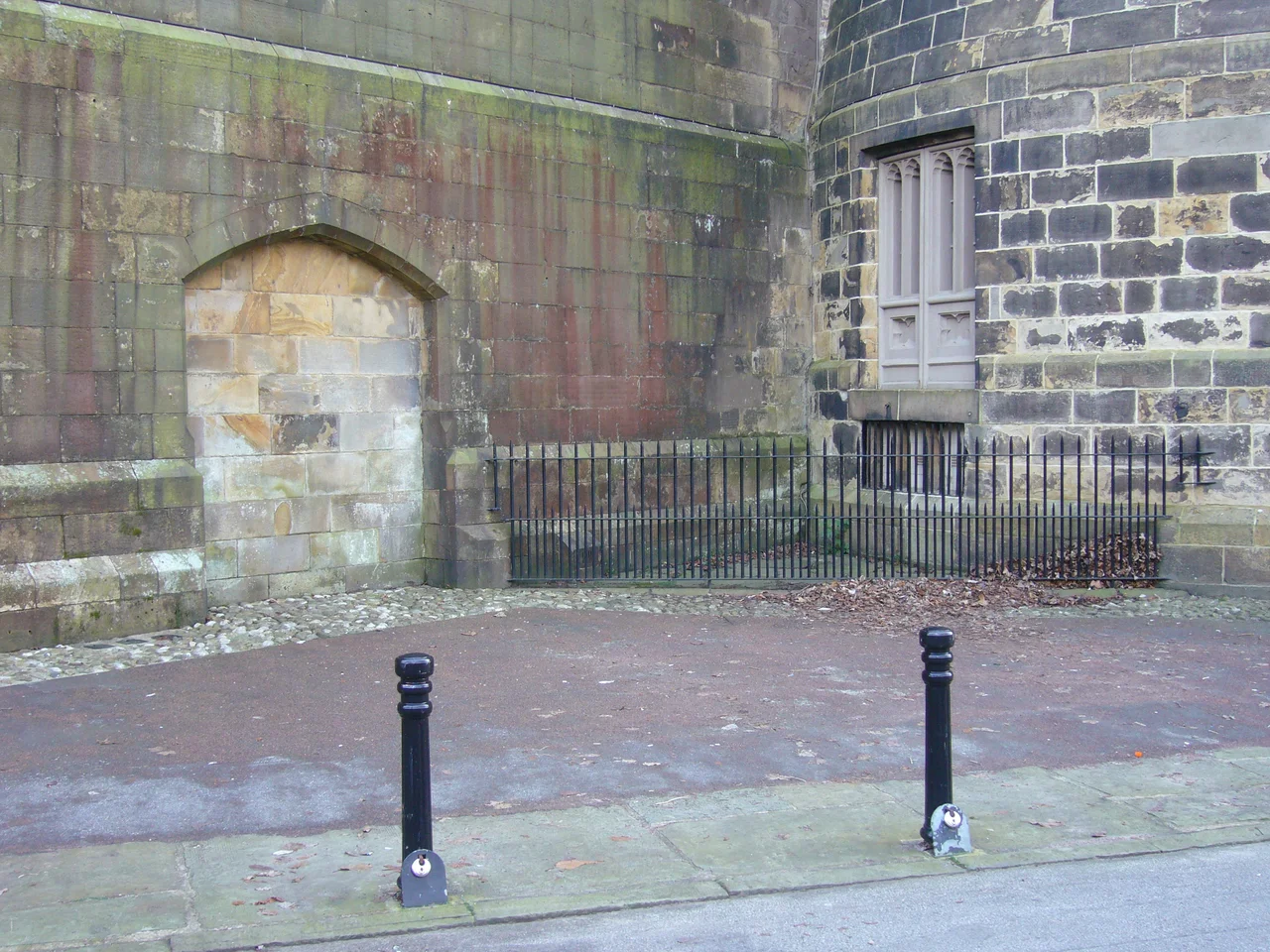

Lancaster Castle
Between 1782 and 1865, around 265 people were hanged at Lancaster Castle. The number sounds Victorian and exotic until you sit with it: this small Lancashire town held the only Assize Court for the entire county, including the rapidly growing industrial centres of Manchester and Liverpool. Crowds gathered in the churchyard. Children climbed the walls of Lancaster Priory next door for a better view. People came to die here from places fifty miles away, and people came to watch. The court that earned Lancaster its grim nickname - the Hanging Town - was sitting inside walls already six hundred years old.
Foundations
Between 60 and 73 AD, the Roman army built a fort on the hill above the River Lune to control a strategic river crossing. A thousand years later, after the Norman Conquest, Roger de Poitou probably raised the first timber castle on the same hill, reusing the Roman earthworks. By the late 12th century the timber had been replaced in stone. The square keep that still stands at the centre of the site dates roughly to that period, though the exact date is unknown - the King of Scotland held this castle briefly during the Anarchy in 1141 and may have built or rebuilt the keep himself. In 1164, when William of Boulogne died, the Honour of Lancaster came under permanent royal control. It has been a royal building ever since.
The Pendle Witches
In August 1612, ten people were hanged on Lancaster Moor after a trial held in the castle's Great Hall. They had been accused of witchcraft. Most were poor women from the villages around Pendle Hill: Elizabeth Southerns, known as Demdike, who died in the castle's dungeon before trial; her daughter Elizabeth Device; her granddaughter Alizon Device; her grandson James; the rival matriarch Anne Whittle, called Chattox; Chattox's daughter Anne Redferne. They lived hand-to-mouth as beggars, healers, and curse-mongers in a corner of Lancashire that the seventeenth century considered remote and superstitious. When King James I's witchcraft paranoia met local feuds and the testimony of a nine-year-old child, Jennet Device, who gave evidence against her own family, the result was one of the best-documented witch trials in English history. The court did not invent witches; it accepted as evidence the things the accused said about themselves, often after months in a dark cellar. Carol Ann Duffy's poems are inscribed on ten waymarkers along the Lancashire Witches Walk that ends at the castle gate.
Civil War and George Fox
Parliamentary forces took the castle in February 1643. The Royalists tried to retake it three times in three months and failed. After the war ended, Parliament ordered that "all the walls about Lancaster Castle should be thrown down" - the standard slighting that left so many English castles as ruins. Lancaster's walls came down; the keep and gatehouse survived. In 1660 George Fox, the founder of the Religious Society of Friends, was imprisoned here as a politically dangerous radical. Fox had had his foundational vision on Pendle Hill in 1652, fifteen miles east, looking out over Lancashire and seeing "a great people to be gathered." That he ended up locked inside the same castle that had hanged the Pendle Witches forty-eight years earlier is one of the strange symmetries of seventeenth-century Lancashire.
Prison and Refurbishment
For most of the 19th and 20th centuries, Lancaster Castle was His Majesty's Prison Lancaster - first the county gaol rebuilt in the 1780s by architect Thomas Harrison, then a Category C men's prison from 1955 until its closure in March 2011. The Crown Court still sits in the Shire Hall that Joseph Gandy completed in 1802. After the prison closed, the Duchy of Lancaster - the castle's owner, as it has been since 1164 - began a long restoration. The courtyard reopened to the public in 2013. The Lancashire Police Museum opened in A Wing in 2022. A 2016 tree-ring analysis dated oak timbers in the keep's undercroft to the 1380s and the gatehouse timbers to around 1404, when John of Gaunt's grand rebuilding programme was underway. Visitors can now walk the same passages that condemned prisoners walked, and stand in the courtroom where their cases were heard.
From the Air
Lancaster Castle sits at 54.050°N, 2.806°W, on Castle Hill above the River Lune in central Lancaster. The keep tops out about 350 ft AMSL. Best viewed VFR at 1,500-2,500 ft AGL. Nearest airports: Blackpool (EGNH) about 17 nm southwest, Manchester (EGCC) about 50 nm south. The castle and the adjacent priory church share a single hilltop above the curving river - the two pale stone buildings are immediately recognisable. The M6 motorway and the West Coast Main Line both pass close by, useful for navigation. Williamson Park and the Ashton Memorial dome lie a mile to the east.
Nearby Stories
- Piel Castle 1.3 km away
- Samlesbury Hall 4.7 km away
- Kendal Castle 6.5 km away
- Murder of Lindsay Rimer 7.8 km away
- Hardknott Pass 9.8 km away
- Bolton Castle 10 km away
- Embsay and Bolton Abbey Steam Railway 12 km away
- Hoylake Lifeboat Station 43 km away