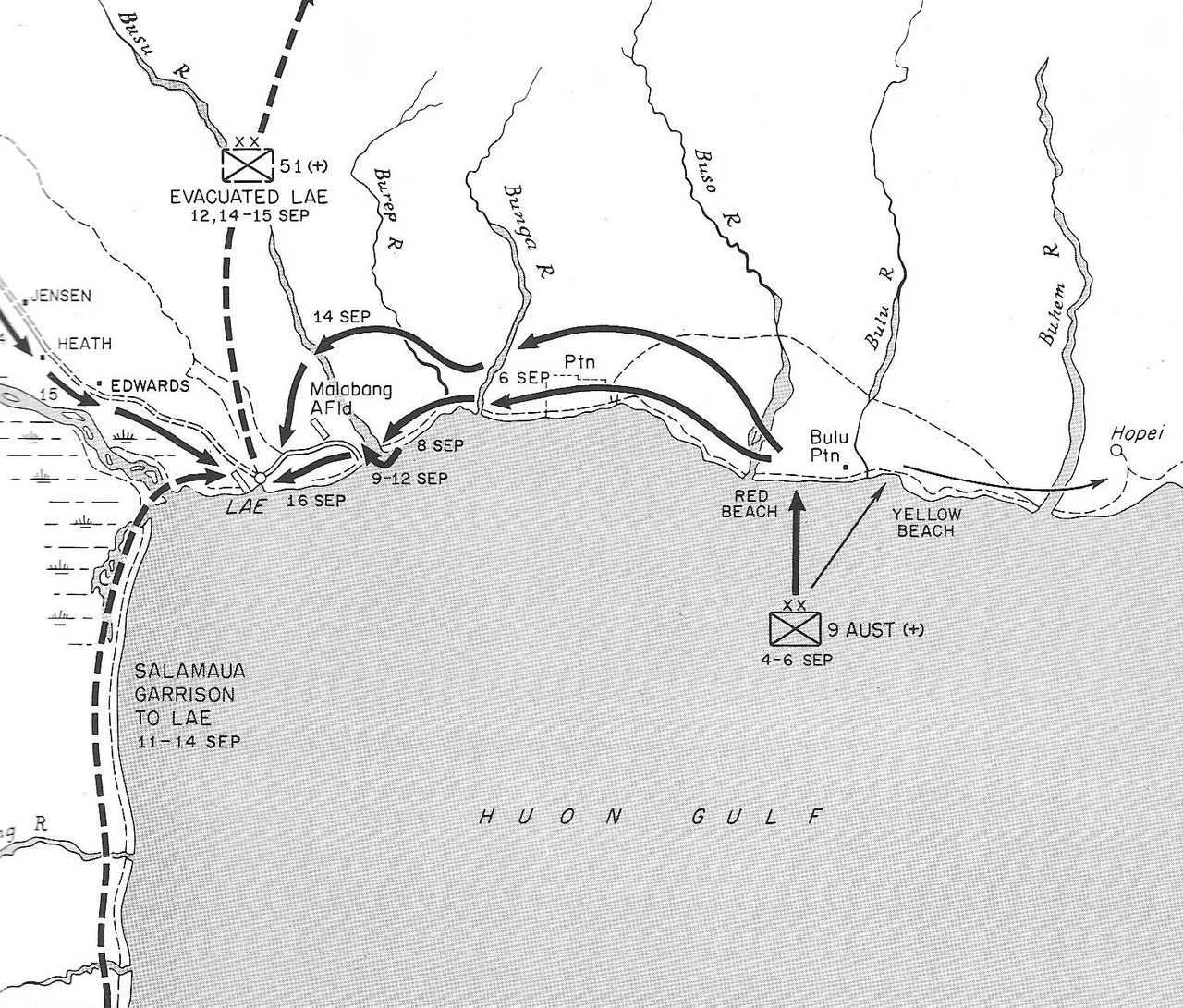

Landing at Lae
For the men in the landing craft that morning, it was the first time an Australian army had come ashore under fire since Gallipoli - twenty-eight years of army memory telling them how wrong this kind of operation could go. The beaches they were aimed at sat about 27 kilometers east of Lae, a sickle of sand between a jungle wall and the Huon Gulf. It was 4 September 1943. Across those ten miles of water, the Japanese had been dug in at Lae for eighteen months. The plan was not to storm the town at all. It was to land behind it, drop paratroopers inland, and squeeze the garrison between two advancing forces until something gave.
Operation Postern
The landing was the opening move of Operation Postern, itself one piece of MacArthur's larger Cartwheel strategy to crack open the Japanese stronghold at Rabaul. By mid-1943 the Allies had won enough fights in New Guinea - Kokoda, Milne Bay, Buna-Gona, the Battle of the Bismarck Sea - that they could finally reach for the initiative rather than just defend. Lae was the next logical target. It had airfields, a harbor, and sat athwart the coast road the Japanese hoped to build across the Finisterre Range. Take Lae and the Allied line would shift forward hundreds of miles. The Australian 9th Division would put the hammer down from the east while the 7th Division dropped into Nadzab, inland, and came at Lae from behind. Between them, about 12,000 Japanese defenders of the 51st Division.
The Landing Beaches
The plan called for two beaches, imaginatively named Red and Yellow, separated by a small creek. The U.S. VII Amphibious Force would deliver the Australians - the first time the young amphibious command had worked with them, the first time the Australian Army had done this kind of operation at scale since 1915. Seven landing ships, assorted smaller craft, fire support from four destroyers. The 20th Brigade went in first to secure the beachhead. The 26th followed to expand it. The 24th came ashore in the following days. Opposition at the waterline was light - the Japanese had not expected a landing this far east - but Japanese aircraft from Rabaul and Wewak tried hard, sinking a landing ship and killing 51 men. Malaria, heat, rain, and the sheer logistical weight of moving a division through coastal swamp quickly became as much the enemy as the defenders ahead.
The Airborne Pincer
While the 9th Division pushed west along the coast, the 7th Division came from the sky. On 5 September, paratroopers of the U.S. 503rd Parachute Infantry Regiment dropped onto Nadzab, 30 kilometers inland in the Markham Valley, followed in subsequent days by Australian troops flown in on C-47s. It was the only major airborne operation conducted by American paratroopers in the Southwest Pacific, and it worked. Within days the 7th Division was advancing east down the Markham toward Lae, while the 9th advanced west along the coast. The Japanese garrison was caught between two armies in a narrow corridor, with the sea to the south and the mountains to the north.
Race to the Town
The advance was not tidy. Rains turned tracks into black muck. The Busu River, in flood, swept away soldiers trying to cross. A division's worth of supplies - fuel, ammunition, rations, quinine - had to come by landing craft and jeep through conditions the planners had underestimated. There was never enough time. Despite being the ones who had landed first and stood closer to the objective, the 9th Division's advance stalled. The 7th, coming down the Markham Valley, moved faster. On 16 September, the 7th Division walked into the outskirts of Lae first. The 9th followed the next day. The Japanese garrison had slipped away north, beginning a grueling retreat over the Saruwaged Range to the north coast - a march through 4,000-meter passes that would kill more of them than Australian bullets had.
What the Landing Meant
Lae fell with around 115 Australians killed in the 9th Division's sector. Given the scale of the operation - the first Australian amphibious landing in a generation, conducted with an American partner the Australians had never worked with before - that was a remarkable outcome. The Landing at Lae proved something the planners had worried about for months: that the Australian Army could do this kind of operation, and do it well. The amphibious doctrine learned here would carry forward into Finschhafen, New Britain, and eventually Borneo. For the families of the men who did not come home, this was little consolation. But for the soldiers moving up the green ridges north of Lae in the weeks that followed, there was a hard satisfaction in knowing the tide of the Pacific War was finally turning in their direction.
From the Air
The landing beaches lay roughly 27 km east of Lae along the north shore of the Huon Gulf, near 6.73°S, 147.00°E. From cruising altitude the terrain tells the story: narrow coastal strip between dark green jungle and pale gulf waters, with the Saruwaged Range rising north. Nadzab airfield (now AYNZ) sits about 40 km inland in the Markham Valley. Lae itself occupies the river delta on the west end of the gulf. Visibility is often reduced by monsoon cloud buildup over the ranges from November through April.
Nearby Stories
- Black Cat Track 10 km away
- Battle of Sattelberg 12 km away
- Battle of Finschhafen 28 km away
- 2022 Papua New Guinea Earthquake 31 km away
- Huon Peninsula 37 km away
- Battle of Kaiapit 70 km away
- Battle of the Bismarck Sea 70 km away
- Strathallan Estate 185 km away