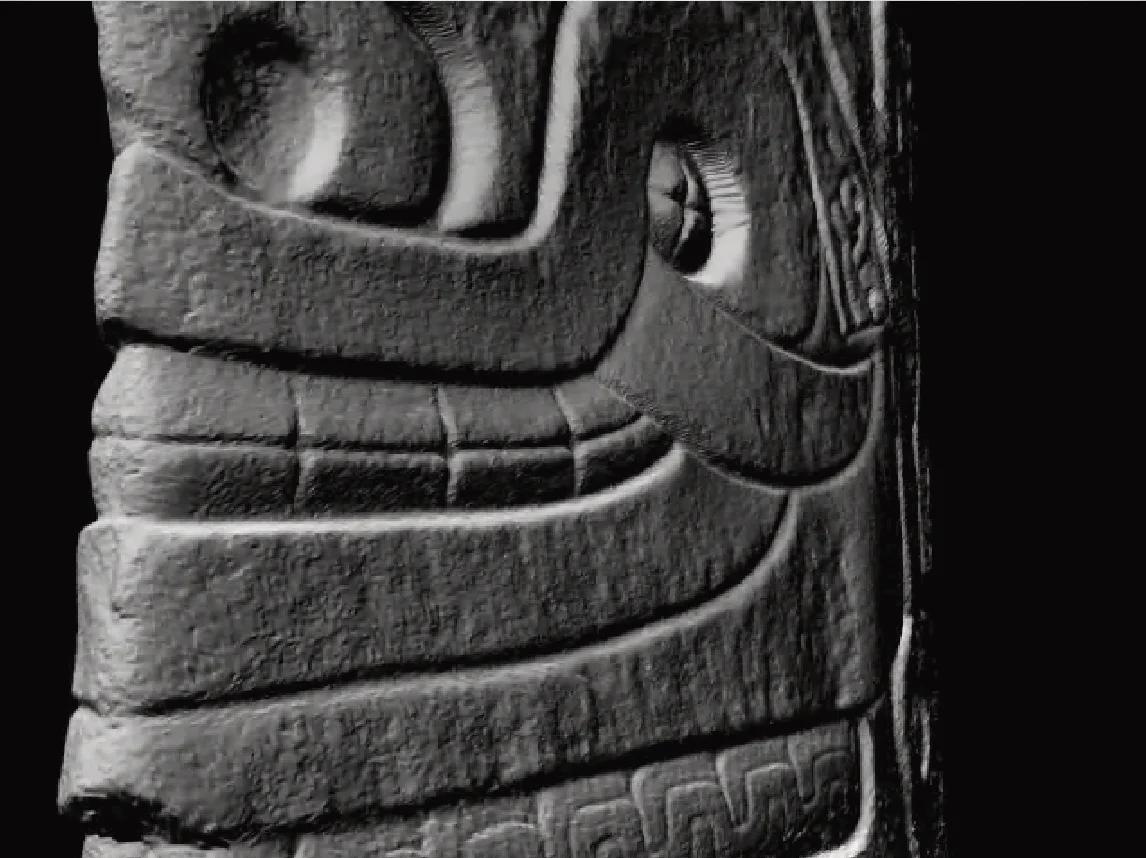

Lanzón
You do not walk to the Lanzón. You are led. Down stone corridors that twist and fold upon themselves in pitch blackness, your head still spinning from the San Pedro cactus you drank an hour before, the Chavín priests guide you through a maze that ends at something you cannot quite see. Then a torch flares. Four and a half meters of carved granite loom above you - fanged, clawed, hair writhing into serpents - and you understand why the Andes's first great religion built an entire temple to hide this single stone.
The Lance That Isn't a Lance
Spanish conquistadors named it Lanzón, the lance, for the way its narrow granite form tapers toward a buried point in the chamber floor. They were wrong about the metaphor. The sculpture's shape resembles a chaquitaclla, the Andean foot-plow farmers used to break high-altitude earth. If that resemblance was deliberate, then this snarling figure - erected around 500 BCE during the Early Horizon - was a deity of the harvest as much as of the hunt. The deep-cut eyes, nose, and teeth project outward in high relief, making the face leap from the stone. The carving is almost perfectly symmetrical, except for one hand raised toward the sky and one lowered to the earth, the axis mundi fixed in living rock.
The Maze as Ritual
The sculpture is fixed in a cruciform chamber deep inside the Old Temple at Chavín de Huantar. Reaching it required moving through a deliberately disorienting network of galleries - narrow passages, sudden turns, ventilation shafts that whistled when wind moved through them. Archaeologists believe initiates drank psychoactive San Pedro cactus before entering. The combination was engineered: fasting, darkness, a hallucinogen that sharpens edges and distorts scale, sound that seemed to come from everywhere at once. When the Lanzón finally appeared by torchlight, it could not have looked like carved stone. It would have looked alive.
The First Great Religion of the Andes
The Chavín religion flourished between roughly 900 and 200 BCE, the first major spiritual movement to bind together peoples across the Andean world. Chavín de Huantar sat on one of the few viable mountain passes between the Pacific coast and the Amazon lowlands - a natural funnel where pilgrims from both sides could meet. Textiles echoing Chavín iconography have been found as far away as the south coast at Karwa, hundreds of kilometers distant. The Lanzón anchored this network. It was the god at the center of the world.
Jaguar, Serpent, Thunder
The imagery is layered and deliberate. The snarl and fangs belong to a jaguar - the Amazonian predator that the Chavín people may have adopted as spiritual animal, worshipping qualities they admired: stealth, power, sight in darkness. The hair flows outward and resolves into serpents. The eyes stare with dilated pupils, what scholars call pendant eyes, as if seeing beyond the cave walls. The belief system behind these choices was camay - the idea that a physical object could house a celestial being. The Chavín brought food and ceramic offerings to the Lanzón because, in their cosmology, a god lived inside it.
Convergence and Duality
Andean religion prized opposites held in balance. Night and day, life and death, male and female, upper world and lower world - all became sacred through their tension. The Lanzón embodies this principle. One arm lifts toward the heavens, the other falls toward the earth. The jaguar body carries the serpent hair. The stone sits at the convergence of two rivers, the Mosna and the Wacheqsa, in a concept called tinku - the meeting of parts that create something new. Even the temple's location expressed the idea: perched between the arid cordillera and the green Amazon, between two halves of the Andean cosmos.
What Remains
Chavín de Huantar was eventually abandoned, the religion displaced by the Paracas and Nazca cultures to the south and the Moche to the north. But the Lanzón has never moved. It remains in the Old Temple chamber where it was raised twenty-five centuries ago - a floor-to-ceiling stone deity that outlasted its worshippers, its religion, and the Spanish empire that named it. Visitors today walk the same passages, turn the same corners. There is no San Pedro now. Only electric light. Even so, coming around the final turn and seeing that face emerge from the rock still takes the breath away.
From the Air
Located at 9.59°S, 77.18°W in the Callejón de Conchucos, Ancash Region, at about 3,180 meters elevation. The site sits in a high valley between two branches of the Andes, east of the snow-capped Cordillera Blanca. Nearest airports are Huaraz (ATA/SPHZ) about 75 km west across the cordillera and Anta (SPAN) near Huaraz. Recommended viewing altitude 13,000-16,000 feet AGL. The valleys channel strong afternoon winds.
Nearby Stories
- Pampas Grande 17 km away
- Cordillera Negra 38 km away
- Huánuco 45 km away
- Huaricanga 72 km away
- Inca Civil War 73 km away
- Raura Mountain Range 79 km away
- Huacrachuco 79 km away
- Pucallpa 252 km away