
Lapworth Museum of Geology
Wenlock Limestone outcrops near Dudley have been famous to fossil collectors for almost three hundred years. The rock, formed about 428 million years ago in a warm tropical sea, is full of trilobites. The most common species, Calymene blumenbachii, is so closely associated with the Black Country that locals nicknamed it the Dudley Bug and put it on the borough's coat of arms. Most of the fine specimens were pulled out of the ground in the 18th and 19th centuries by quarrymen who were not after fossils. They were after flux for the iron furnaces. The trilobites kept turning up anyway. The best ended up in private cabinets and then, eventually, in glass cases at the Lapworth Museum of Geology on the University of Birmingham campus, where you can still meet them face to compound-eyed face.
The man and the name
Charles Lapworth was a Victorian schoolmaster who became one of the most important British geologists of the 19th century. Born in Faringdon in 1842, he taught at a school in Galashiels in the Scottish Borders and spent his free time mapping the local rocks. He used tiny fossils called graptolites, which look like fragments of pencil lead embedded in shale, to date and correlate strata across the region. In 1879 he proposed a new geological period, the Ordovician, to resolve a famous boundary dispute between his older colleagues. The Ordovician is now one of the standard divisions of Earth's time chart. The same year, Lapworth took a chair at Birmingham's Mason College, which became part of the University of Birmingham in 1900. He spent the rest of his career there. The museum that grew up around his teaching collection still bears his name, and his archive at the Lapworth is one of the most complete records of any 19th-century geologist's working life.
Aston Webb and the redevelopment
The Lapworth is housed in a wing of the Grade II* listed Aston Webb Building, the great red-brick semicircle that anchors the university's Edgbaston campus. The building was designed by Sir Aston Webb, who also designed the facade of Buckingham Palace, and Ingress Bell, with original Edwardian features that survive throughout. The museum has occupied this space since the 1920s, but in the early 2010s it was overdue for a refresh. A 2.7 million pound redevelopment project, funded by Heritage Lottery Fund grants, alumni donations through the Circles of Influence campaign, Arts Council England, and DCMS Wolfson, ran from 2014 to 2016. Real Studios designed the new exhibits, The Hub built them, and Squint Opera handled the audiovisual work. The museum reopened in June 2016. Sir Paul Nurse, the Nobel Prize winner and former president of the Royal Society, did the honours alongside the university's vice-chancellor David Eastwood and Professor Alice Roberts, the public-facing anatomist.
Three galleries, four and a half billion years
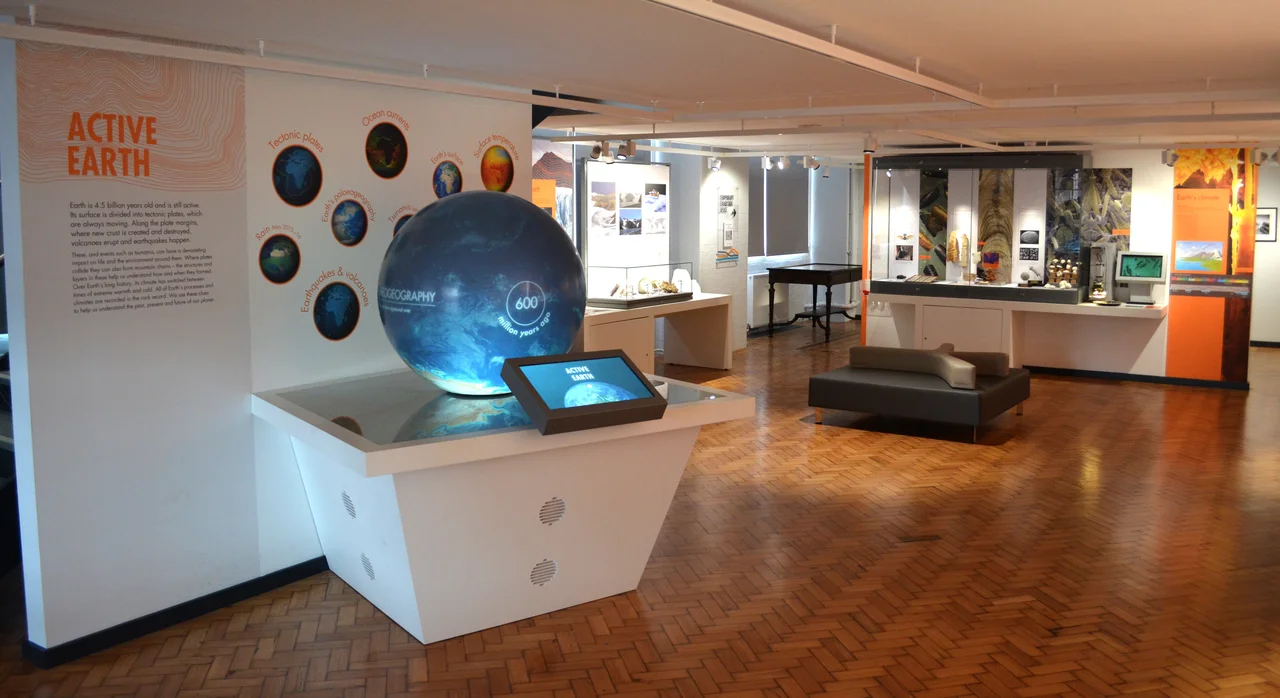
The Evolution of Life gallery fills the main hall, with a replica skeleton of Allosaurus standing guard and a Pteranodon hanging overhead. A floor-to-ceiling rock wall explains the rock cycle. Animated reconstructions show the Midlands as it shifted across the planet over geological time: a Silurian tropical reef, a Carboniferous swamp forest, a Jurassic warm shallow sea, a Quaternary tundra grazed by mammoths. Specimens of those mammoths and the cave bears that lived alongside them are in the cases. The Active Earth gallery covers Earth processes, with an interactive globe projector that lets visitors watch the continents drift. The Mineral Wealth gallery holds about twelve thousand mineral specimens, with strong holdings from Cornish, Cumbrian, and Shropshire mines, and a collection that belonged to William Murdoch, the Scottish engineer who worked at Soho House with James Watt and Matthew Boulton. There is also a case of minerals that fluoresce in startling colours under ultraviolet light.
The collection behind the cases
The Lapworth holds about 250,000 specimens. Most of them are in storage rather than on display, available to researchers and serious enthusiasts by appointment. The collection includes fossils from the famous Solnhofen Limestone of southern Germany, which preserved Archaeopteryx, and from the Burgess Shale of British Columbia, which captured soft-bodied Cambrian animals in extraordinary detail. The archive houses important materials documenting the work of pioneering scientists who passed through Birmingham, including Dame Maria Ogilvie Gordon, one of the first women to earn a doctorate in geology, Dame Ethel Shakespear, who studied graptolites alongside Lapworth, and Li Siguang, the Chinese geologist who founded the modern Chinese earth sciences. In 2008 the entire collection was designated as of outstanding national and international importance by the Museums, Libraries and Archives Council. The museum is free to visit, open every day except Mondays except for bank holidays, and is small enough to see in an afternoon but rich enough to keep you wandering back.
From the Air
The Lapworth Museum sits at 52.449 degrees north, 1.932 degrees west, on the University of Birmingham's main Edgbaston campus three kilometres south-west of central Birmingham. From 1,500 to 3,000 feet AGL, the most prominent landmark is the Joseph Chamberlain Memorial Clock Tower, a 100-metre Italianate campanile that stands at the centre of the campus and is visible for many miles. The Aston Webb Building, with its semicircular red-brick courtyard, encloses the tower; the Lapworth occupies one wing. University railway station is immediately west. Birmingham International (EGBB) is fifteen kilometres east, Coventry (EGBE) is twenty-eight kilometres south-east, Wolverhampton Halfpenny Green (EGBO) is twenty-eight kilometres west-north-west. Low cloud is common over the city in winter.
Nearby Stories
- Shepshed 8.5 km away
- Battle of Evesham 11 km away
- Hixon rail crash 12 km away
- Battle of Cropredy Bridge 12 km away
- Wenlock Priory 15 km away
- RAF Shawbury 16 km away
- Market Bosworth 17 km away