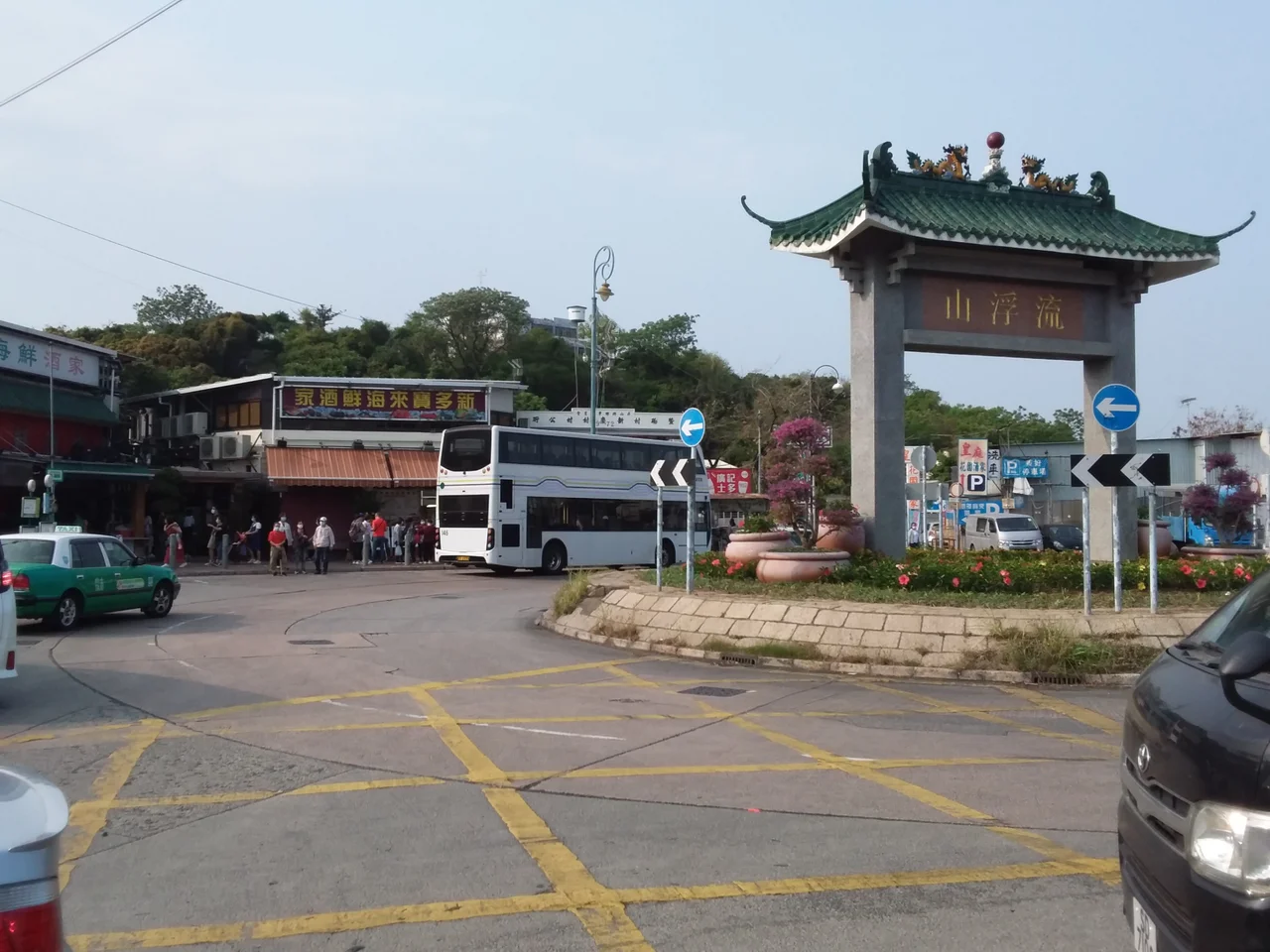

Lau Fau Shan
The monk Pui To, the story goes, arrived on this shore inside a wooden tub. He had crossed the sea in it — or so the legend holds — and when he landed at the edge of what is now called Deep Bay, he founded a temple that has stood in some form for 1,500 years. Whether or not a man ever navigated open water in a tub, the story captures something true about Lau Fau Shan: it is a place where the improbable has always been treated as ordinary. A fishing village at the far western end of the New Territories, it once produced around 100 tons of fresh oysters a year. It looks across the bay at Shekou in Shenzhen, and the Shenzhen Bay Bridge stretches into view on the horizon, a span of concrete linking the two cities that would have been unimaginable when the oyster farmers were at their peak.
The Oyster Shore
Lau Fau Shan sits at the edge of Deep Bay, the sheltered inlet that separates the New Territories from Guangdong Province. The bay's shallow, muddy waters — fed by the Sham Chun River from the mainland — created ideal conditions for oyster cultivation. For generations, families here worked the tidal flats, harvesting Crassostrea hongkongensis, a species prized for its briny depth and suited to the bay's brackish conditions. At the peak of the industry, roughly 100 tons came out of these waters every year, supplying Hong Kong restaurants and export markets in neighboring countries. The oyster was not just food; it was the economic identity of the village. Restaurants on the main street served them fresh, dried, or fermented into the oyster sauce that Cantonese cooking depends on. Some sold directly off boats. The smell of drying seafood — laid on racks in the sun along the waterfront — was the smell of the place.
The Slow Departure of the Oysters
The industry declined over decades, worn down by a combination of factors: water quality in Deep Bay degraded as Shenzhen's rapid industrialization in the 1980s and 1990s transformed the rivers feeding it; the labor-intensive work of oyster farming became harder to sustain as Hong Kong's economy offered easier alternatives; and the market for locally grown oysters contracted as imports from mainland China and elsewhere became available. Today most inhabitants of Lau Fau Shan have given up oyster culture. Some seafood restaurants remain, and the village still draws visitors who come for the view across the bay and the memory of what the waterfront once offered. But the tidal flats that once produced the harvest are quieter now. The Shenzhen Bay Bridge, visible from the shore, is one measure of how much the world beyond the bay has changed.
A Temple and a Legend
Pui To's temple has endured through everything the bay and its surroundings have thrown at it — flooding, dynastic change, Japanese occupation, and the convulsions of the twentieth century. A 1,500-year history in a place this small is not nothing. The temple honors a monk whose arrival by wooden tub may be legend, but whose presence in the cultural life of the shore is entirely real: the structure has been rebuilt and repaired many times, but the site has not moved. Nearby, the Former Lau Fau Shan Police Station stands as another layer of the village's history — a colonial-era building that has been assessed by Hong Kong's Antiquities Advisory Board as a historic structure. The police station and the temple together mark two very different sources of authority over the same small place.
The View Across the Bay
Stand at the waterfront in Lau Fau Shan and look north. What you see is the border. Deep Bay is the body of water that separates Hong Kong from Shenzhen, and the far shore — visible on a clear day, close enough to feel immediate — is China. The Shenzhen Bay Bridge, completed in 2007 and connecting Shekou to Yuen Long, crosses the bay in the middle distance. Egrets and other waterbirds work the mudflats in the foreground, part of the reason Deep Bay has been designated a conservation area with restricted access to protect the habitat. The wetlands around the bay support one of the most significant bird populations in the Pearl River Delta. The village that once looked out at fishing grounds now looks out at an international border, a major bridge, and one of the fastest-growing cities in the world — all within the same field of vision.
Reaching the Edge of the Territory
Lau Fau Shan is in Yuen Long District, near Tin Shui Wai, at what feels like the edge of the city's reach. The main street is short and commercial, lined with seafood restaurants that continue to attract visitors from elsewhere in Hong Kong willing to make the journey for a meal. Getting there requires a bus from Yuen Long town; there is no MTR stop. The remoteness is part of the appeal — and part of why the village has retained something of its character while so much of the surrounding New Territories has changed. The light over the bay in the late afternoon, when the tide is out and the mudflats catch the sun, is the particular light of a working waterfront that no longer fully works, still beautiful in the way that places are when they carry the weight of what they used to be.
From the Air
Lau Fau Shan sits at approximately 22.468°N, 113.983°E on the southern shore of Deep Bay in Yuen Long District, New Territories. From 2,000–4,000 feet, the village is visible as a small settlement at the water's edge, with the Shenzhen Bay Bridge spanning the bay to the northwest and Shenzhen's towers rising beyond the northern shore. Hong Kong International Airport (VHHH) is approximately 18 km to the southwest on Lantau Island. The wetlands of the Mai Po Nature Reserve extend to the southeast. Deep Bay restricts low-altitude flight near the border; check current airspace rules before approaching. Visibility is best in autumn and winter.
Nearby Stories
- Chapel of St. Francis Xavier 3.5 km away
- Cuiheng 4.1 km away
- 2015 Shenzhen Landslide 16 km away
- Shunde 31 km away
- Wanshan Archipelago 37 km away
- Nanxiong Formation 96 km away
- Heyuan 149 km away
- Checheng Fu'an Temple 629 km away