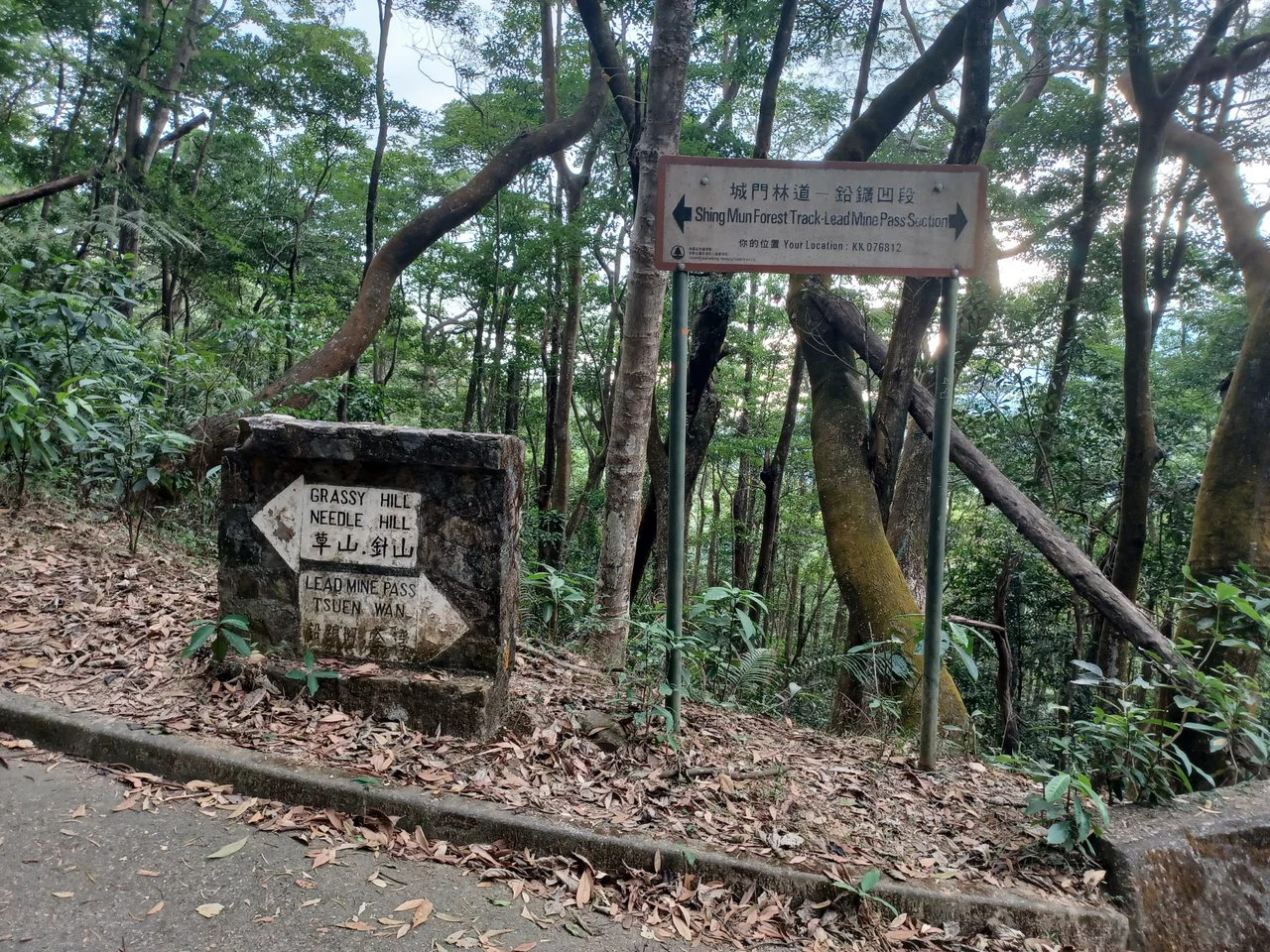

Lead Mine Pass
The pass gets its name from the wrong metal. Lead was found here, along with zinc and copper, but the mineral that brought serious money and serious men to this saddle between the Shing Mun hills was tungsten — a dense, high-melting-point ore critical for industrial and military manufacturing. Tungsten ore was discovered at Lead Mine Pass during the construction of Shing Mun Reservoir in the late 1930s, and mining began in 1938. What followed was nearly three decades of extraction, interrupted by war, shaped by geopolitics, and finally abandoned in 1967 when the tunnels went dark and the equipment was left where it stood. Today two of Hong Kong's major hiking trails intersect at this pass, and the people who walk through rarely know they are crossing an industrial site.
The War that Made Tungsten Valuable
Tungsten's importance in the mid-twentieth century was partly a product of war. The metal is alloyed with steel to produce tungsten carbide — extraordinarily hard, heat-resistant, used in cutting tools, armor-piercing ammunition, and high-temperature applications. When the Korean War broke out in 1950, demand for tungsten spiked and prices climbed steeply. The effect at Lead Mine Pass was immediate: unlicensed miners arrived alongside licensed operations, digging into the hillside to extract ore at a pace that outstripped formal oversight. It was a small-scale version of a dynamic playing out across Asia and beyond — a mountain pass in the New Territories drawn, through the price of a metal, into the logic of a war being fought on the Korean Peninsula. The boom conditions that followed the war's outbreak drew workers who had not previously been in the mining business and who were not operating within the regulatory structures that governed licensed extraction.
Into the Tunnels
Mining at Lead Mine Pass continued until 1967, when operations ceased and the facilities were abandoned. The tunnels dug into the hillside still exist. Hikers who make it to the pass can find their entrances — dark openings in the rock, receding into the mountain. The structures inside have not been maintained and are considered dangerous to enter. Collapses are possible; the shoring timbers are old; no one monitors them. They are present but inaccessible, a physical record of an industrial chapter that ended half a century ago without ceremony. The ore extracted was taken down to the valley for processing and eventual sale; the infrastructure that supported that movement — the paths, the small facilities, the equipment — is gone or overgrown, leaving the tunnels as the most legible remains of what happened here.
Where the Trails Cross
Lead Mine Pass sits north of Shing Mun Reservoir, near the top of a ridge that divides Tai Po District from Tsuen Wan District. Two of Hong Kong's major long-distance hiking routes cross here: the MacLehose Trail, which runs 100 kilometers east to west across the New Territories, uses the pass on Stages 7 and 8; the Wilson Trail, which runs north to south for 78 kilometers, passes through on Stage 7. For hikers doing extended sections of either trail, Lead Mine Pass is an unavoidable waypoint — a place where you stop, check your map, perhaps eat something, and then continue in a different direction. Grassy Hill rises nearby. The saddle itself is not dramatic; it is a functional gap in a ridge, exactly what a mountain pass is supposed to be, useful rather than scenic.
A Trail and a Campsite
Beyond the hiking trails that cross it, Lead Mine Pass has a designated campsite, making it a rest point for multi-day walkers moving through Shing Mun Country Park and the surrounding area. The park protects the ridgelines and secondary forest that have regrown since the hillside was last heavily worked. Trees that were cut for charcoal and construction in the nineteenth and early twentieth centuries have grown back; the green cover is dense enough that the mining history is not obvious from any distance. You have to be at the pass, looking for the tunnel entrances, to find them. The landscape presents itself as simply a forested mountain, which it is — and also, buried inside it, an industrial remnant that the jungle has not quite swallowed.
What the Name Holds
The name 'Lead Mine Pass' is technically a misnomer — the tungsten was the point, and the lead was secondary. But names stick for reasons that have less to do with accuracy than with how they land, and 'Lead Mine Pass' has a weight to it that 'Tungsten Pass' would not. It sounds like somewhere. It sounds like somewhere things were found and taken, which is precisely what happened. Hong Kong's New Territories hold many such sites: places where industry came and went within a few decades, leaving behind a name and some holes in a hill, while the trails that walkers use today were sometimes the same paths that men and ore carts once used to move raw material out of a mountain. The pass is a crossing point. It has been one for a long time.
From the Air
Lead Mine Pass is located at approximately 22.413°N, 114.158°E in the hills of the central New Territories, on the boundary between Tai Po District and Tsuen Wan District, north of Shing Mun Reservoir. From 3,000–5,000 feet, the pass is visible as a saddle in the ridgeline separating the Shing Mun valley to the south from the Tai Po River watershed to the north. The terrain is forested and rugged. Hong Kong International Airport (VHHH) is approximately 30 km to the southwest on Lantau Island. Kowloon lies to the south, visible on clear days. The area is within Shing Mun Country Park; low-altitude overflights should account for the hilly terrain and restricted airspace near Kai Tak (now VHHX) to the southeast.
Nearby Stories
- Chapel of St. Francis Xavier 3.5 km away
- Cuiheng 4.1 km away
- 2015 Shenzhen Landslide 16 km away
- Shunde 31 km away
- Wanshan Archipelago 37 km away
- Nanxiong Formation 96 km away
- Heyuan 149 km away
- Checheng Fu'an Temple 629 km away