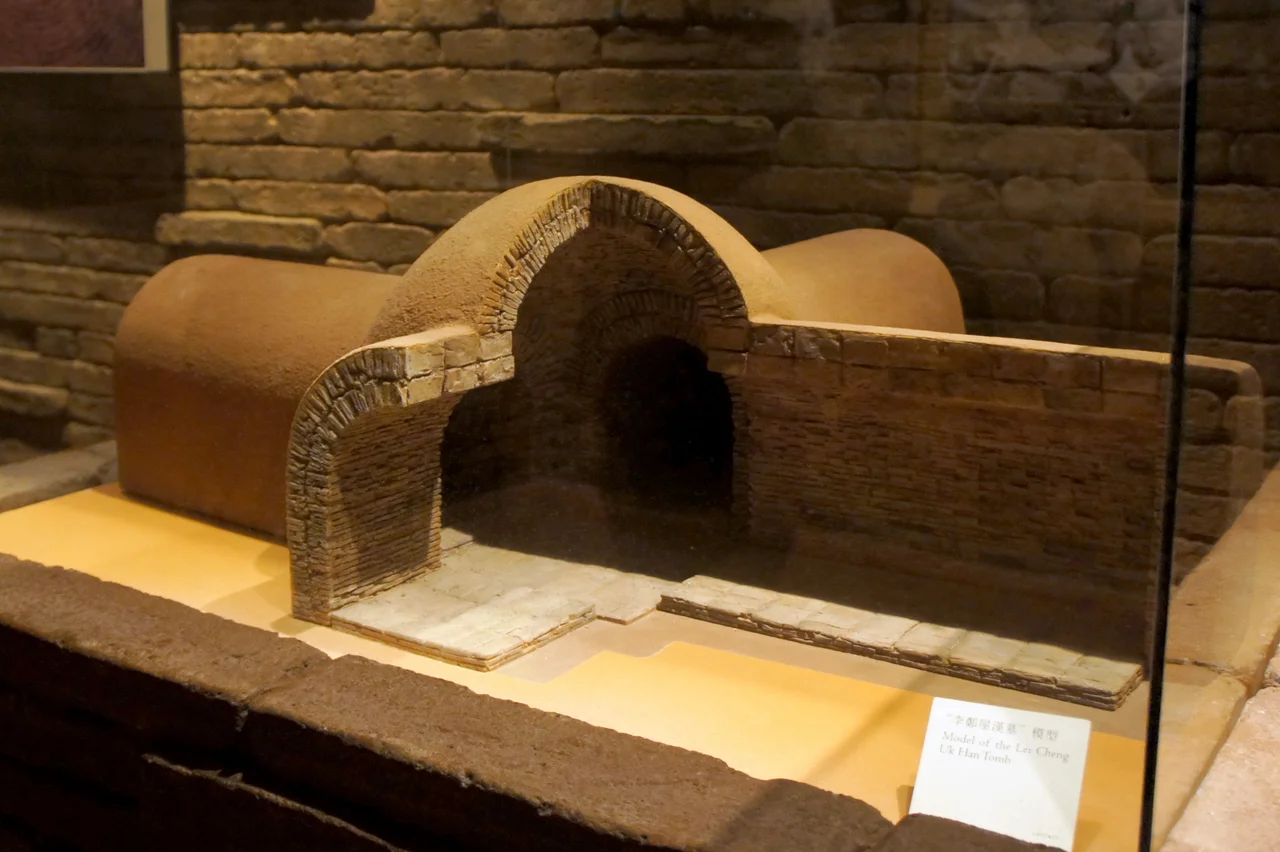

Lei Cheng Uk Han Tomb Museum
Beneath a crowded Kowloon housing estate, under layers of concrete, waterproofing, topsoil, and turf, a tomb has been waiting since the Eastern Han dynasty. It was built sometime between 25 and 220 AD — most likely for a Chinese military officer stationed at a local garrison — and it sat undisturbed for nearly two millennia before construction workers stumbled upon it in 1955. The finding upended what anyone thought they knew about early settlement in Hong Kong. A Han dynasty presence this far south, this well-preserved, this specific: it changed the story entirely.
The Discovery That Rewrote Hong Kong's Ancient History
When construction workers broke ground at Lei Cheng Uk village in Cheung Sha Wan in 1955, they weren't looking for history. They were building public housing. What they found instead was a cruciform brick tomb — four barrel-vaulted chambers arranged in a cross, their walls laid with inscribed bricks that archaeologists could use like calendar pages to date the structure. The tomb is the only Han dynasty brick tomb ever unearthed in Hong Kong, and its significance goes well beyond the rarity. Before it was found, little physical evidence existed to document how early Han people had moved into this part of southern China. The tomb, and the 58 artifacts inside it, proved they had been here — settled, organized, and burying their dead with ceremony — nearly two thousand years ago.
Fifty-Eight Objects, and What They Tell Us
No human skeletal remains were found inside the tomb. What the excavation did recover was a carefully chosen set of objects: 50 pottery pieces and 8 bronze items. Among the pottery were cooking utensils, food containers, storage jars, and miniature models — a house, a granary, a well, a stove — the kinds of objects meant to provision the dead for whatever came next. The bronze items included bowls, basins, mirrors, and bells. The exhibition hall beside the tomb organizes these finds thematically, opening with the old Chinese adage that grounds the entire collection: 'Food is the first necessity of the people.' Nearly everything in the tomb was about sustenance. That the ancient officer was given models of a granary and a stove, as much as bronze mirrors, says something about what the living valued, and what they hoped the dead would carry forward.
Sealed, Preserved, Seen Only Through Glass
Visitors have not been permitted inside the tomb since the mid-1980s. Conservation concerns made physical access untenable, and today the tomb is sealed in a temperature- and humidity-controlled environment, visible only through a glass panel at the entrance passage. A canopy was added during a 2005 renovation after rainwater leakage threatened the structure. 3D laser scanning technology has since captured precise digital records of its interior, and a full-scale replica of the tomb's inside is on display at the Hong Kong Museum of History across town. The museum beside the original tomb — a branch of that same institution — uses 3D digital animation to walk visitors through the chambers they can no longer enter. Hong Kong declared the tomb a gazetted monument in November 1988, protecting it permanently under the Antiquities and Monuments Ordinance.
Where the Sea Used to Be
One detail about the tomb's location shifts everything into perspective. When the officer was buried here in the Eastern Han dynasty, the site overlooked the sea. Today it sits almost 2,000 meters from the waterline — the result of decades of land reclamation that has pushed Hong Kong's shoreline steadily outward. The Han Garden, completed next door in December 1993, was designed in the architectural style of the dynasty and includes pavilions, terraces, towers, fishponds, and rock sculptures. It is an odd and affecting thing to stand in a Han dynasty garden in the middle of one of the world's densest urban landscapes and realize that the tomb beneath you is the oldest physical argument for why any of this settlement happened in the first place.
From the Air
The Lei Cheng Uk Han Tomb Museum sits at approximately 22.338°N, 114.160°E in the Cheung Sha Wan district of northwest Kowloon, about 7 km northeast of Hong Kong International Airport (VHHH). Approaching from the west at 2,000–3,000 feet, the dense high-rise texture of Sham Shui Po District is visible below, with the museum tucked along Tonkin Street. The Kowloon Peninsula's grid of residential towers extends south toward Victoria Harbour. Best viewed on a clear day; haze is common in the Pearl River Delta region.
Nearby Stories
- Chapel of St. Francis Xavier 3.5 km away
- Cuiheng 4.1 km away
- 2015 Shenzhen Landslide 16 km away
- Shunde 31 km away
- Wanshan Archipelago 37 km away
- Nanxiong Formation 96 km away
- Heyuan 149 km away
- Checheng Fu'an Temple 629 km away