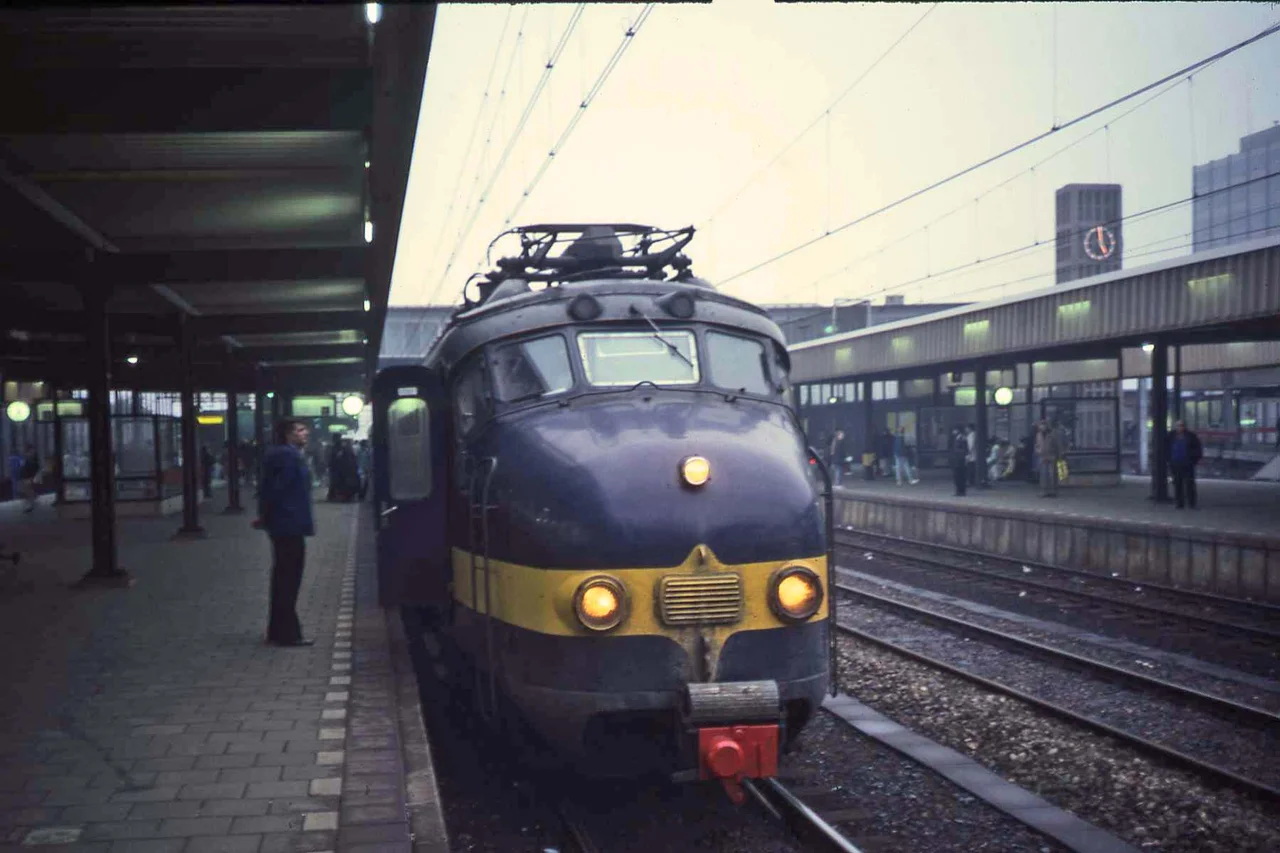

Leiden Centraal railway station
In 1910, on a platform just north of the Leiden canal, Sigmund Freud stepped off one train and Gustav Mahler stepped off another. The two men, the composer of the unfinished Tenth Symphony and the inventor of psychoanalysis, walked together for hours through the streets of Leiden, talking about Mahler's marriage. It was the only time they would ever meet. A few years later, the Leiden physicist Paul Ehrenfest started using the same station as a personal collection point, picking up Albert Einstein, Niels Bohr, and eventually a young J. Robert Oppenheimer from the platforms whenever they came to argue physics with him in town.
Four Stations, One Address
What stands at Leiden Centraal today is the fourth building on this site. The first opened on 17 August 1842, a makeshift structure on the east side of the railway bridge built quickly because the line from Haarlem wasn't ready. A proper terminus, a modest single-storey building, followed in 1843, and at the time it stood in the neighbouring village of Oegstgeest rather than Leiden itself. The second station, finished in 1879, was a far grander affair: a triumphal-arch central window flanked by double columns, modelled on Berlin's Lehrter Bahnhof. It served not just the Old Line between Amsterdam and Rotterdam but a new connection east to Utrecht, run by a rival company, making Leiden a "shared station" by treaty. Critics eventually turned against its eclectic style, and ground-level rail crossings caused traffic chaos in the busy university town. On 11 December 1944 an RAF raid, aimed at nearby V-2 rocket launch sites, damaged the central arch window. It was rebuilt after the war in a simpler, sadder form.
Schelling's Austere Box
The third station, opened in August 1953, solved the level-crossing problem by lifting the tracks onto an elevated viaduct. Its architect, who had designed Amsterdam's Muiderpoort station, gave Leiden a sober post-war building that locals immediately disliked. They felt its plain lines did not match the dignity of a university town that had been printing books before most of Europe had stopped burning them. The complaint also turned out to be practical. The new building was almost as small as the one it replaced, and as Leiden's role as a regional hub expanded, especially after 1976 connections to Den Haag Centraal and the 1981 Schiphol line, the platforms became unbearably crowded. The decision to demolish and rebuild was made in the early 1990s.
The White Lattice
The fourth station opened on 4 May 1996. NS architect Harry Reijnders designed a white lattice structure with a curved, shell-like entrance, fronting a ticketing hall lined with shops and cafes. The structure followed the Rail 21 plan, which allowed high-speed trains to pass straight through the middle of the station at 160 kilometres per hour without stopping. Two terminal tracks serve trains turning toward Utrecht. Two island platforms handle the heavy north-south traffic. The original floor was a striking blue and white, but passengers kept slipping on it and standard tile took over. On 22 May 1997 the name officially changed from Leiden Station to Leiden Centraal, an acknowledgement that the place had become the country's fifth-busiest stop. By 2019 it was sixth busiest, with 82,689 daily passengers.
A Station for Scholars
Roughly 35,000 students who study at Leiden University, the country's oldest, do not live in Leiden. They commute. Every morning the platforms fill with bikes, laptops, and coffee cups. The trains scatter them: Intercity services to The Hague, Schiphol, Amsterdam, Rotterdam, Eindhoven, Arnhem, Nijmegen, even down to Vlissingen on the Zeeland coast. Sprinters run east through Alphen aan den Rijn to Utrecht and beyond. On a weekday two trains an hour leave for almost every major Dutch city, and a single night train threads Rotterdam, The Hague, Amsterdam, and Utrecht together while the rest of the country sleeps. The station also feeds the Leiden University Medical Center directly out its rear exit. When ticket barriers were installed in 2007 for the new OV-chipkaart smart card, that exit briefly became contested ground; locals had walked through the station as a public shortcut for generations. By 2017 the barriers were closed for good.
The Famous and the Forgotten
The 1944 RAF raid hints at something the bright new building is careful not to dwell on. Trains carried Dutch Jews from stations like this one to camps from which they did not return. Leiden's prewar Jewish community was decimated. The station after the war was, like so much Dutch infrastructure, both rebuilt and reckoned with quietly. Today the canopies shelter touring violinists from the conservatory, biology students hauling lab notebooks back from Utrecht, and the occasional incoming Nobel laureate, summoned, as Einstein once was, by Leiden's physicists. On the night of 28 November 2011, a Sprinter rear-ended another Sprinter standing on the line. Three passengers were injured, none seriously. The station kept running. It always does.
From the Air
Located at 52.1664 degrees north, 4.4822 degrees east in central Leiden, just north of the historic university quarter and the canal ring. Recommended viewing altitude 1500 to 2500 feet for the city; the elevated rail viaduct cuts a clear east-west line across the urban grid. The Pieterskerk and the canal-girdled old town lie south; the Leiden University Medical Center sits directly behind the station. Nearest airports: Rotterdam The Hague Airport (EHRD) about 17 nautical miles south, and Amsterdam Schiphol (EHAM) about 14 nautical miles northeast. Schiphol-bound Intercity trains pass through Leiden at 160 km/h; pilots looking down will see the high-speed tracks bisect the station building itself.
Nearby Stories
- Woerden Train Disaster 2.5 km away
- Ransdorp 5 km away
- Barendrecht 9.6 km away
- 1973 Dutch Grand Prix 10 km away
- Dussen Castle 14 km away
- Moermond Castle 15 km away
- HMS Cressy 20 km away
- Hollandse Kust West Offshore Wind Farm 34 km away