
Leighton House Museum
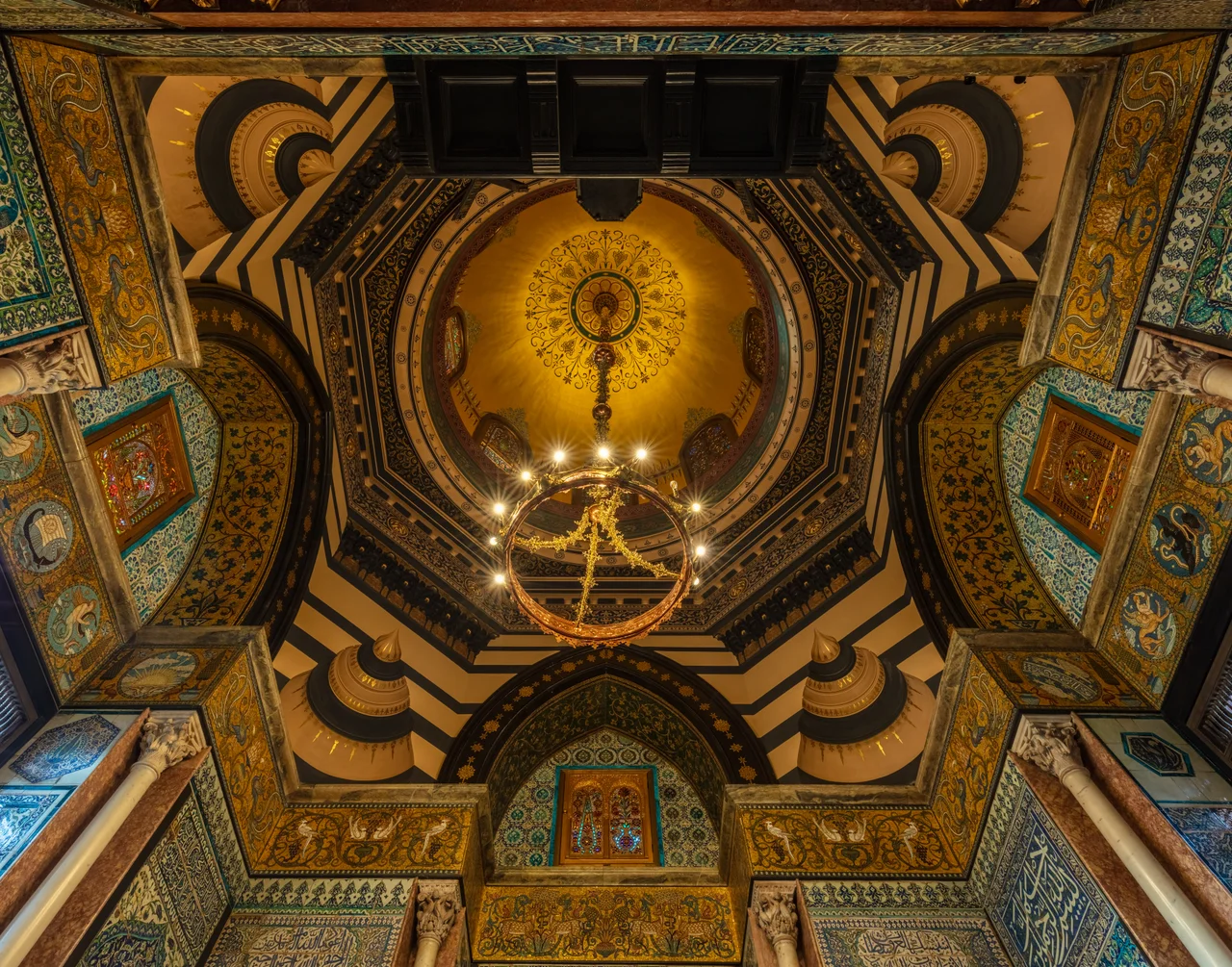
Behind a sober red-brick facade on a quiet Holland Park street, a peacock-blue dome glints above pierced wooden screens, a marble fountain trickles in a tiled courtyard, and seventeenth-century Syrian tilework climbs the walls above sixteenth-century Iznik ware from Ottoman Turkey. This is the Arab Hall of Leighton House, and it is not a museum recreation. It is the private home a Victorian painter built for himself, room by room, over thirty years, until his death in 1896.
A House for One Man
Frederic Leighton was, by the 1860s, on his way to becoming the most successful painter in Britain - eventually President of the Royal Academy, eventually the first painter ever made a peer. In 1864 he commissioned the architect George Aitchison to design him a house in Holland Park that would serve as both home and studio. The first phase, only three windows wide in restrained classical brick with Caen stone dressings, cost 4,500 pounds and was ready by the end of 1866. There was a single bedroom. Leighton never married, kept no resident family, and treated the place as a workshop with sleeping quarters attached. The whole architectural project of the next three decades would essentially be the slow accretion of more space for art.
The Studio Upstairs
The heart of the original house was the first-floor studio, oriented north and originally measuring forty-five by twenty-five feet, with a great central window engineered to deliver consistent painting light. A small gallery sat at one end for displaying work in progress. A separate staircase ran up beside it so that artists' models could come and go without crossing the household. This is where Leighton produced his enormous classical canvases - Hercules wrestling Death for the body of Alcestes, Clytemnestra watching for the beacons, the famous Flaming June. In 2016 Flaming June returned for an exhibition, hung in the very room where Leighton had painted it more than a century before.
Building the Arab Hall
In 1877 to 1879 Aitchison added what would become Leighton's most extraordinary statement. The two-storey Arab Hall was built specifically to house the tiles, lattices, and inlaid panels Leighton and friends had been collecting on travels through the Middle East. The design drew on La Zisa, the twelfth-century Norman-Arab palace in Palermo. Seventeenth-century Damascene tiles climbed the walls. Carved wooden mashrabiya screens from the same period filtered the light. Large sixteenth-century Iznik tiles glowed beside fourteenth-century pieces set into an alcove. A small marble fountain ran in the floor. The room is breathtaking - and it carries with it the complications of its era. Leighton acquired these works during the heyday of European Orientalism, when objects flowed from the Ottoman Empire and beyond into private European hands under terms that today would be examined far more carefully than they were then.
Victorian Craftsmen at Work
What Leighton commissioned around the imported pieces is just as ambitious. The capitals of the smaller columns were carved by Sir Joseph Boehm from Aitchison's designs. The capitals of the great columns - gilded and shaped like birds - are by Randolph Caldecott. The mosaic frieze that runs above the tilework was designed by Walter Crane, the Arts and Crafts illustrator and socialist. The marble work was by George P. White. The tiles in the passage leading to the Arab Hall came from the kilns of William De Morgan, the great ceramicist who supplied so many Aesthetic Movement interiors. The room is a meeting place between two craft worlds - one Ottoman, one Victorian - and both spoke the same language of pattern and luminous surface.
After Leighton
Leighton died in 1896 and the contents of the house were sold, including at least a thousand of his own drawings - most of them rescued by the Fine Art Society. The building itself opened to the public in stages. In 1929 a memorial wing designed by Halsey Ricardo was added, paid for by Mrs Henry Perrin in memory of her daughter Muriel, an artist who had trained at the Royal College of Art and worked for the catalogue section of Airco - the Aircraft Manufacturing Company - during the First World War. In 2012 the museum won the Europa Nostra Award. A major eight-million-pound refurbishment in 2022 added a new wing, café, learning centre, and a new spiral staircase whose ceiling carries Shahrzad Ghaffari's circular mural Oneness. Inside, alongside Leighton's own work, hang paintings by Millais, Burne-Jones, and George Frederic Watts - the Pre-Raphaelite world Leighton knew and influenced. The pseudo-Islamic court has played itself in the films Brazil and Nicholas Nickleby, and silently behind The Stranglers' Golden Brown video. After all the visitors have left, it is still the strange dream of one man, frozen in tile.
From the Air
Coordinates 51.4986 N, 0.2031 W in Holland Park, west London, between Kensington High Street and Holland Road. From altitude look for the green of Holland Park to the immediate north and the wider sweep of Hyde Park and Kensington Gardens to the east. Nearest airport London Heathrow (EGLL) about 11 nm west; London City (EGLC) about 11 nm east. Clear days reveal the Albert Memorial and Royal Albert Hall a short distance east-northeast.
Nearby Stories
- Battle of Britain, Northfleet 1.1 km away
- Bayham Old Abbey 5.4 km away
- Catharine Macaulay 6.4 km away
- Hatfield rail crash 8.8 km away
- Chequers 8.9 km away
- Chelmsford Cathedral 10 km away
- Queen Victoria Hospital 13 km away
- Fishbourne Roman Palace 36 km away