
Lewisham rail crash
It was Wednesday, 4 December 1957, just after six in the evening. The fog over south-east London was so thick that even the signals were barely visible from the cab of a moving train. The 5:18 service from Charing Cross to Hayes, ten carriages crammed with almost 1,500 office workers on their way home, had stopped at a red signal at Parks Bridge Junction in St Johns, directly under a heavy railway bridge that carried the line out toward the Nunhead loop. The signalman wanted to confirm the driver's identity by telephone. The train sat. Behind it, hidden in the fog, the Charing Cross to Ramsgate express, hauled by the Battle of Britain class locomotive No. 34066 Spitfire, was approaching at about thirty miles an hour. Its driver had passed two caution signals without slowing. The fireman saw the danger signal in the murk and called out. The brakes went on too late.
Two Minutes That Lasted Fifty Years
The Ramsgate train struck the back of the Hayes train at 6:20 p.m. The eighth coach of the Hayes service was telescoped by the ninth and destroyed. The tender and leading carriage of the Ramsgate train derailed and slammed into a pier of the overhead bridge. The bridge collapsed, dropping its girders onto the two carriages below. Two minutes after the impact, a third train approached on the bridge and stopped just short of the gap, its leading coach tilted into space but holding. The death toll was 90. Another 173 were injured, of whom 109 were admitted to hospital. To this day the Lewisham crash remains the third-worst railway accident in British history, behind only Harrow & Wealdstone in 1952 and Quintinshill in 1915.
The People on the Trains
The names of the dead at Lewisham have never become as familiar as those of larger disasters, but they were ordinary commuters. Office workers heading home to Bromley and Beckenham. Shop clerks who had stayed an hour late to catch the bus to a Christmas show. Schoolchildren who had been to a matinee. Wives meeting husbands at suburban stations. Henry Chadwick, a man living near the railway line, ran out of his house when he heard the impact and spent hours helping pull survivors from the wreckage of telescoped carriages. He later sued British Railways for the psychiatric injury he suffered that night, a case that became a 30-year legal precedent for compensating bystanders in disasters. The Salvation Army, the Women's Voluntary Service, and St John Ambulance arrived alongside the fire brigade and the police. By 10:30 p.m., every injured person had been moved to hospital. Some had survived to retell the story for sixty years afterward; others died within hours.
The Driver and the Inquest
The driver of the Ramsgate train, William Trew, was charged with manslaughter. He had passed two caution signals without slowing, and applied the brakes only after his fireman saw the danger signal and called out. The cab of the Battle of Britain class was known for poor sightlines; the Ministry of Transport report would later recommend wider windscreens. The coroner's jury declared the deaths due to gross negligence, but the coroner rejected the verdict and substituted accidental death. Trew was tried for manslaughter twice. The first jury could not agree. The second acquitted him. There was no clean villain to put at the centre of the story. The Ministry of Transport report, published in 1958, concluded that an Automatic Warning System would have prevented the collision. Installation of AWS had been agreed after Harrow & Wealdstone five years earlier, but priority had gone to main-line semaphore routes. Lewisham was working on coloured-light signalling, and the system had not yet reached it.
The Bridge That Never Came Back
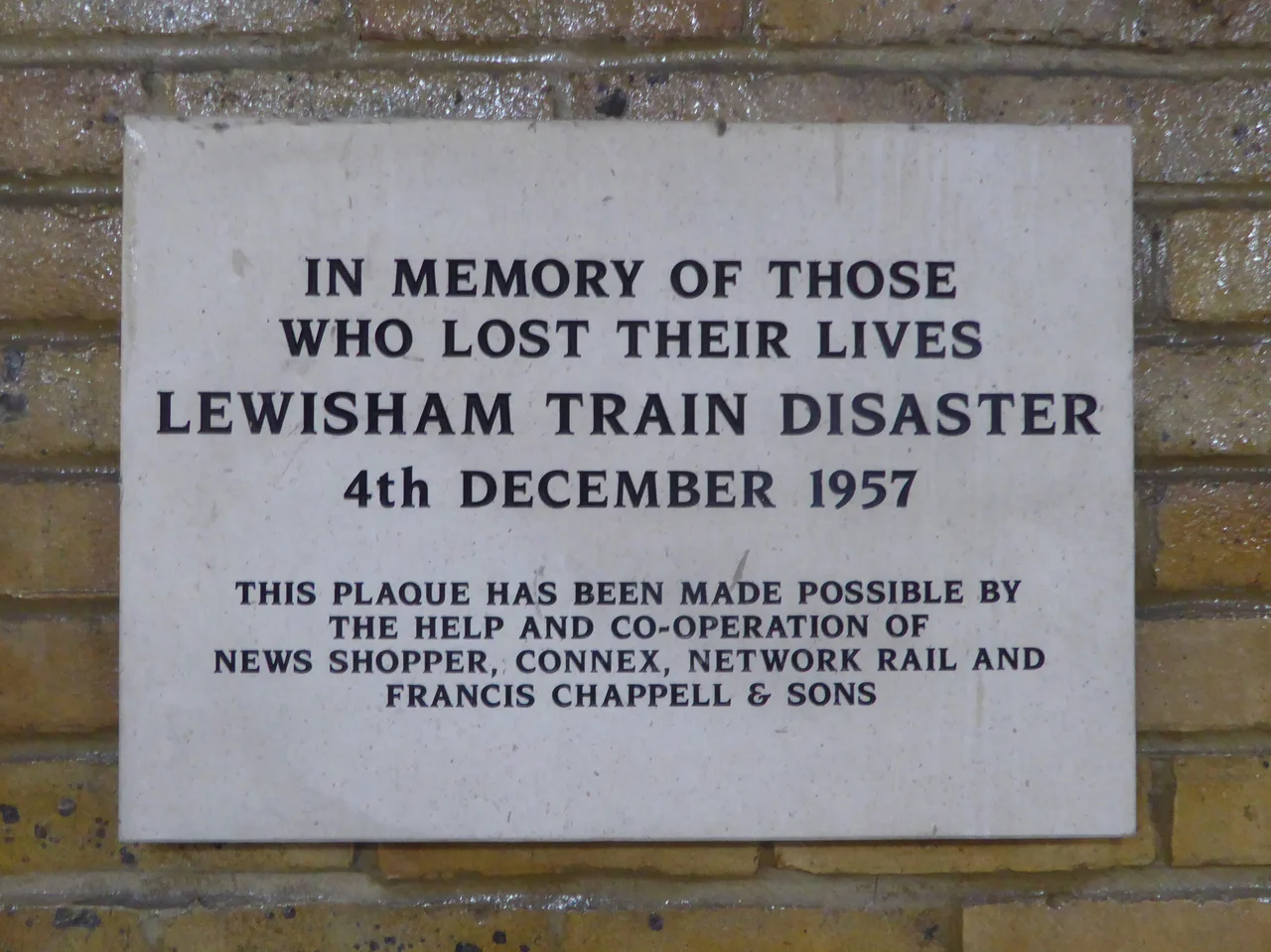
All four tracks under the bridge and the two over it were blocked. The wreckage took six days to clear. The track was relaid; the lines under the bridge reopened at 5:00 a.m. on 12 December. The bridge itself was a different problem. It was replaced by a temporary military trestle structure, the kind built in wartime to span a destroyed crossing, and that trestle is still there. Sixty-eight years later, trains continue to run across it daily. There is a plaque at Lewisham railway station, set in the wall near the main entrance, listing the date and the loss of life. Most commuters pass it without noticing. The St Johns local history group has done research into the names of every passenger who died, but the official memorial does not list them, and the city has never built a larger one.
Legacy in the Fog
The crash hastened the rollout of Automatic Warning System across British Rail in the 1960s and 1970s. Fog-related collisions, which had been a regular feature of the British railway from its earliest decades, declined steeply once the new system warned drivers of cautions and danger signals by audible tone in the cab. By the time the older steam locomotives were retired in the late 1960s, Lewisham-style accidents had become almost unthinkable. The third train on the bridge that night, the one that braked just in time, was carrying its own load of nearly a thousand commuters. If it had not stopped, the casualty figure would have been almost twice as high. South London still runs through this junction every minute of every weekday, and the fog still rolls in over the Ravensbourne river some winter evenings. The trains slow now. The Lewisham dead bought that slowness, in 1957.
From the Air
51.4678 N, 0.0196 W at the St Johns junction in the London Borough of Lewisham, southeast of the Thames between Greenwich and Catford. The temporary military trestle bridge and the railway crossings are still visible, in dense suburban rail infrastructure. Nearest airport: London City (EGLC) 4 nm north.
Nearby Stories
- Battle of Britain, Northfleet 1.1 km away
- Bayham Old Abbey 5.4 km away
- Catharine Macaulay 6.4 km away
- Hatfield rail crash 8.8 km away
- Chequers 8.9 km away
- Chelmsford Cathedral 10 km away
- Queen Victoria Hospital 13 km away
- Fishbourne Roman Palace 36 km away