
Library of Birmingham
A sixteen-year-old girl stood at the entrance on 3 September 2013 and told the crowd that one book, one pen, one teacher could change the world. Malala Yousafzai had every reason to know. The Taliban had shot her in the head at close range for the crime of going to school, and she now lived a short drive from this site in Centenary Square. The £188.8 million building she opened that morning would become the largest public cultural space in Europe, the largest regional library on the continent, and within a year, the tenth most popular visitor attraction in the United Kingdom. Birmingham had built it as a statement about what cities owe their citizens.
A Building Sheathed in Light
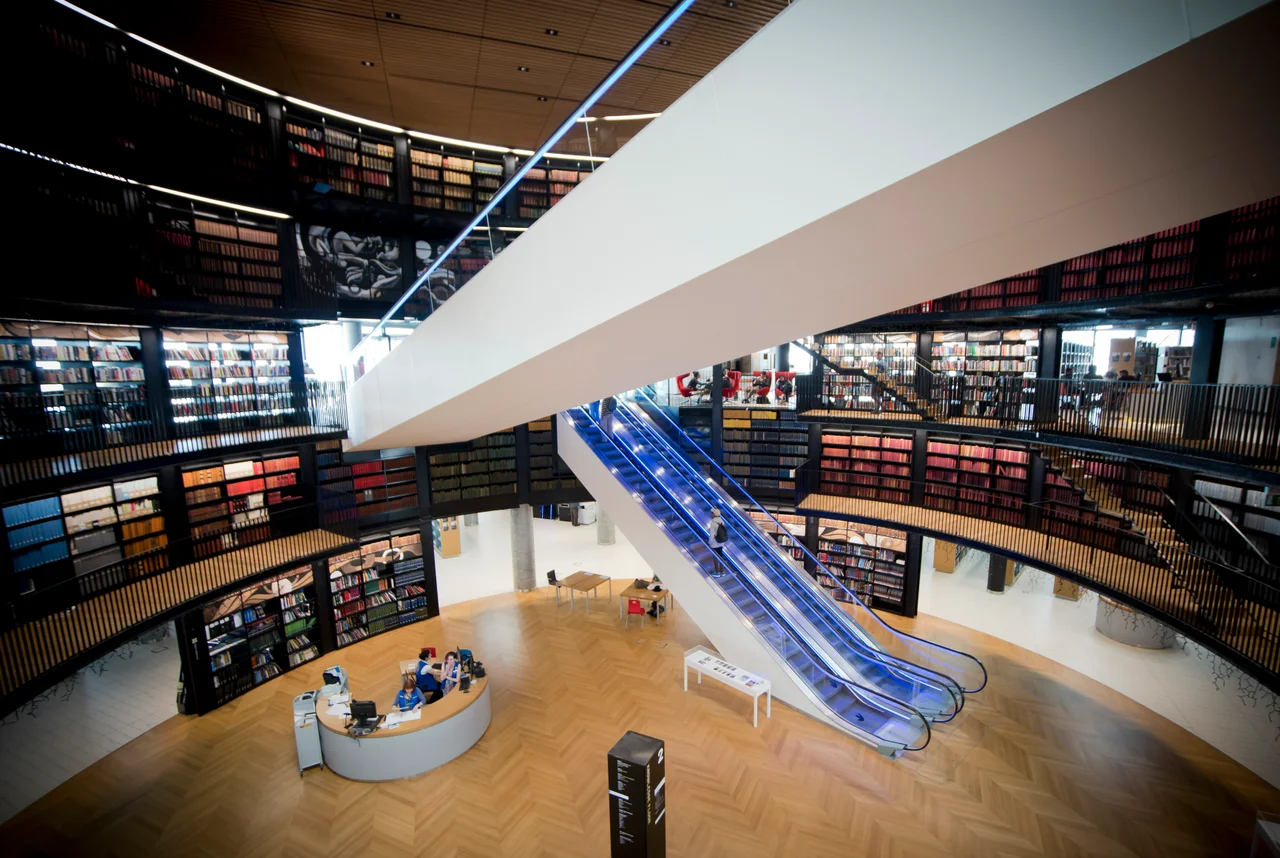
The Dutch firm Mecanoo won the international design competition in August 2008, beating Foster and Partners, OMA, and five other practices selected from more than a hundred entrants. The result is impossible to mistake for any other library. A facade of interlocking aluminium rings, layered like industrial lacework, wraps a tower whose tiers cantilever outward as it rises. Inside, a book rotunda spirals upward through galleries that frame a vertical view from ground floor to skyline. The roof opens onto a discovery terrace and a Secret Garden, with views across the West Midlands. John Madin, who had designed the Brutalist Central Library this building replaced, criticised the new one before it opened, complaining that eighty per cent of its interior lacked natural light. Visitors disagreed. In its first year, 2.7 million of them came through the doors.
The Shakespeare Room That Travelled
On the seventh floor, behind glass, sits a small wood-panelled room from 1882. John Henry Chamberlain designed the Shakespeare Memorial Room for Birmingham's first Central Library, all carved oak and Renaissance Revival detail. When that building came down in 1974, the room was dismantled piece by piece and stored. It was rebuilt inside the concrete bones of the next Central Library, then dismantled again when that one was demolished in 2016. Three buildings, one room. Birmingham keeps its promise to Shakespeare. The collection it guards is one of the most significant in the world, alongside the Boulton and Watt archives, which document the steam engines that made the city's fortune, and a children's book collection that runs to many thousands of volumes.
The Reckoning That Followed
Within sixteen months of opening, Birmingham City Council announced it could no longer afford to run the library it had just built. Opening hours were cut from 73 a week to 40. Roughly half the 188-person staff lost their jobs. Visitor numbers dropped to 1.8 million in 2015, still good enough to make this the most popular attraction outside London. Some hours were later restored when the Brasshouse Language Centre moved in and helped share the costs. The library that was meant to redefine civic ambition became, almost overnight, a parable about what happens when public buildings outlast the budgets that built them. The books are still there. So are the people who come for them.
Cold Water and Quiet Engineering
Underneath the building, a more modest miracle. Cold groundwater is pumped up from the aquifer beneath Centenary Square, run through the air-conditioning system, then returned to the earth through a second well. No refrigerants. No towers belching steam. The library cools itself by borrowing heat from the rock below, and the rock barely notices. Sustainable engineering at this scale was rare in 2013 and remains uncommon today. The library is also a quiet rebuke to the idea that civic landmarks must be wasteful. The same building that holds the Boulton and Watt archives, the patent papers of the men who tamed steam, runs on geothermal physics those men would have recognised.
What Centenary Square Holds Now
The library shares Centenary Square with the Birmingham Repertory Theatre, which it physically connects to and partly shares facilities with, and with Baskerville House, named for the eighteenth-century printer whose typefaces still appear on book covers everywhere. Stand in the square at dusk and the aluminium rings on the facade catch the last light, glowing copper for a few minutes before turning to silver under the sodium lamps. Then the building lights up from inside, its galleries visible from the street, books on display through glass. Birmingham gave itself this. Through austerity, controversy, and the architect's own quarrel with his successor, the building stayed open. Malala's plaque is still there at the entrance.
From the Air
Coordinates 52.4798 N, 1.9085 W. Sits in central Birmingham at Centenary Square, immediately west of the New Street rail corridor. Recommended viewing altitude 1,500 to 2,500 feet AGL for the distinctive aluminium-ring facade. The Library and adjacent Birmingham Rep form a recognisable cluster between Broad Street and the city's Brutalist core. Nearest airports: Birmingham International (EGBB) 7 nm east-southeast; Wolverhampton Halfpenny Green (EGBO) 12 nm west; Coventry (EGBE) 14 nm east. Expect industrial haze in summer, low cloud common October through March.
Nearby Stories
- Shepshed 8.5 km away
- Battle of Evesham 11 km away
- Hixon rail crash 12 km away
- Battle of Cropredy Bridge 12 km away
- Wenlock Priory 15 km away
- RAF Shawbury 16 km away
- Market Bosworth 17 km away