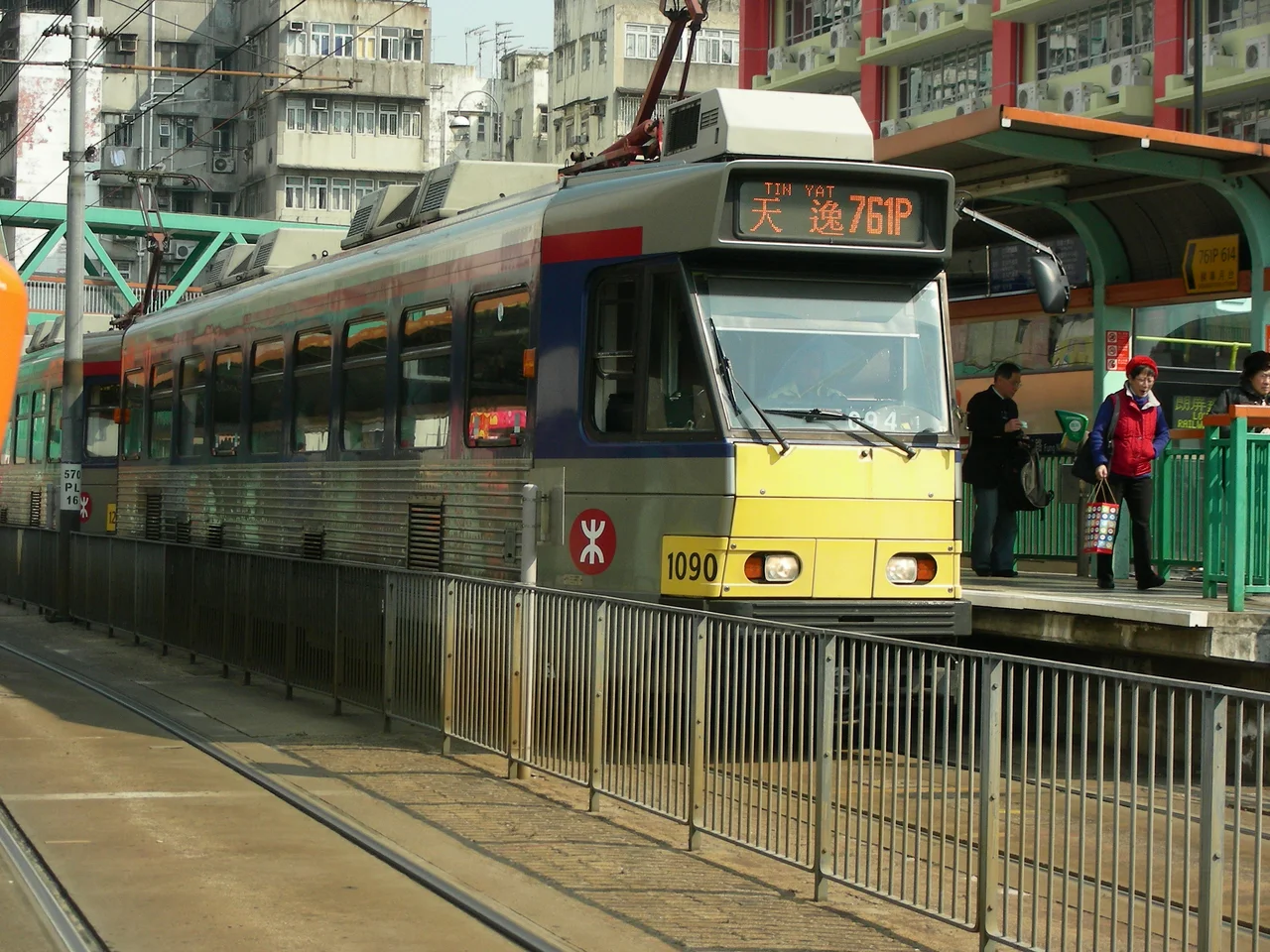

Light Rail (MTR)
Before there was a Light Rail in Hong Kong's northwestern New Territories, there was a problem: Tuen Mun was growing fast, and the government needed to move people through it. Hong Kong Tramways briefly considered running double-decker trams. The Mass Transit Railway Corporation was too deep in debt. So in 1984 the Kowloon-Canton Railway Corporation agreed to build a new kind of network, budgeted at HK$1.5 billion, unlike anything else in the territory — a street-level light rail system that would weave through the new towns of Tuen Mun and Yuen Long the way veins weave through tissue. Construction began on 14 July 1985. The first passengers rode free on 14 September 1988, between Tuen Mun and Yuen Long. Four days later, regular service began.
Built for New Towns, Run Like a Grid
When Tuen Mun was developed as a new town in the 1970s, the government set aside land for rail tracks — but not yet for a specific system. By the time the Light Rail opened, Kowloon Motor Bus had already built a profitable internal network in both Tuen Mun and Yuen Long. The government's solution was blunt: it created a 'Light Rail Service Area' covering both districts, within which the LRT monopolized all public transport services. KMB was required to withdraw its internal routes entirely. In exchange, KCRC feeder buses would connect outlying areas to the LRT network. It was a calculated bet that a single, unified system would serve more passengers more efficiently than competing routes. The bet generally paid off: today the Light Rail carries about 483,000 passengers daily. The network is coloured goldenrod on the MTR system map, a warm amber thread connecting public housing estates, town centers, and ferry piers across a landscape of reclaimed fish ponds and high-rise blocks.
The Vehicles: From Melbourne to Nanjing
The first 70 Light Rail Vehicles arrived from Australia — manufactured by Comeng at their Dandenong factory near Melbourne — and entered service in 1988. All LRVs in the system are uni-directional, 20.2 meters long, with three sliding doors on the left side. Because the vehicles cannot reverse, every terminus features a loop track. Over the decades the fleet has grown through five phases of vehicles from different manufacturers. The most recent arrivals, Phase V cars built by CRRC Nanjing Puzhen, entered service on 17 November 2020. Their commissioning ended the era of the Phase II Kawasaki Heavy Industries cars, which were retired in a formal ceremony on 26 February 2023. One of the retired Phase I cars (car 1088) found a second life at Ying Wa College and Primary School, unveiled as a STEAM classroom on 11 February 2023. In June 2024, MTR borrowed a hydrogen fuel cell-powered tram from Foshan, China for a three-month trial — part of a broader government push toward hydrogen transport — before sending it back at the end of the year.
Expanding Into Fish Ponds and New Towns
The system as it opened in 1988 was already a network of loops and branches — two large loops and three small ones serving northern Tuen Mun, plus branches to On Ting, the Tuen Mun Ferry Pier, and Yuen Long. Extensions followed demand. The biggest expansion came in December 2003, when the West Rail line (now part of the Tuen Ma line) opened and the Light Rail was redesigned around it. Stations were reconfigured so that passengers could transfer easily, with the LRT becoming a short-distance feeder for the longer heavy rail line. Tin Shui Wai, originally an area of fish ponds, grew into a residential new town in the early 1990s; an LRT spur opened there in 1993, and extensions followed in 1995 as the town kept growing. The system now operates eleven routes. Its zonal fare structure remains unique in Hong Kong — the only network in the territory to organize fares by zone rather than by individual journey.
Incidents on a Street-Level System
Running at street level through dense urban areas, the Light Rail operates with a level of exposure that elevated or underground metro systems do not share. The history of the network includes serious collisions. In September 1994, a coach carrying factory workers ran a red light and was crushed between two LRT trains near Fu Tei; the coach driver and a passenger were killed. The LRV captains were cleared of wrongdoing, and the government implemented new safety measures including video recording at junctions. In May 2013, an LRV on route 761P derailed on a tight curve south of Tin Shui Wai after traveling at 40.9 km/h — nearly three times the posted speed limit of 15 km/h. At least 77 people were injured; the captain was later convicted of negligence. Each incident prompted operational or infrastructure changes. The system continues to carry nearly half a million passengers through the northwestern New Territories every day.
From the Air
The Light Rail network spans approximately 22.38°N–22.47°N, 113.95°E–114.03°E across the Tuen Mun and Yuen Long districts of the northwestern New Territories, roughly 5–15 km north and east of Hong Kong International Airport (VHHH). From the air at 1,500–2,500 feet on approach or departure from VHHH, the distinctive surface rail lines are visible threading through the high-density residential blocks of Tuen Mun and the broader flatlands around Yuen Long and Tin Shui Wai. Castle Peak and its bay are visible to the northwest; Tolo Harbour opens to the northeast.
Nearby Stories
- Chapel of St. Francis Xavier 3.5 km away
- Cuiheng 4.1 km away
- 2015 Shenzhen Landslide 16 km away
- Shunde 31 km away
- Wanshan Archipelago 37 km away
- Nanxiong Formation 96 km away
- Heyuan 149 km away
- Checheng Fu'an Temple 629 km away