
Lismore, Scotland
The story goes that two Irish saints, Moluag and Mulhac, raced their boats across the Lynn of Lorn in the 6th century, with the right to found a monastery on the prize island going to whoever touched land first. Mulhac was winning. So Moluag, realising he was about to lose, drew a knife, cut off his own finger, and threw it ashore north of the broch of Tirefour. By the rules of the race, his flesh had touched the island. Moluag claimed Lismore. Whatever you make of the story, the saint founded a monastery on Lismore around 562 AD, became the patron saint of the island, and left behind a wooden pastoral staff - the Bachuil Mòr - that the chiefs of Clan MacLea still keep, in the same family, fifteen hundred years later.
Lios Mòr - The Great Garden
The name itself promises something. Lismore comes from the Gaelic Lios Mòr, the great garden, and the island's limestone bedrock makes it one of the most fertile patches of the Inner Hebrides. It runs about ten miles long and a mile wide across the mouth of Loch Linnhe, separating the salt water of the loch from the open Firth of Lorn. Robert Hay titled his 2009 history of the island simply Lismore: The Great Garden - the name has done its own marketing for a thousand years. The cathedral of the medieval Bishops of Argyll once stood here; in 1749 its ruins were trimmed down, given a roof, and turned into the parish church, which still does service today with the bell tower of a cathedral and the proportions of a country kirk.
Whisky Stills And Catholic Seminary
After the 1707 Acts of Union, whisky distillation got expensive. Taxes climbed, the legal trade collapsed, and the illegal trade went into the hills - including Lismore's. Two illicit stills from this period have been found on the island, the kind of small-scale operation that supplied a community of friends and trusted buyers and nobody else. Then in 1803, in a development that must have astonished the staunchly Presbyterian islanders, a Roman Catholic seminary opened at Kilcheran House in the south-west - the only Catholic seminary in the west of Scotland at the time. It stayed open until 1828. Two limekilns from the seminary's grounds still stand beside the old buildings, a quiet monument to the years when the island taught Catholic priests and the islanders themselves resolutely declined to become any.
Famous Sons And A Memorial Cross
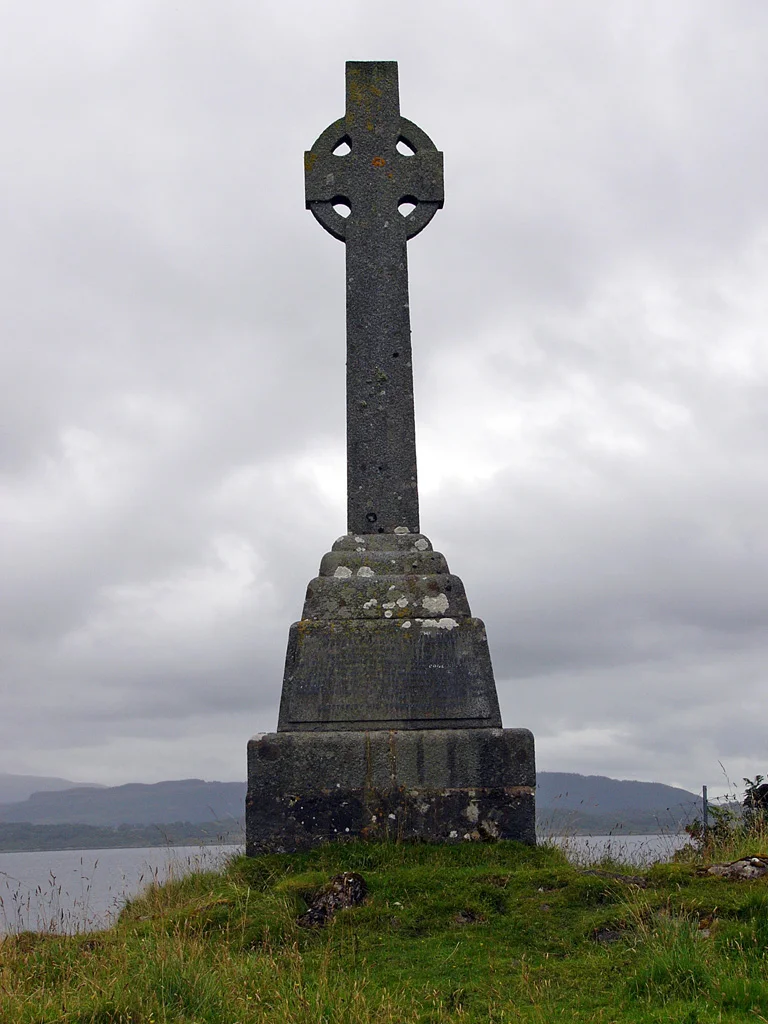
John Stuart McCaig, the Oban banker who tried to build a Scottish Colosseum on Battery Hill, was born on Lismore. So was Alexander Carmichael, the great 19th-century folklorist who collected the Carmina Gadelica - the prayers, charms, and incantations of the Gaelic-speaking Highlands and Hebrides. Overlooking Lismore Bay stands a Celtic Cross commemorating Waverley Arthur Cameron, son of Duncan Cameron, who invented the popular Waverley nib pen and owned The Oban Times. For an island whose population has stayed under two hundred for most of the last century, the export rate of significant Victorians is striking. The Clearances took the rest; in 1841 there were 1,399 people here, and by 1961 only 155.
Present Day, And A Shop Worth Saving
The 2022 count put 190 people on Lismore. They reach the mainland by two ferries: a Caledonian MacBrayne car ferry that crosses to Oban, and a smaller council passenger boat that hops to Port Appin at the north end. A single road, the B8045, runs the length of the island, and 29% of the population speak Gaelic. Until 2007 there was no piped water - islanders pulled from wells and springs - before Scottish Water connected boreholes. In 2023 the only shop, which was also the post office, was about to close because the person running it wanted to go back to teaching. The Lismore Community Trust ran a campaign and asked the island for £70,000. They got more. The shop stayed.
The Piper Who Never Came Back
Carmichael also recorded the story of the Piper's Cave. A piper entered the Uamh-Chraidh, the cave of pain, intending to come out at the Uamh-an-duine, the cave of the man. His bagpipes could be heard sounding through the rock as he walked the underground passage. The piping went on for a long time, then stopped. The dog emerged from the far cave alone, blind and stripped of its hair. The piper was assumed to have drowned in the cave's deep pools. Islanders preserved his lament: Mis air airin baidh 'us burrail / Measg nan glumag eagalaich - I was drowning and howling, amongst the horrid pools. It is the kind of story that sticks to a landscape and stays there.
From the Air
Lismore lies at 56.5167 N, 5.5 W, a long narrow limestone island in the Lynn of Lorn between the Morvern peninsula and the mainland of Argyll. It is unmistakable from cruising altitude: roughly ten miles long, one mile wide, oriented south-west to north-east, sitting in the channel between Oban and Loch Linnhe. Oban Airport (EGEO) at Connel is 4 nm east of the southern tip. Inverness (EGPE) is 70 nm north-east, Glasgow (EGPF) 70 nm south-east. The island makes an excellent navigation reference; the long bright limestone profile is visible far further than typical Hebridean islands. Ferries cross to both Oban and Port Appin, traceable as small white wakes across the loch. Highland weather is volatile - expect rapid changes when fronts arrive from the Atlantic.
Nearby Stories
- Inner Hebrides 2.1 km away
- Arrochar Alps 6.7 km away
- Glenfinnan Monument 10 km away
- Slate Islands, Scotland 12 km away
- Lochaber Narrow Gauge Railway 13 km away
- 2009 Buachaille Etive Mòr Avalanche 15 km away
- Muck 18 km away
- Colonsay 25 km away