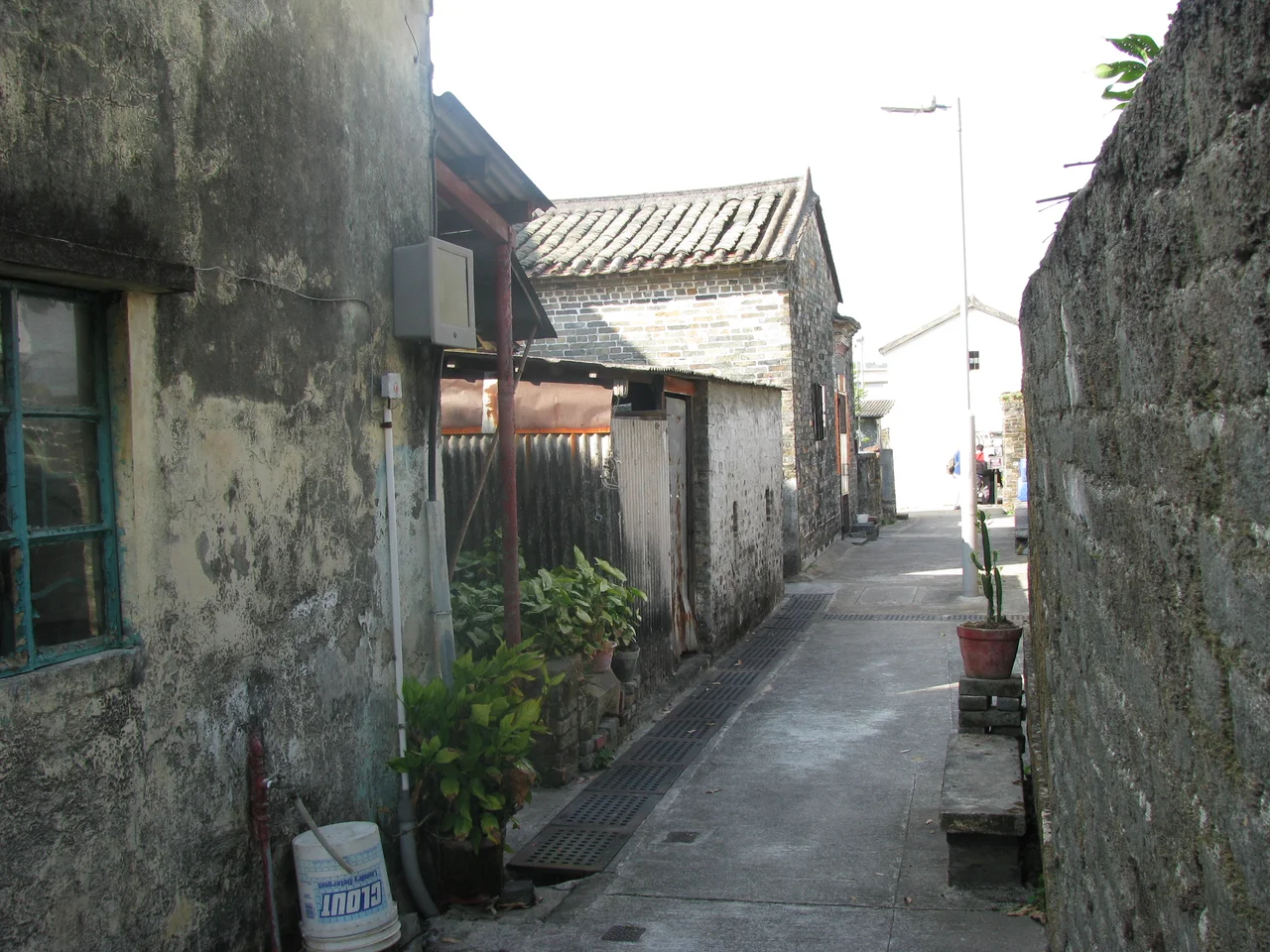

Lo Wai, Lung Yeuk Tau
The walls went up because the world outside them was dangerous. Lo Wai — the name means simply "old walled village" — sits in the Lung Yeuk Tau valley near Fanling in the northern New Territories, and it has been walled since before anyone now alive can remember. In a landscape where five walled villages and six open villages developed in close proximity, all of them Tang clan settlements, Lo Wai holds the distinction of being the oldest. Its entrance tower still stands. Its enclosing walls still stand. The Hong Kong government has declared them monuments, and the Lung Yeuk Tau Heritage Trail routes visitors past them, but the village predates heritage designation by centuries.
Five Wai and the Tang Clan
Lung Yeuk Tau — the name translates roughly as "dragon's ascending ridge" — is not a single village but a cluster of eleven settlements: five walled villages, known as the Five Wai, and six open villages, the Six Tsuen. All of them trace their founding to the Tang clan, one of the great indigenous lineages of the New Territories, who established themselves in this valley during the Song Dynasty. Lo Wai is the oldest of the five.
The walled-village form itself speaks to the conditions under which these communities developed. External walls, watchtowers, a single controlled entrance: the architecture of a community that needed to defend what it had built. In the Pearl River Delta region and across the New Territories, dozens of walled villages went up during the Ming and Qing dynasties as clans sought to protect their people and their ancestral halls from banditry and inter-clan conflict. Lo Wai's walls are the physical memory of that period.
What the Walls Enclose
Inside Lo Wai, the lanes are narrow and the houses close together, following a plan that has not changed fundamentally in centuries. A water well stands near the entrance tower, still visible to visitors. The entrance tower itself — the focal point of the village's defensive architecture — anchors the eastern face of the enclosure, relocated there from its original northern position for feng shui reasons. Beyond it, the walled perimeter runs in a rough rectangle, and within that rectangle generations of Tang clan families have lived.
The entire village is now located along the Lung Yeuk Tau Heritage Trail, a walking route that connects the notable historic sites of the valley. The trail links Lo Wai to the Tang Chung Ling Ancestral Hall, which sits between Lo Wai and the neighbouring village of Tsz Tong Tsuen. The Ancestral Hall is one of the most significant traditional Chinese buildings in Hong Kong. Together, the hall and the walled village form the core of what remains of Lung Yeuk Tau's pre-colonial history.
Declared Monument in a Living Village
The entrance tower and enclosing walls of Lo Wai were declared monuments under the Antiquities and Monuments Ordinance of Hong Kong, placing them alongside landmarks such as the Kowloon Walled City remains and the Tung Chung Fort. The designation protects the structures from alteration or demolition, and it has ensured that Lo Wai remains visually intact in a way that many of Hong Kong's other historic buildings are not.
But Lo Wai is not a museum. It is a recognized village under the New Territories Small House Policy, which means that indigenous male villagers of Tang clan descent retain certain rights to build within the village's established boundary. The village has representation in the Fanling District Rural Committee and falls within the Queen's Hill constituency for electoral purposes. People live here. The declared monument is also someone's home — or rather, the gate through which people have been walking in and out for many hundreds of years.
A Valley Stepped in Time
Standing outside Lo Wai's entrance tower, looking back at the low granite hills of the northern New Territories, it is easy to understand why this valley was chosen. The hills offer some shelter; the valley floor, though modest, provided cultivable land. The proximity of what is now Fanling — today served by the MTR East Rail line — gave the settlements connections to wider trade networks.
The Lung Yeuk Tau Heritage Trail takes perhaps two hours to walk in full, winding between the walled villages, the ancestral halls, the temples and pavilions that mark the history of the Tang clan presence here. Lo Wai is the trail's oldest stop. Its walls have absorbed six or seven centuries of weather, and the entrance tower has watched every generation of the valley pass through it. The surrounding new towns of Fanling and Sheung Shui have grown enormously since the 1970s, but this small rectangle of walls and lanes remains as it was — declared historic, still inhabited, still entered the same way.
From the Air
Lo Wai sits at 22.4978°N, 114.1519°E in the Lung Yeuk Tau valley near Fanling, in Hong Kong's North District. From the air at 2,000–4,000 feet, the walled village is visible as a tight rectangular cluster of traditional grey-tile rooftops set apart from the surrounding modern housing developments. Fanling town and the MTR East Rail line are immediately to the south. The border with Shenzhen and mainland China is approximately 4 km to the north, making this one of the northernmost settlements in Hong Kong territory. Hong Kong International Airport (VHHH) is roughly 40 km to the southwest. Low-level flight in this area requires awareness of the airspace arrangements near the Hong Kong-Shenzhen boundary; Shenzhen Bao'an International Airport (ZGSZ) is approximately 12 km to the northwest.
Nearby Stories
- Chapel of St. Francis Xavier 3.5 km away
- Cuiheng 4.1 km away
- 2015 Shenzhen Landslide 16 km away
- Shunde 31 km away
- Wanshan Archipelago 37 km away
- Nanxiong Formation 96 km away
- Heyuan 149 km away
- Checheng Fu'an Temple 629 km away