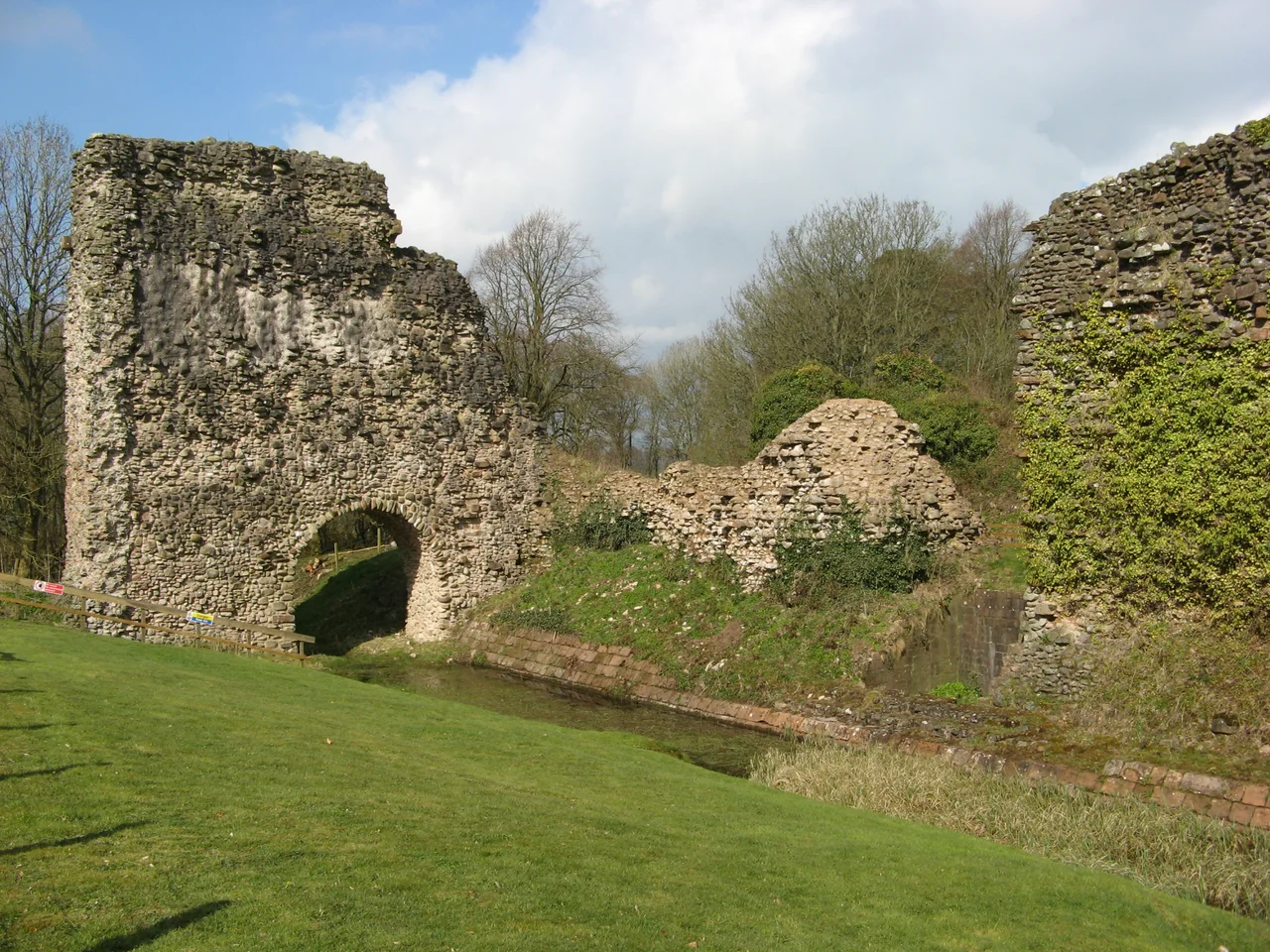

Lochmaben Castle
Castle Loch is a brown mirror in winter, dimpled by herons and the occasional vendace - a rare freshwater fish found almost nowhere else in Britain. At the south end of the loch, on a low spit of land guarded on three sides by water, a roofless rectangle of red sandstone juts out of the grass. From a distance Lochmaben Castle looks almost humble, just a few jagged walls and the trace of a moat. Walk closer and the scale rewires you. The masonry is enormous. The drawbridge pit gapes. This was Edward I of England's answer to the Bruces of Annandale, an aggressively engineered fortress that was meant to dominate a country and a clan that resisted being dominated for the better part of three centuries.
Edward's Stone Answer to the Bruces
The Bruce family came to Annandale around 1124, granted the lordship by David I, and built a wooden motte-and-bailey castle a little south of where the present ruin stands. From this small mound the Bruces grew into the family that produced Robert the Bruce. Around 1300, in the violent middle of his Scottish wars, King Edward I of England flattened the wood-and-earth version and ordered a much sturdier stone castle at the south end of Castle Loch - a fortress to hold what was, by then, conquered territory. Even in ruin the defences are massive: thick curtain walls, a wet moat fed from the loch, towers at the corners. The Bruces had built; Edward had replaced. The clan's response would take the next century. On 4 February 1384, after a nine-day siege, Archibald the Grim, Lord of Galloway - working with the Earls of March and Douglas - took the castle from its English garrison and 'razed it to the ground.'
Kings, Cards, and Drinksilver
The castle was rebuilt and returned, repeatedly, to royal hands. James IV of Scotland played cards inside its hall with Lord Dacre on 23 August 1504; a local mason named Gluffar had finished the roof of that hall earlier the same year, using local timber. Robert Lauder of The Bass was appointed Captain and Keeper on 16 January 1509, reappointed in 1512. In November 1542, James V watched from Burnswark Hill as his army burned the country south of the border, then retreated to Lochmaben for the news. The news was the battle of Solway Moss, a humiliating Scottish defeat. James left for Stirling Castle and was dead within weeks. Three years later, in the war of the Rough Wooing, Regent Arran besieged Lochmaben after Lord Maxwell allowed English garrisons into his castles; James Crawford brought artillery up from Edinburgh Castle and Arran paid the gunners 'drinksilver' - small tips in coin for a job well done. Mary, Queen of Scots and her young husband Lord Darnley came riding here in October 1565 at the close of the Chaseabout Raid, a brief and futile civil war against her own half-brother.
A Woman Walks Into the Castle
In June 1592 something stranger happened. Francis Stewart, the 5th Earl of Bothwell, was a turbulent magnate who had been in and out of trouble with James VI for years. He needed Lochmaben for an uprising. According to the chroniclers he simply dressed as a woman and walked in. The castle was held at the time by Sir John Carmichael, and Bothwell apparently took it under Carmichael's nose by passing himself off as part of the household. The crown soon clawed it back, but the story is one of those small, vivid pieces of Scottish history that refuses to fade. Four years earlier, in 1588, Lord Maxwell had held the castle in another rising against the Protestant monarchy; James VI besieged it with English help, gunpowder hauled down from Edinburgh, and when the keeper David Maxwell and five other men finally yielded, James had them hanged - despite William Stewart of Monkton's efforts to negotiate. One royal soldier was shot in the leg. Even the small numbers ache: six men who had probably grown up knowing each other, hanged together on a summer day.
A Ruin and a Hereditary Title
By the early seventeenth century the wars that had made Lochmaben essential were over. James VI of Scotland was also James I of England now, the border was a frontier no longer, and the castle slid into slow abandonment. King James allocated £1,600 sterling for repairs in 1624 - a substantial sum - but nothing seems to have been done with it. The roofless walls weathered into the romantic ruin you see today, now a scheduled monument cared for by Historic Environment Scotland. The Earl of Mansfield holds the entirely peaceable title of Hereditary Keeper of Bruce's Castle of Lochmaben, a quiet echo of the violent office once filled by Lauder and Carmichael. Walk the path round the moat at sunset, when the last light catches the red sandstone, and the place reveals what it always was: a stone argument made by an English king and answered, over centuries, by Scots.
From the Air
Lochmaben Castle stands at 55.12 degrees north, 3.43 degrees west, at the south end of Castle Loch about three miles west of the M74 and ten miles north-east of Dumfries. From altitude the four lochs around Lochmaben town (Castle, Mill, Kirk and Hightae) form an unmistakable cluster of dark blue patches in the green Annandale farmland; the castle peninsula juts into the largest. Carlisle Lake District Airport (EGNC) lies about 25 nautical miles south-east; Glasgow Prestwick (EGPK) is roughly 50 nm north-west, Edinburgh (EGPH) about 65 nm north-east. Best photographed from low altitude on a still spring morning when the loch surface is mirror-flat and the ruin's red sandstone glows in low light.
Nearby Stories
- Hawick 6.2 km away
- Dundrennan Abbey 6.6 km away
- Aspatria 9 km away
- Moniaive 11 km away
- RAF Spadeadam 16 km away
- Oliver Castle 16 km away
- Penrith 20 km away
- New Cumnock 20 km away