
London Museum of Water & Steam
When the boiler is lit and the 90-inch engine begins to work, the whole building breathes. The beam, half the length of a railway carriage and weighing around fifty tons, lifts at one end and falls at the other in a slow rhythm that started in 1846 and has not really changed. The piston rod whispers. Steam exhales somewhere in the cellar. Up in the great brick standpipe tower, the iron pipes that once carried the day's drinking water for Paddington and Kensington are dry now, but the geometry of the engine room is the same as it was on the morning Queen Victoria's London first turned on a tap and trusted that water would come out. At the London Museum of Water & Steam, the past does not sit behind glass. It clanks.
A Pumping Station Born of Bad Water
Kew Bridge Pumping Station opened in 1838 because the water further down the Thames had stopped being drinkable. The Grand Junction Waterworks Company had been pumping from Chelsea, where industrial discharge and sewage had made the river dangerous. They moved upstream, beyond the tide, to Kew, and built a new pumping station on land that backed onto reservoirs and filter beds covering almost ten acres. Through Victorian eyes the operation was an act of civilisation: clean water lifted from the Thames, settled, filtered, and pressed into the brick mains that ran toward Paddington and Kensington. By the 1900s the station housed six steam pumping engines and four diesels, working day and night. In 1944 the electric pumps arrived and the engines were stood down. In 1958 the last steam-driven demonstration shut the chapter.
The Largest Working Beam in the World
The Metropolitan Water Board, owners of the site, refused to scrap the resident engines. They were too important and too beautiful. In 1974, a group of volunteers from the Crofton Pumping Station restoration formed the Kew Bridge Engines Trust and asked permission to bring them back to life. The 1820 Boulton & Watt engine, the oldest in the collection, ran again under steam in 1975. The Grand Junction 90-inch followed in 1976, by which point it was, briefly, the largest working beam engine in the world. The Maudslay engine of 1838 followed in 1985. To watch a Cornish-cycle beam engine work is to understand how Britain went from agricultural to industrial in a single century. The slow, deliberate movement of the beam looks medieval. The precision of the valves, the timing of the steam admissions and exhausts, is pure 19th-century engineering.
The Standpipe Tower
The museum's most visible feature is not an engine but a tower. The 200-foot Italianate brick standpipe tower, designed by John Aird & Sons and built in 1867, is not a chimney. Inside it are two systems of vertical pipes, each tall enough to provide the constant pressure head the mains needed before the more modern arrangement of high-level reservoirs replaced them. It replaced an open metal lattice structure that had been damaged repeatedly by frost. The tower is Grade I listed; the engine houses and the boiler house are also Grade I or Grade II*. The whole site sits on the European Route of Industrial Heritage, the network of preserved industrial landscapes from the Ironbridge Gorge to the Krupp factories in Essen, of which Kew Bridge is the anchor point for the British water-supply story.
Volunteers and the Lancashire Boiler
The museum runs on volunteers. The trust has steamed engines almost every weekend for decades. Then the COVID-19 lockdowns shut everything down for over a year, and in 2022 the gas-fired Lancashire boiler that fed the rotative engines failed. For eighteen months not a single engine could move under steam, while the trust hunted for a replacement boiler. They found one. Since then the smaller engines have been steamed monthly rather than weekly. The 90-inch Grand Junction has not run publicly since 2015, awaiting a long-promised restoration of the Great Engine House around it, which is taking on water through a damaged roof. In 2025 the government's Museum Estate and Development Fund granted the museum £2.6 million to fix the building. The 100-inch engine waits its turn alongside its sibling.
Mind the Beam
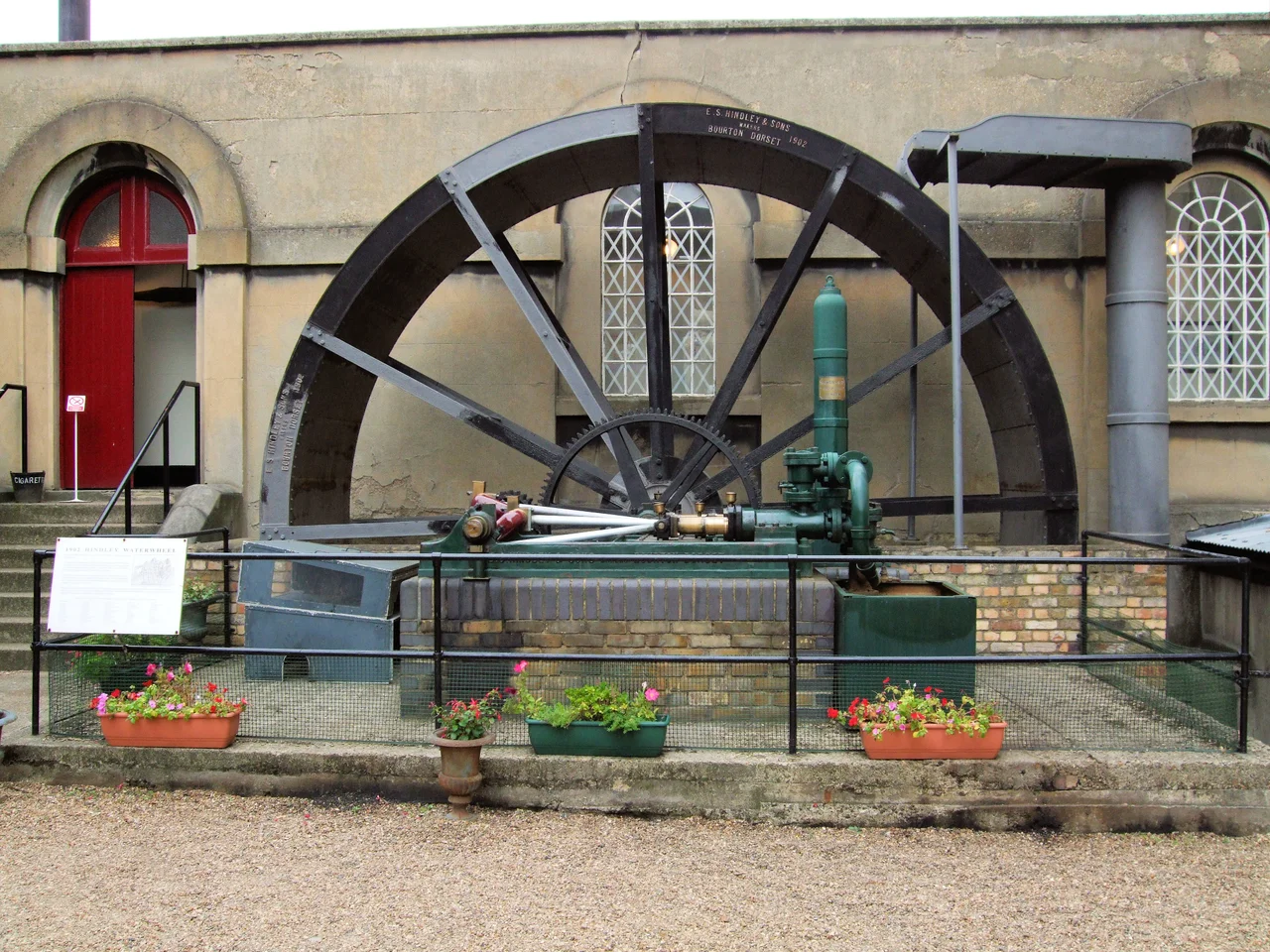
On a steam day the museum smells, faintly, of coal and oil and warm metal. Children find the noise overwhelming and want to leave; volunteers in flat caps and overalls coax them back to watch the moment a long horizontal valve clicks and the beam tips. A 1902 Hindley water wheel pump from a Wiltshire estate turns slowly in another room. A 1860 Shand Mason fire engine, painted Post Office red and brass, runs at occasional events. The museum has appeared as a film location in Doctor Who, EastEnders, The Bill, and the title sequence of Top of the Pops between 1991 and 1995. Most of its visitors come for one of the working days, when the engines run. They leave with the feeling, common to industrial heritage museums but rarer than it should be, that the Victorians did not just build big. They built things that, with care and intelligence, would still work in another century.
From the Air
51.4890 N, 0.2904 W on the north bank of the Thames at Brentford in the London Borough of Hounslow, near Kew Bridge. The 200-foot Italianate brick standpipe tower is the most prominent landmark on the site, set among the historic engine houses. Nearest airport: London Heathrow (EGLL) 4 nm west.
Nearby Stories
- Battle of Britain, Northfleet 1.1 km away
- Bayham Old Abbey 5.4 km away
- Catharine Macaulay 6.4 km away
- Hatfield rail crash 8.8 km away
- Chequers 8.9 km away
- Chelmsford Cathedral 10 km away
- Queen Victoria Hospital 13 km away
- Fishbourne Roman Palace 36 km away