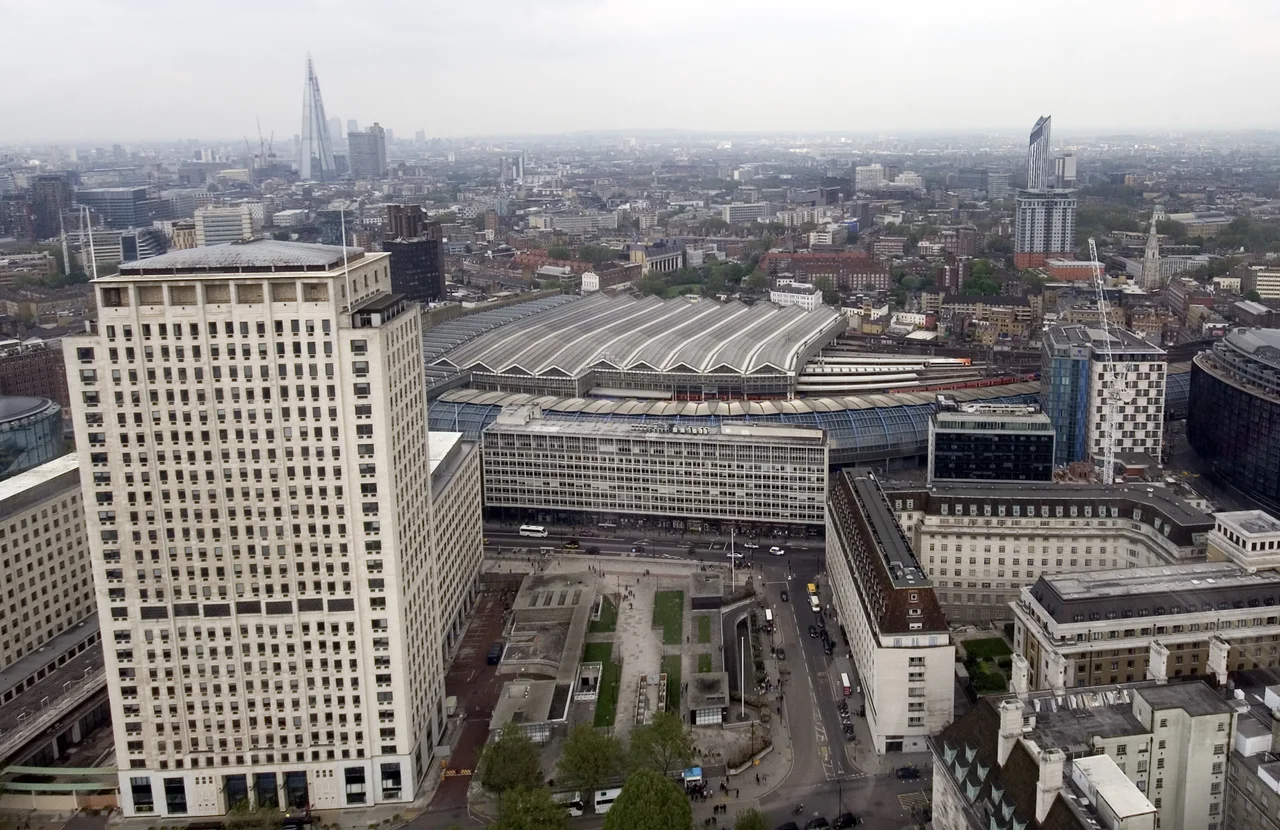

London Waterloo station
Meet me under the clock at Waterloo. For more than a century that phrase has needed no further explanation in London. The four-faced clock hanging above the great concourse - each face five feet across - is one of the most reliable rendezvous points in the city. Below it, on any weekday morning, somewhere between half a million and three quarters of a million commuters pour through twenty-four platforms toward Surrey, Hampshire, Wessex and the Isle of Wight. Waterloo is named for a battle the French would prefer to forget, and the French once politely asked that it be renamed before Eurostar trains began arriving from Paris. The renaming did not happen.
The Station That Was Never Meant to End Here
Waterloo opened on 11 July 1848 as Waterloo Bridge Station, designed by William Tite for the London and South Western Railway. It was always meant to be a through station - the line was supposed to continue east into the City of London. That eastward extension never came. The Panic of 1847 killed the financing, and successive proposals over the next half-century failed to find money or political will. So the LSWR did what railways often did: they built platforms anyway, in whatever direction more were needed, calling each new addition temporary until the through line arrived. By 1899 there were sixteen platforms but only ten platform numbers in use, with some duplicated across different parts of the complex. Each cluster acquired its own nickname - Cyprus Station, Khartoum, the Windsor Station, the Central Station - each with its own ticket office and street entrance. Travelers got lost; Jerome K. Jerome made the confusion a comic set piece in Three Men in a Boat.
The Great Transformation
By the turn of the twentieth century the LSWR had given up on reaching the City overland - they had built a tube line instead, the Waterloo and City Railway, opened in 1898, still nicknamed The Drain. With Waterloo accepted at last as a terminus, the railway tore the whole place down and started over. Six and a half acres were bought, six streets demolished, two more partly destroyed, and around 1,750 displaced residents rehoused in six new blocks of LSWR-built flats. All Saints' Church came down. The new station opened in stages, finally complete in 1922 with twenty-one platforms, a 700-foot concourse, and a stained-glass window crowning the main entrance with the LSWR's company crest - even though, by then, the Railways Act 1921 had legislated the LSWR itself out of existence.
The Victory Arch
The main pedestrian entrance, designed by James Robb Scott, is the Victory Arch. It is a war memorial. When it opened in 1922 it bore the names of 585 LSWR employees killed in the First World War. Two sculptural figures flank the arch: 1914, depicting Bellona in armour with sword and torch; and 1918, showing Pax, the Roman goddess of Peace, seated upon the Earth. During the war itself Waterloo had been a junction point for soldiers heading to Southampton and the British Expeditionary Force, with a free buffet running on the station between December 1915 and April 1920. The Second World War brought worse: bombs on 7 September and 29 December 1940, and a heavy raid on 10 to 11 May 1941 whose fires burned for four days. A 2,000-pound unexploded bomb dropped in those raids was not discovered until builders found it on York Road in 1959.
The Eurostar Years
Beginning 14 November 1994, an unlikely train began arriving at Waterloo: Eurostar, direct from Paris and Brussels. Five platforms on the western side, replacing the old platforms 20 and 21, became Waterloo International, designed by Nicholas Grimshaw with a writhing glass roof that became one of the most photographed pieces of British infrastructure of the decade. The inaugural service on 6 May was jointly opened by Queen Elizabeth II and French president Francois Mitterrand. The arrangement was always temporary. The Channel Tunnel Rail Link to St Pancras opened in 2007, and on 13 November Eurostar moved out. The international platforms sat empty until they were brought back into domestic service between 2018 and 2019, increasing total station capacity by thirty percent.
The Busiest Station in Britain
For sixteen consecutive years Waterloo was Britain's busiest railway station by passenger numbers. Pre-pandemic, it handled close to ninety-five million entries and exits in a single year. The complex - Waterloo Main, Waterloo East, the Underground station, and the bus interchange - moves more passengers than any transport hub in Europe. In 2023, with the Elizabeth line fully open, Liverpool Street narrowly overtook it. The two-faceted competition continues. In the meantime, Waterloo handled 70.4 million passengers in the year to March 2025 and remains the UK's largest station in floor space and platform count. It also remains, indelibly, the setting for the Kinks' Waterloo Sunset, recorded in 1967 - a song originally titled Liverpool Sunset and then changed because, Ray Davies later said, there were already too many songs about Liverpool. Now the song belongs entirely to this stretch of the south bank, where the river curves and the day ends behind the bridge.
From the Air
Coordinates 51.5031 N, 0.1132 W on the south bank of the Thames in Lambeth, just southeast of Waterloo Bridge. From altitude the station roof reads as a long block of glazing alongside the river. Look for the London Eye immediately north and the BFI IMAX cylinder just outside the main entrance. Nearest airports London City (EGLC) about 6 nm east and London Heathrow (EGLL) about 14 nm west. Clear days reveal the Palace of Westminster directly across the river and the City clusters at Bank and Canary Wharf in the distance.
Nearby Stories
- Battle of Britain, Northfleet 1.1 km away
- Bayham Old Abbey 5.4 km away
- Catharine Macaulay 6.4 km away
- Hatfield rail crash 8.8 km away
- Chequers 8.9 km away
- Chelmsford Cathedral 10 km away
- Queen Victoria Hospital 13 km away
- Fishbourne Roman Palace 36 km away