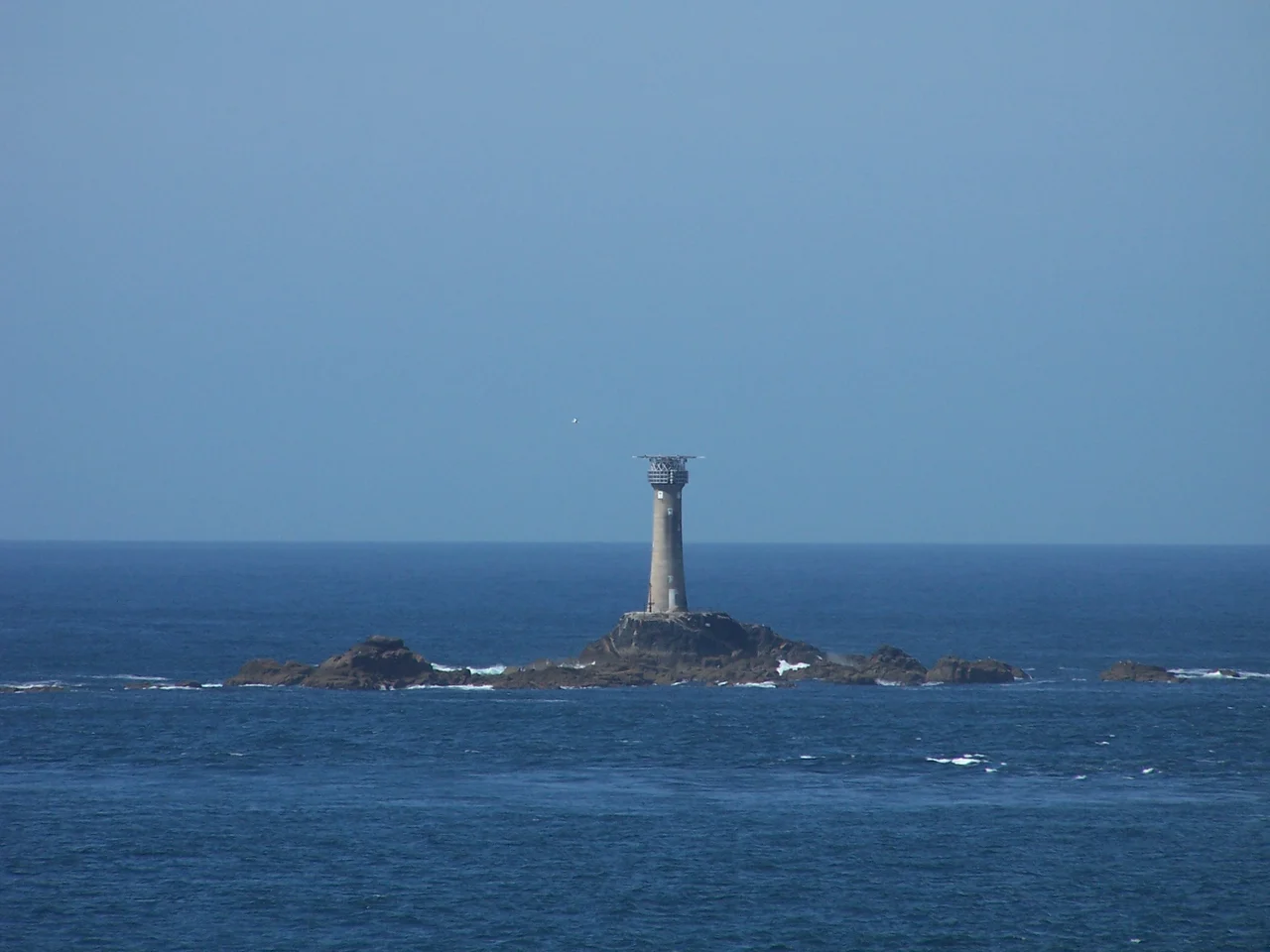

Longships Lighthouse
In January 1901, a search party reached the Longships Lighthouse after several weeks of storms had prevented anyone from relieving the keepers, and a national newspaper had begun worrying aloud about whether the men out there had run out of food. They had not. The stores were full. The only thing the keepers were short of was tobacco, and they had been improvising since Christmas with whatever happened to come out of the kitchen: coffee grounds, hops from the brewing supplies, and dried tea leaves. They smoked the tea. The Longships Lighthouse, on a wave-battered pinnacle of granite a mile and a quarter off Land's End, has been demanding that kind of patience from its keepers since 1795. Today there are no keepers at all. The lamp is solar-powered and runs itself.
A Tower on a Pinnacle
The Longships are a small chain of rocky islets just over a nautical mile west of Land's End, regularly breaking the surface of one of the most treacherous stretches of water in the British Isles. The highest of them, Carn Bras, rises only 12 metres above high water level, which gave anyone proposing to build a lighthouse on it a problem: there was barely any rock to build on, and the prevailing weather hurled the open Atlantic at it. In the second half of the 18th century, shipowners petitioned Trinity House so insistently that, in 1790, the engineer John Smeaton was sent to survey the area. He recommended either Wolf Rock to the south or the Longships, and Trinity House chose the latter. The lease was granted in 1791 for fifty years to a Lieutenant Henry Smith on the standard commercial terms of the period: build it yourself, maintain the light, and collect dues from passing ships.
Smith Goes to Prison
Smith engaged Samuel Wyatt, newly appointed Surveyor of Trinity House, as his architect. Work on Carn Bras began in 1793. The tower, built of Cornish granite, was eventually completed in 1795: only 38 feet high, but raised on its rock pinnacle so that the lantern stood 24 metres above the sea. It was equipped with Argand lamps and reflectors, probably the first time such modern optics had been installed on an offshore British lighthouse. Smith had badly underestimated both the time and the cost of construction. Because the dues only became collectable once the lighthouse was lit, he took out increasingly expensive loans to finish the work, and was unable to repay them when the lamp finally shone. In 1801, six years after his lighthouse first lit the Atlantic for inbound vessels, Henry Smith was committed to the Fleet Prison in London as a debtor. The light he had built kept burning.
The Replacement Tower
The first tower was too low. Even at 24 metres above sea level, exceptional Atlantic seas were known to wash up the rock and obscure the lantern itself, defeating the whole purpose. In 1869 Trinity House began building a replacement to the designs of William Douglass, using equipment salvaged from the recent construction of the Wolf Rock Lighthouse. The new granite tower was finished in 1873 and lit in 1875. Its lens array, more than nine feet tall, sat on a four-foot pedestal inside the lantern. The light source was an eight-wick oil lamp burning colza (rapeseed) oil. A fog bell sounded two strokes every fifteen seconds; later replaced by Brock fog rockets, then by an electrically detonated explosive signal, then by a compressed-air supertyfon horn. After the new tower was lit, Wyatt's old lighthouse was dismantled. Even with all of this, the SS Bluejacket managed to wreck herself on rocks within metres of the lighthouse on a clear night in 1898, nearly demolishing the tower in the process.
Keepers and the Empty Tower
Through almost two centuries the lighthouse was run by rotating teams of keepers, usually two on at a time, a month on station and a month ashore. They lived inside the tower, hauled their supplies up the rock face, watched the lamp through the long winter nights and signalled merchant ships passing close enough to see them wave. In 1974 a helipad was constructed on top of the lantern itself, ending centuries of difficult boat relief and making routine maintenance dramatically safer. The end came in 1988, when Trinity House automated the lighthouse and withdrew the last keepers. The light was initially monitored by a telemetry link from Lizard Lighthouse to the east; since 1996 it has been watched over by the Trinity House Operations and Planning Centre in Harwich, Essex, three hundred miles away. In 2005 the lamp was converted to solar power. It now flashes twice every ten seconds, visible for 15 nautical miles.
The Day the Horn Would Not Stop
In March 2025 the Longships Lighthouse made the national news for a more peculiar reason. Residents and visitors at Land's End and Sennen Cove began to notice that the fog horn was sounding continuously, all day and all night, in clear weather and rough. The complaints reached the BBC. Trinity House engineers visited and reported that a fault in the visibility sensor was triggering the low-visibility alarm even when the air was clear; the technical fix was made and the bellow ceased. For a few weeks of late winter the lighthouse, which has spent two and a half centuries trying to be heard above the wind, had been heard a little too well. It was, in its small way, a reminder of why the place was built in the first place: not for picturesque sea views from the cliffs above Sennen, but to warn ships, in fog and dark, off the rocks. The horn at full volume was simply the lighthouse remembering its job, in error.
From the Air
The Longships Lighthouse stands at approximately 50.067 degrees north, 5.747 degrees west, on the islet of Carn Bras roughly 1.25 nautical miles west of Land's End in Cornwall. From the air the white tower with its helipad is unmistakable, set on a black-rock pinnacle in often-broken water; in heavy weather the entire group of islets can be lost in spray. Land's End Airport (EGHC) at St Just lies 3 nautical miles to the north-east and is the closest airfield. The Land's End headland and tourist complex are visible to the east; the Isles of Scilly lie 25 nautical miles to the south-west; the Seven Stones reef (site of the Torrey Canyon wreck) lies north of the Scillies. Expect strong Atlantic swell year-round and frequent sudden sea fog.
Nearby Stories
- Mullion Cove 1.3 km away
- Great Wheal Charlotte 3.7 km away
- Castle Down 5.3 km away
- SS Georgia (1890) 30 km away
- Wheal Coates 41 km away
- 1979 Fastnet Race 55 km away
- HMS Affray 126 km away
- Routes of Santiago de Compostela: Camino Frances and Routes of Northern Spain 713 km away