
Lotherton Hall
On 6 August 1944, Captain Douglas Wilder Gascoigne was killed leading a tank in Normandy. He was Sir Alvary Gascoigne's only son and heir. Exactly twenty-five years later, on 6 August 1969, Lotherton Hall opened to the public for the first time. Sir Alvary had presented the house and grounds to the City of Leeds in 1968, with no heir left to take them on. The opening date was not a coincidence. It was, in the most precise way an English country house can manage it, a memorial - an entire estate transferred from private possession to public access on the anniversary of a son's death in war.
The Gascoignes' Other House
Lotherton was not the family's main seat. That was Parlington Hall, a few miles away - a grand country house that the Gascoignes had occupied since the seventeenth century. Lotherton was a smaller manor house that came into the family in 1825 when Richard Oliver Gascoigne bought it. In 1842 both his sons died, leaving the estates to his unmarried daughters Elizabeth and Mary Isabella. The sisters divided the family lands; Mary Isabella took Parlington, Elizabeth took Lotherton. Through Elizabeth's marriage to the 2nd Baron Ashtown, Lotherton was mostly let to tenants between 1842 and 1893. It is only with Colonel Frederick Gascoigne, who inherited Lotherton in 1893, that the house began to be transformed into the country residence we see now.
Florence Nightingale's Goddaughter
Colonel Gascoigne's wife Gwendolen was the daughter of the engineer Sir Douglas Galton, and the second cousin and goddaughter of Florence Nightingale. She brought to Lotherton both a strong design sensibility and a deep family connection to one of the most famous Victorians. Between 1896 and 1931 the Gascoignes remodelled the house extensively for their growing family - adding a dining room, an entrance hall, a drawing room and a servant's wing in the comfortable Edwardian country-house manner. Gwendolen designed and built the formal Edwardian gardens that still run along the south front. When Parlington Hall began to fail, the Colonel moved furnishings across to Lotherton; the Gascoignes essentially transferred the family's domestic centre from one estate to the other. Parlington was demolished in the 1950s. Lotherton inherited its contents.
Ambassador and Heir
Sir Alvary Gascoigne, the Colonel's son, was a career diplomat - British ambassador to Japan, then to the Soviet Union. He inherited Lotherton in 1937. The house filled with Oriental works of art he had collected during his postings. His first marriage to Sylvia Wilder produced one son, Douglas, who joined the army during the Second World War and was killed in his tank in Normandy on 6 August 1944. The Gascoigne line ended there. Sir Alvary's second wife Lorna lived with him at Lotherton until his death in 1970, but there were no further children. In 1968 he made the gift: house, grounds, contents, and an endowment for future acquisitions, all to the City of Leeds, opened on the August anniversary of his son's death.
Three Thousand Objects
What Leeds inherited was extraordinary. The Lotherton collection runs to about 3,000 objects across five categories. The headline piece is Pompeo Batoni's 1779 portrait of Sir Thomas Gascoigne, painted in Rome during the Grand Tour - Sir Thomas posed as a connoisseur among books and sculptures, holding a snuffbox that bears the portrait of Marie Antoinette. The actual snuffbox is also in the collection, one of those rare cases where the prop and the painting survive together. There are five Joaquin Sorolla beach paintings from 1906. Four George Clausen portraits and three of his landscapes. Furniture by Pugin, Burges, Charles Rennie Mackintosh, William Morris, Voysey, Webb and Godwin - essentially a textbook of nineteenth-century English design under one roof. The studio pottery collection includes Bernard Leach, Hans Coper and Lucy Rie.
Deer, Rare Birds and Christmas
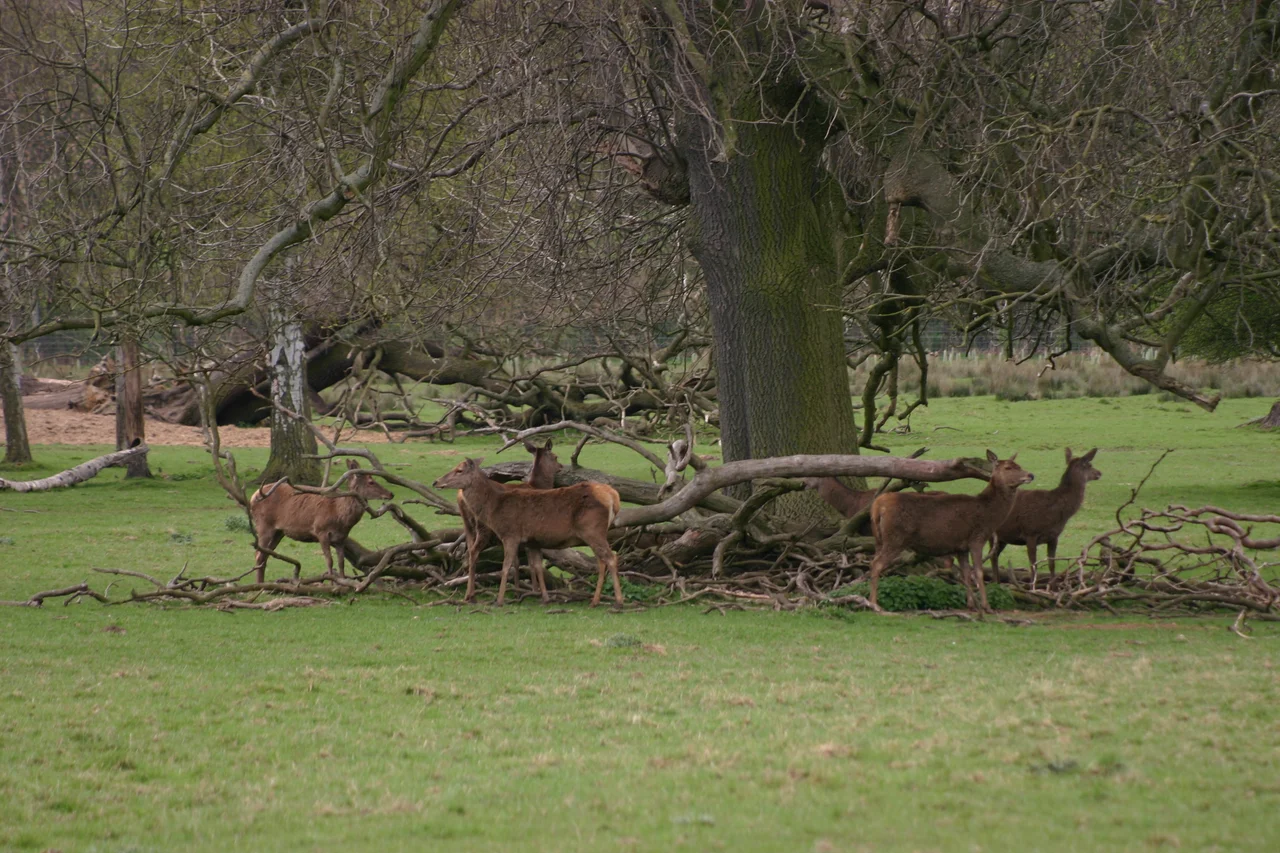
The estate is more than a museum. Red deer graze the parkland. The bird garden holds endangered species in a programme established in the 1960s; in 2003 a walk-through aviary called "Into Africa" was added. The twelfth-century Norman chapel in the grounds - used as a place of worship for the lost medieval village of Lotherton, then restored during the First World War to house wounded soldiers under the V.A.D. hospital scheme - still stands. Every winter the estate runs the Lotherton Christmas Experience, which had 64,743 visitors in its first year (2016) and has become one of the largest seasonal events in the north of England. For a country house that was never the Gascoignes' first choice, Lotherton has become a busier and better-loved place than Parlington, the family seat, ever was.
From the Air
Lotherton Hall at 53.82N, 1.32W, just east of the A1(M) motorway near Aberford, about 10 nm east of Leeds city centre and 14 nm south-west of York. Best viewed at 2,500-3,500 ft AGL. The A1(M) is the prominent linear feature running north-south just west of the estate. Leeds Bradford (EGNM) is 11 nm to the west, Doncaster Sheffield (EGCN) 20 nm to the south-southeast. The estate parkland - distinctive open grassland with mature trees - sits at the eastern edge of the gently rolling Vale of York country; the Pennines rise as the high ground 30 nm to the west.
Nearby Stories
- Scampston Hall 3.5 km away
- Salts Mill 4.7 km away
- Newburgh Priory 6 km away
- Brodsworth Hall 6.2 km away
- Coverham Abbey 16 km away
- RAF Leconfield 17 km away
- Macclesfield Canal 27 km away
- RAF Scampton 35 km away