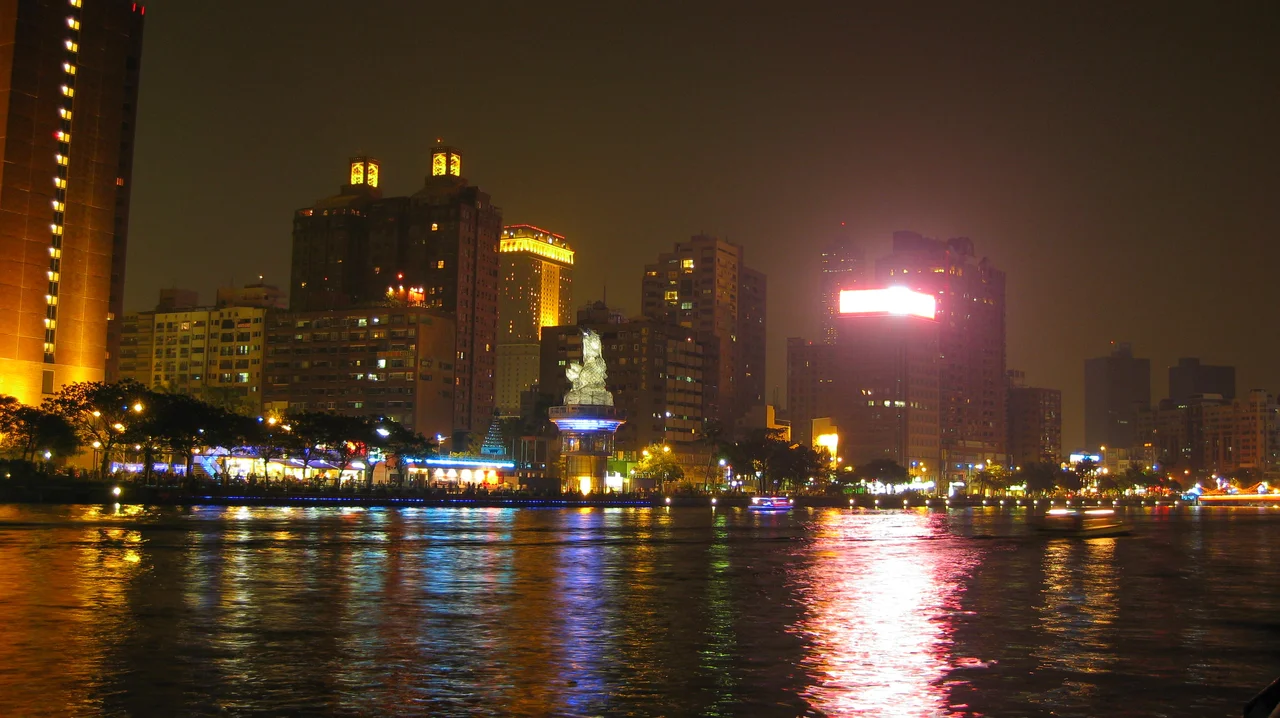

Love River
A typhoon gave it the name. In the late 1940s, a boat company called Love River Cruise operated along the newly built riverside park in Kaohsiung. A storm ripped the signboard from its storefront, leaving only the first two characters: "Love River." The name stuck, eventually becoming official in 1972. It is a fitting origin story for a waterway that has been renamed, repurposed, and reborn more times than most rivers twice its length. Flowing 12 kilometers from Renwu District to Kaohsiung Harbor, the Love River has served as an irrigation canal, a lumber transport channel, an open sewer, and finally -- against considerable odds -- the vibrant cultural heart of southern Taiwan's largest city.
Names and the Stories Behind Them
Before it was the Love River, it was the Takao River, named by the Makatao people of the Pingpu tribe who lived along its banks. During the Qing dynasty, the name persisted through centuries of gradual settlement. The Japanese, who colonized Taiwan in 1895, dredged the river and turned it into a canal for transporting lumber from Southeast Asia. After 1945, when Taiwan came under Republic of China control, the name shifted to the Kaohsiung River. Then came the doomed lovers. In the late 1940s, a couple died by suicide in the river's depths, and locals began calling it the Love River -- a name born from tragedy that somehow became romantic through repetition. In 1968, Kaohsiung mayor Yang Chin-hu tried to rename it Jen Ai River to honor Chiang Kai-shek's birthday. The effort failed. The river kept the name the typhoon left behind.
Death and Resurrection of a Waterway
For decades, loving the Love River required imagination. The first pollution arrived during the Japanese occupation, when paper mills began dumping waste into the water. But the real catastrophe came with Taiwan's postwar industrialization. In 1965, raw sewage began flowing directly into the river after an export processing zone was established nearby. The river turned black and fetid. Fish died. Residents avoided its banks. What had once been a working waterway surrounded by farms became an open drain bisecting a growing city. The resurrection took years of unglamorous infrastructure work: the city government diverted wastewater to a treatment plant in Cijin District, slowly coaxing the water quality back from the brink. Today, the same river that once drove people away draws them in -- duck boats, gondola rides, and love boats carry tourists past the Holy Rosary Cathedral, the Kaohsiung Bridge, and outdoor cafes with live music.
Festivals on the Water
The Love River has become Kaohsiung's premier stage for public celebration. Since 2008, the annual Kaohsiung Lantern Festival has transformed the riverbanks into corridors of light, with water dances, fireworks, and art installations drawing crowds that spill across both sides of the waterway. The festival typically spans the period around both the Western Valentine's Day and the traditional Lantern Festival, a coincidence that plays perfectly into the river's romantic branding. During the Dragon Boat Festival, the river hosts dragon boat races -- an event that gained international prominence when the 2009 World Games, hosted by Kaohsiung, included dragon boat racing as a competition. In December 2018, newly elected mayor Han Kuo-yu held his inauguration ceremony on the banks of the Love River, choosing the waterway as a backdrop that signaled his intention to revitalize the city's economy through tourism and culture.
The Spine Viewed from Above
From the air, the Love River traces a sinuous line through Kaohsiung's urban grid, connecting the inland suburbs of Renwu to the harbor waterfront. At night, its banks glow with the lights of the riverside park, night markets, and cafe strips along Hesi Road. The river functions much the way the Thames does for London or the Seine for Paris -- not as Kaohsiung's largest feature, but as its organizing principle, the line along which the city's cultural life arranges itself. Where the river meets the harbor, the old mangrove forests that once fringed the estuary are long gone, replaced by the industrial infrastructure of one of Asia's busiest ports. But upstream, where the boardwalks run and the lanterns float, the Love River has completed one of the more remarkable urban turnarounds in East Asia.
From the Air
Located at 22.624N, 120.290E, the Love River is visible as a sinuous waterway running north-south through central Kaohsiung. It empties into Kaohsiung Harbor near 22.613N, 120.279E. Nearby airports: RCKH (Kaohsiung International Airport, 7 km south). Best viewed at 2,000-4,000 ft AGL at dusk or after dark when riverside lighting is visible. The harbor entrance and Cijin Island barrier beach are prominent landmarks to the west.
Nearby Stories
- Taimali 7.2 km away
- Meinong East Gate Tower 15 km away
- Kunci Temple 20 km away
- Checheng Fu'an Temple 42 km away
- Dongji Island 49 km away
- Orchid Island 69 km away
- South Penghu Marine National Park 77 km away
- Hong Kong 12 549 km away