.jpg)
Lui Seng Chun
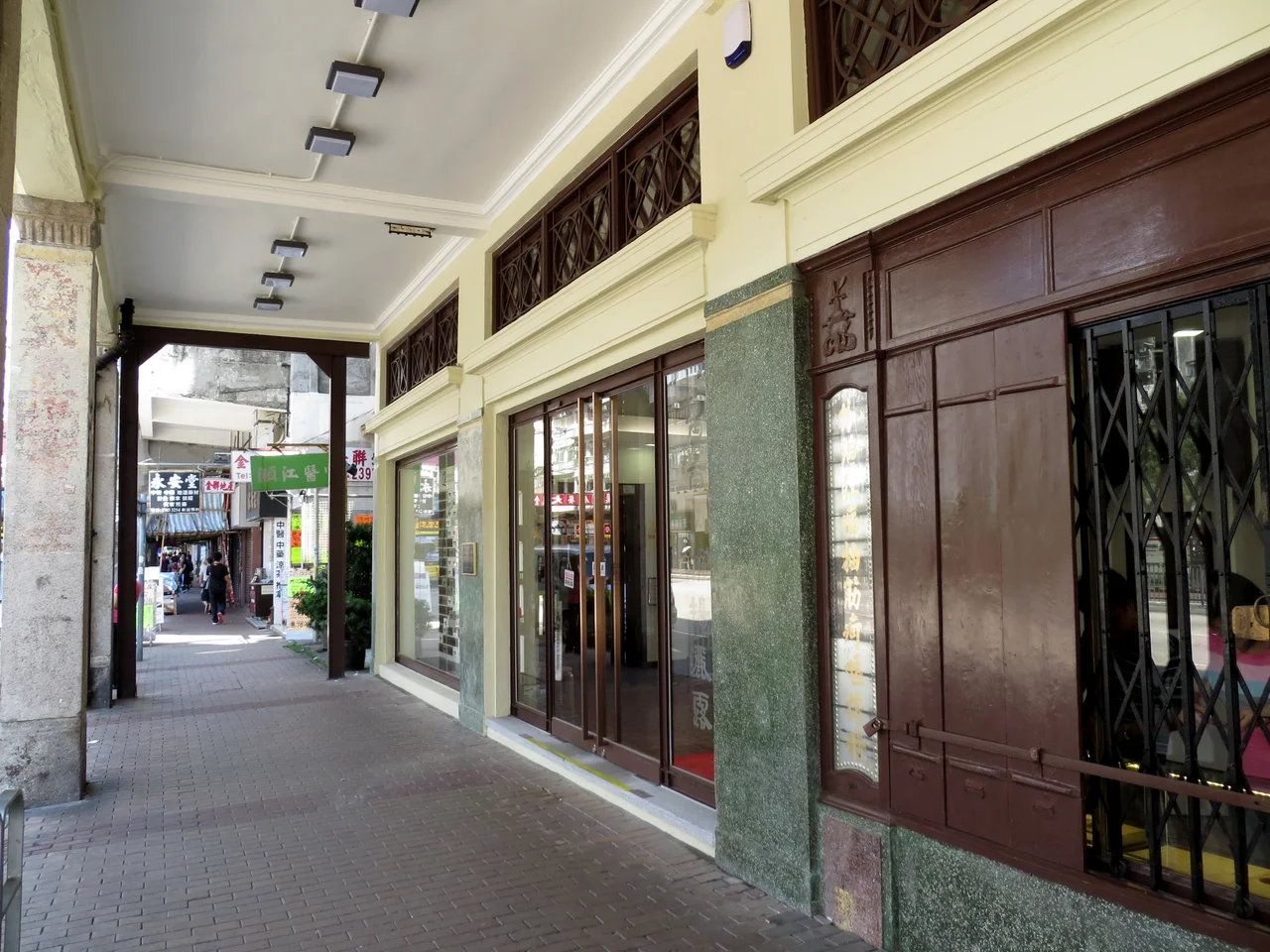
The name was a promise. "Lui Seng Chun" — drawn from a pair of rhymed Cantonese couplets — carried a bold guarantee: the medicine sold here could bring a patient back to life. That confidence was baked into the very walls of 119 Lai Chi Kok Road, a four-storey tong lau shophouse that Lui Leung completed in Mong Kok in 1931. It has outlasted the bone-setting wine shop it was built for, survived decades of neglect, and now stands as one of Hong Kong's most layered heritage buildings, declared a monument since 2022.
A Taishan Man Builds a Kingdom
Lui Leung arrived in Hong Kong from Taishan County in Guangdong Province, and he wasted little time. He threw himself into transport and trading, eventually becoming one of the founders of the Kowloon Motor Bus Company (1933) Limited — the buses that still thread through the Kowloon streets today. In 1929 he purchased a piece of land from the Hong Kong Government at the junction of Lai Chi Kok Road and Tong Mi Road, and commissioned architect W. H. Bourne, a local specialist in shophouse design, to build him something that could serve two purposes at once. The result, completed around 1931, was 600 square metres across four floors, each storey wrapped in a wide covered balcony — elegant shade against the subtropical sun, practical shelter from the monsoon rains. Lui married three wives and raised many children. The building had to pay its way and house his family simultaneously, a balance the tong lau typology was made for.
The Medicine That Could Raise the Dead
The ground floor opened as a Chinese bone-setting medicine wine shop bearing the building's name. Word spread about the remedies sold there, and the shop earned a reputation that reached well beyond Hong Kong. The name itself did a great deal of the marketing — that boast of restoration, of life returned to the ailing, was embedded in the couplets that gave the place its identity. Then Lui Leung died in 1944, and the shop followed him not long after. The floors that had once housed his extended family gradually filled with tailors and renters. By the 1980s no one lived in the building at all. It stood empty on Lai Chi Kok Road, unmaintained and slowly fading, while the neighbourhood around it accelerated into the frantic, neon-lit density of modern Mong Kok.
Given Back, Not Sold
In 2000, the Lui family made an unusual decision. They proposed to the Antiquities and Monuments Office that they donate the building to the Government of Hong Kong — not sell it, donate it. Their reasoning was straightforward: they held memories in these walls, and they wanted the name "Lui Seng Chun" to survive in public life rather than disappear behind a developer's facade. That same year the building received Grade I historic status. The transfer was completed in October 2003. The structure had narrowly escaped the stricter building ordinances of 1935, having been constructed under the more permissive 1903 rules, which accounts for some of its generous proportions and characteristic detailing — the kind of pre-regulatory exuberance that makes the tong lau typology so photogenic.
Revival as a Medicine Hall
Hong Kong's Revitalising Historic Buildings Through Partnership Scheme included Lui Seng Chun in its inaugural Batch I group of seven buildings in 2008. On 17 February 2009 the government announced that Hong Kong Baptist University's School of Chinese Medicine would take over the space. The capital cost was estimated at HK$24.8 million. Restoration finished in early 2012. The ground floor that once sold bone-setting wine now operates as a Chinese medicine and healthcare centre — the circle closed, the promise of the name honoured again. One further footnote: a replica of the building appeared in the 2016 Marvel film Doctor Strange, projecting Lui Seng Chun's distinctive Italianate shophouse silhouette onto cinema screens worldwide, long after its neighbourhood had moved on.
Flying Over Mong Kok
From the air, Mong Kok resolves into one of the densest urban grids on earth, block after block of towers pressed against each other across northern Kowloon. Lui Seng Chun sits at the junction of Lai Chi Kok Road and Tong Mi Road, its four-storey tong lau form modest among the surrounding high-rises. The nearest airport is Hong Kong International (VHHH), roughly 30 kilometres to the west across Lantau. Approach the area at 1,500 to 2,000 feet to pick out the low-rise profile of this building against the vertical mass of Mong Kok's commercial blocks. The broad balconies — that signature of the tong lau — are visible from directly overhead, their horizontal rhythm unlike anything else in the streetscape below.
From the Air
Lui Seng Chun sits at 22.3249°N, 114.165°E in Mong Kok, Kowloon. View at 1,500–2,000 ft to distinguish its four-storey tong lau profile from the surrounding high-rises. Hong Kong International Airport (VHHH) is approximately 30 km to the west. The building sits at the junction of Lai Chi Kok Road and Tong Mi Road — look for the distinctive covered balconies on each floor level.
Nearby Stories
- Chapel of St. Francis Xavier 3.5 km away
- Cuiheng 4.1 km away
- 2015 Shenzhen Landslide 16 km away
- Shunde 31 km away
- Wanshan Archipelago 37 km away
- Nanxiong Formation 96 km away
- Heyuan 149 km away
- Checheng Fu'an Temple 629 km away