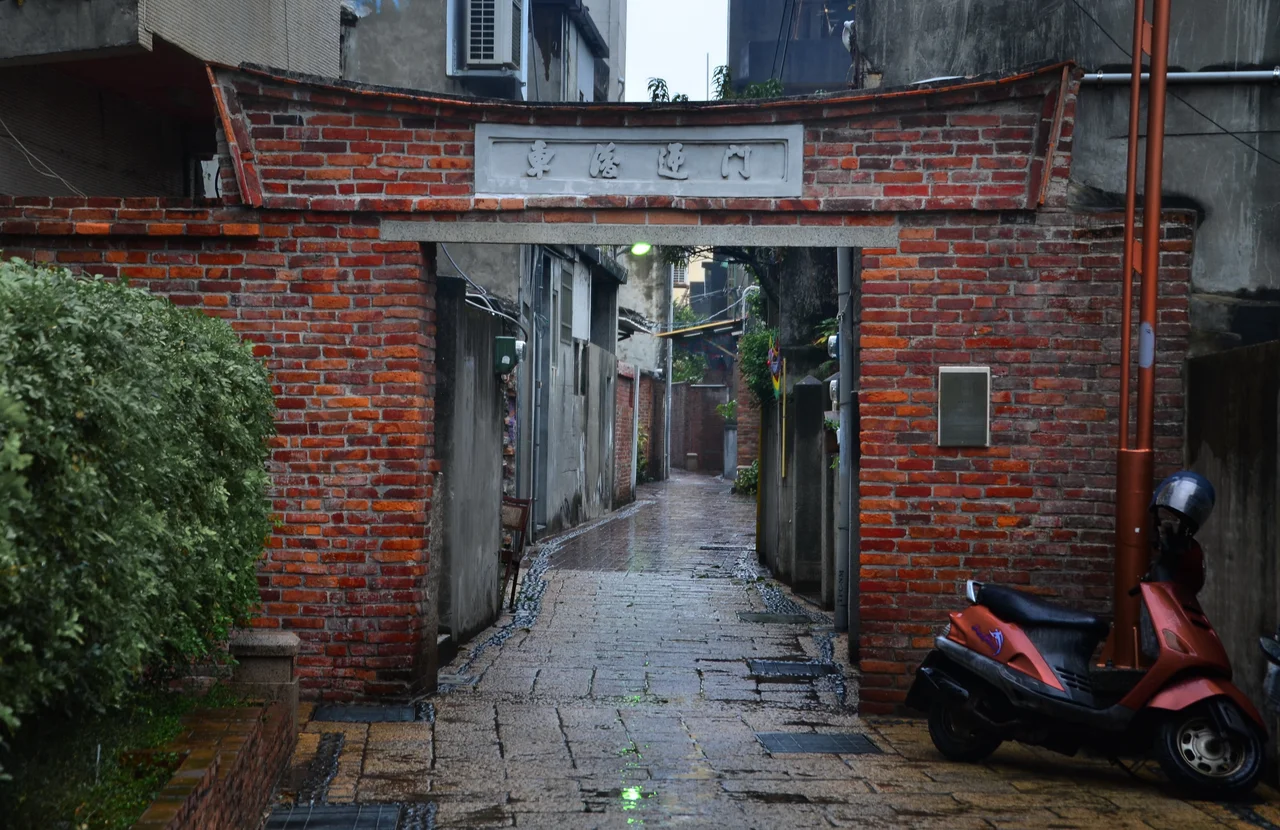

Lukang Ai Gate
In the 19th century, where you came from in Lukang determined which gate you could pass through at night. Merchants who traced their roots to Quanzhou in Fujian province and those whose families hailed from Zhangzhou had spent generations competing for dominance in one of Taiwan's most important ports. The conflicts ran deep enough that local businessmen built a network of Ai Gates — boundary fortifications — to mark territory and control movement after dark. Today, only one of these gates survives. It stands at 3.3 meters tall and 2.7 meters wide, its stone face bearing the inscription 門迎後車, meaning roughly 'the gate welcomes those who come from behind.' It is modest in size. Its story is not.
A Town Divided by Origin
Lukang grew into one of Taiwan's great trading ports during the Qing dynasty, drawing immigrants from the Fujian coast across the Taiwan Strait. But the people who came were not a single community. Settlers from Quanzhou and those from Zhangzhou brought with them competing loyalties, dialects, and economic networks — and in the close quarters of a prosperous port, those differences sparked persistent conflict. The Ai Gates were the physical answer to this social tension. Established as fortification points during the reign of the Daoguang Emperor, they were built by local businessmen to define and defend neighborhood boundaries. When night fell, the gates closed. Outsiders — meaning those from the rival district — were kept out. The system was as much social enforcement as physical security, marking a city where origin story still determined daily life.
What the Gate Remembers
The Ai Gate built in 1839 is small enough to miss on a busy street. Yet its compactness is part of its character — this was never a grand ceremonial arch but a working checkpoint, a door in the fabric of the city that opened for some and closed for others. The gate falls into a category called the roadway Ai Gate, one of three types: boundary gates marked territorial edges, roadway gates controlled street movement, and Bujiantian Street's Ai Gate served that specific commercial corridor. Each type reflected a different layer of the social geography that Lukang's residents had constructed for themselves. The single surviving example stands as the only tangible evidence of a system that once organized an entire townscape.
Stone Witness to Three Centuries
What makes the Lukang Ai Gate remarkable is not grandeur but persistence. Many structures from the Qing dynasty era did not survive Taiwan's turbulent 20th century — Japanese colonial administration reshaped urban forms, and later development erased much of what remained. The Ai Gate endured. It is recognized today as a tourist attraction and a cultural artifact, listed by the Changhua County government as part of the heritage of the region. Standing before it, the inscription reads like a quiet greeting from across two centuries. The gate was built to keep people out. Now it draws them in.
The Living History of Lukang
Lukang itself provides the context that makes the gate legible. Once the second-largest city in Taiwan and a hub of trade between the island and mainland China, Lukang entered a long period of decline when its harbor silted up in the late 19th century, and the arrival of the railway bypassed the town entirely. That economic stagnation, painful at the time, paradoxically preserved Lukang's historic streetscapes, temples, and structures in ways that faster-growing cities could not. The Ai Gate is part of this accidental preservation — a reminder that what gets left behind sometimes becomes what endures longest. Visitors walking Lukang's old lanes today pass through layers of history that larger Taiwanese cities long since paved over.
From the Air
Lukang Ai Gate is located at approximately 24.0745°N, 120.557°E in Lukang Township, Changhua County, on the western coastal plain of Taiwan. The town sits roughly 15 kilometers west of Changhua City. From the air at 3,000 to 5,000 feet, the dense historic streetscape of central Lukang is visible against the flat agricultural plain — look for the cluster of traditional-roofed structures near the town center. The nearest major airport is Taichung International Airport (RCMQ), approximately 30 kilometers to the southeast. Visibility in central Taiwan is generally good outside typhoon season, though coastal haze from the Taiwan Strait is common in summer months.
Nearby Stories
- Huwei, Yunlin 2.8 km away
- Geographic Center of Taiwan 4.2 km away
- Gaomei Wetlands 15 km away
- China Airlines Flight 611 21 km away
- Shei-Pa National Park 25 km away
- Yushan Weather Station 27 km away
- TransAsia Airways Flight 222 30 km away
- Battle of Xiapi 1136 km away