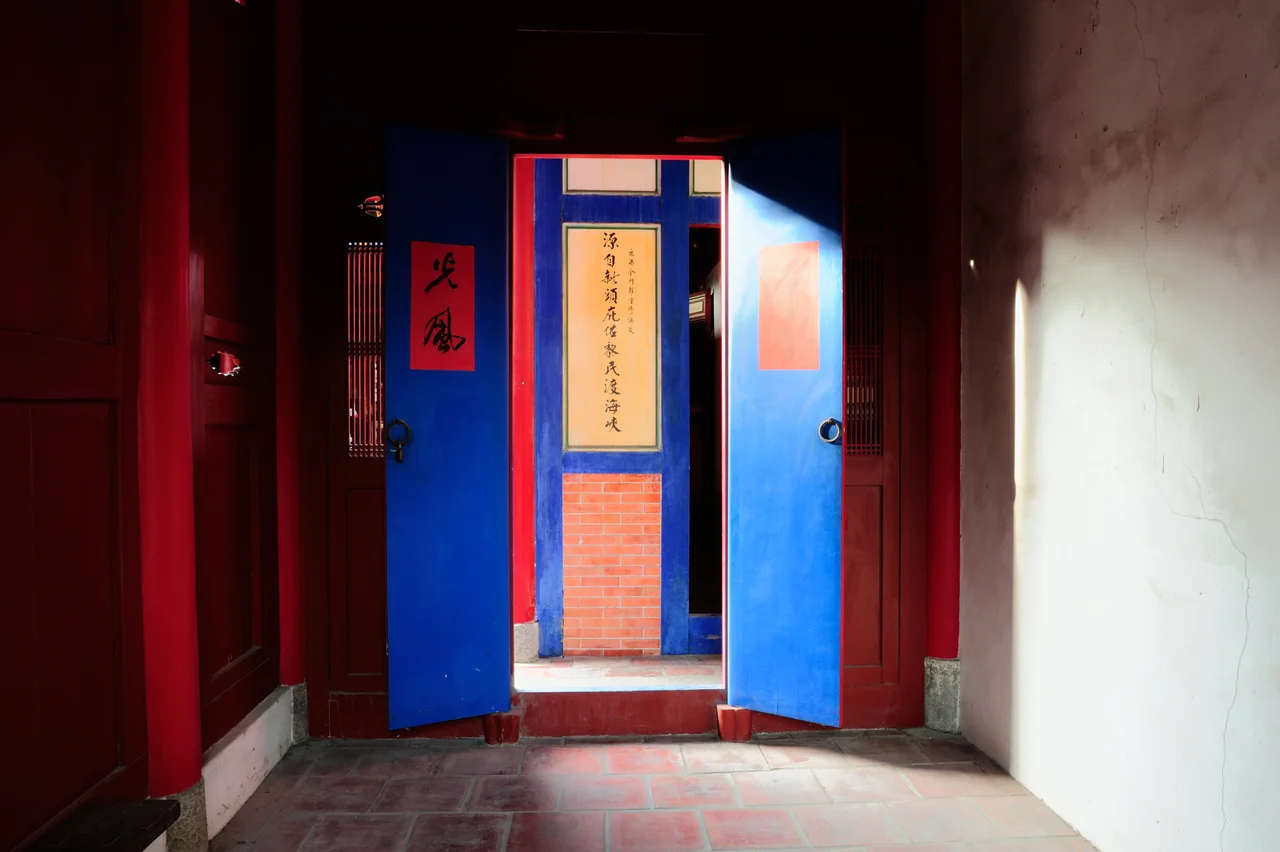

Lukang Kinmen Hall
The man who built the Lukang Kinmen Hall never intended to create a landmark. He was the son of Xu Le-shan, and in 1805 he constructed a temple to enshrine Sufu Wangye — one of the Wang Ye plague-warding deities venerated along the Fujian coast and across early Taiwan. He called it the Wu Jiang Guan and donated the inscribed tablet that still hangs in the main hall today. It was a practical act of faith: Lukang was a working port, and the hall served not only as a place of worship but as a gathering point for the community and the navy. Two centuries later, the hall bears the name Kinmen Hall, has survived an 1848 earthquake and a subsequent restoration, been renovated under Japanese colonial rule, repaired again in the 1970s, and designated a county-level historic site in 2000. The tablet still hangs in the main hall.
A Hall for Sailors and Soldiers
The Wang Ye deities — fearsome divine envoys who came to be worshipped as protectors against pestilence and misfortune — were central to the religious life of Fujian immigrants throughout Taiwan. In a port like Lukang, where disease, storm, and the uncertainties of maritime trade were constant companions, such protection had practical urgency. The Wu Jiang Guan served this community's need directly. The navy used it as a gathering place alongside civilians; the hall bridged military and civic life in the way that temples in Lukang's tightly organized social world often did. The Kinmen connection in the hall's eventual name reflects the deep ties between Lukang and the island of Kinmen in the Taiwan Strait — a reminder of the networks of migration, trade, and mutual obligation that bound these communities together.
Earthquake, Restoration, Endurance
In 1848, an earthquake shook Changhua County hard enough to damage the hall. The building that had stood for more than four decades needed substantial repair, and it took seven years before the restoration was complete. Crucially, the funding and labor came from the navy — the same institution that had used the hall as a gathering point from its founding. When the work was done in 1855, an engraved stone tablet was placed on the wall of the sacrificial hall, commemorating the effort. That stone record still exists. It is one of the details that makes Kinmen Hall feel less like a static monument than a living document: layer upon layer of inscription, donation, and repair, each addition recording the people who cared enough to preserve what had come before.
Through the Colonial Period
When Japan assumed control of Taiwan in 1895, the fabric of civic and religious life on the island shifted significantly. Many temples were repurposed or suppressed during the colonial decades. Kinmen Hall underwent partial renovation in 1908 — not demolition, not abandonment, but cautious adaptation. The hall continued to function. Further repairs to the main hall and the Sanchuan Gate in 1975 extended the building's life again, and in June 1994 the Changhua County Government undertook formal historic site restoration work. The designation as a county-level historic site on 25 October 2000 was a recognition of what had already been demonstrated through two centuries of community effort: this building was worth keeping.
What County Recognition Means
A county-level historic site designation in Taiwan provides formal protection and opens pathways for conservation funding — but it also represents a collective judgment about what matters. Kinmen Hall earned this status not through architectural grandeur but through accumulation: nearly two hundred years of continuous use, multiple rounds of community-funded repair, and a historical record reaching back to the early Qing dynasty. The sacrificial hall with its 1855 stone tablet, the main hall with Xu's original donated plaque, the Sanchuan Gate that has framed the entrance through renovation after renovation — these elements together form a building that carries more history per square meter than most. Walking into Kinmen Hall today means walking into a structure where every repair was someone's act of devotion.
From the Air
Lukang Kinmen Hall is located at approximately 24.05°N, 120.436°E in central Lukang Township, Changhua County, on the western coastal plain of Taiwan. The historic district of Lukang, roughly 15 kilometers west of Changhua City, shows as a compact cluster of traditional architecture amid the flat agricultural plain when viewed from the air. The nearest major airport is Taichung International Airport (RCMQ), approximately 30 kilometers to the southeast. The Taiwan Strait coastline lies about 5 kilometers to the west. Best viewed at 2,000 to 4,000 feet on clear days when the tiled rooftops of Lukang's historic core are distinct.
Nearby Stories
- Huwei, Yunlin 2.8 km away
- Geographic Center of Taiwan 4.2 km away
- Gaomei Wetlands 15 km away
- China Airlines Flight 611 21 km away
- Shei-Pa National Park 25 km away
- Yushan Weather Station 27 km away
- TransAsia Airways Flight 222 30 km away
- Battle of Xiapi 1136 km away