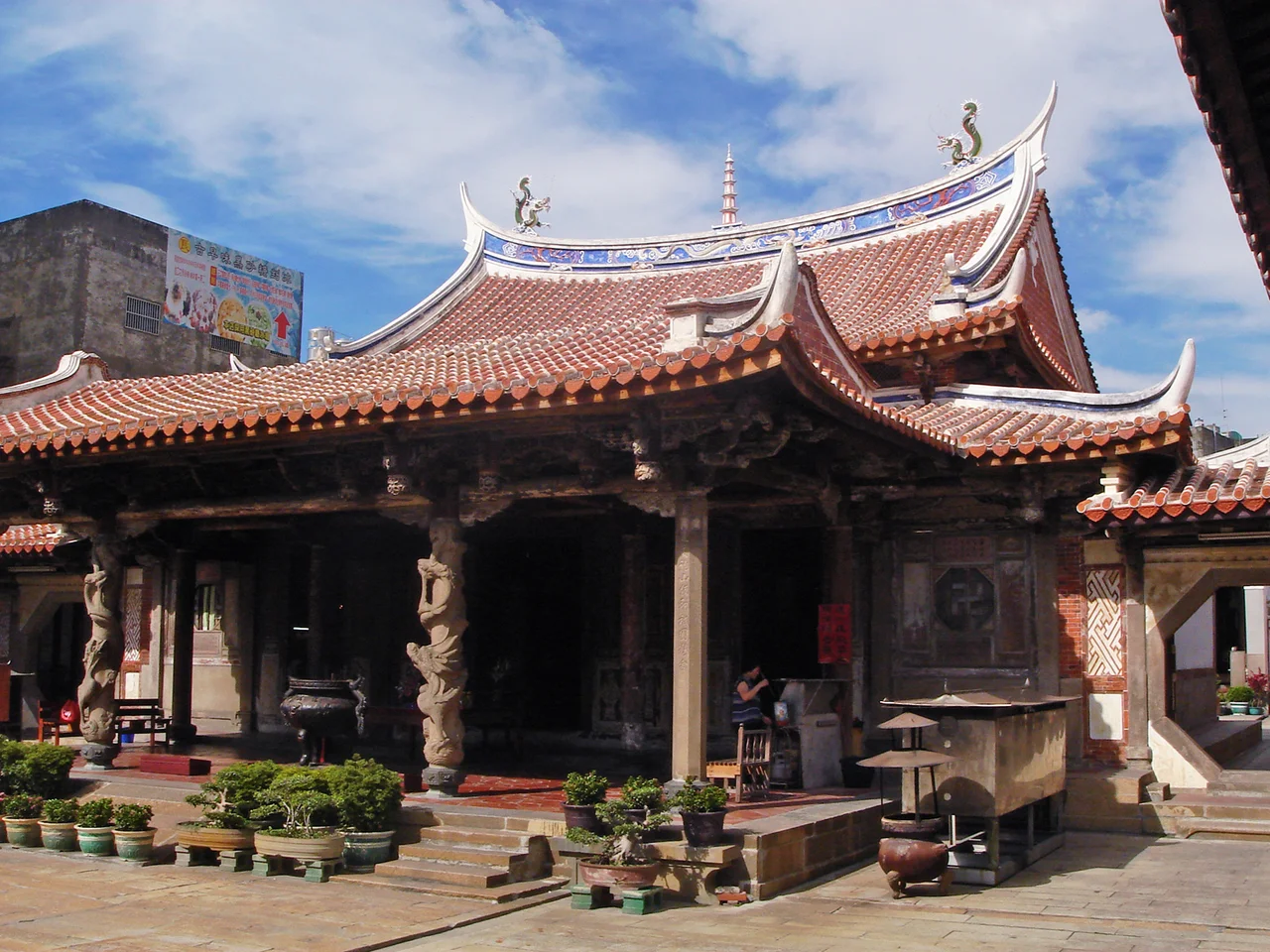

Lukang Longshan Temple
Run your hand along one of the twelve columns in the main hall and you will feel the scales. Each column is hewn from solid stone and wrapped by a dragon carved in high relief, the creature coiling upward in a spiral that feels almost alive under your fingers. These columns are among the most celebrated examples of stone sculpture in Taiwan — but they are only one element of a temple so dense with craftsmanship that visitors regularly find themselves stopping mid-step to look at something they missed on the way in. Lukang Longshan Temple was first built in 1738 as a modest structure dedicated to Guanyin, the Buddhist bodhisattva of compassion. What stands today, after generations of expansion and the long recovery from a 1999 earthquake, is something that rewards not a single visit but many.
What the Woodcarvers Built
The temple's reputation rests above all on its woodcarvings. As Lukang's residents expanded the original small structure over the 18th and 19th centuries, they commissioned craftsmen whose skill has rarely been matched in Taiwan's temple tradition. Bracket sets, lattice screens, beam supports, and decorative panels were worked with a precision and intricacy that reflect a community investing serious resources in a building they intended to last. The carvings depict figures from Buddhist narrative, auspicious symbols, and mythological scenes — layers of meaning that visitors familiar with the tradition can read almost like text. The craftsmanship is never merely decorative. Every carved surface in Lukang Longshan Temple was placed with purpose, the artisans working within a visual vocabulary that connected the building to centuries of Chinese Buddhist temple architecture while grounding it in local Taiwanese expression.
Twelve Dragons, Solid Stone
The twelve major support columns of the main hall are the temple's most iconic structural feature. Each is hewn from granite and wrapped with a carved dragon — not applied as decoration but carved from the column itself, the relief so deep that the creatures seem to emerge from the stone. Stone carving of this quality requires not only technical skill but exceptional material: the stone must be consistent enough to take detailed work without cracking, and the column must remain structurally sound even as its surface is worked down to thin stone scales. The result is both engineering achievement and artistic one. The columns have stood through the humid Taiwanese summers and the seismic stresses of a geologically active island. They survived the 1999 earthquake that damaged much of the rest of the temple. Scaffolding went up; the columns remained.
Damage, Repair, and Return
The 1999 Jiji earthquake was one of the deadliest natural disasters in Taiwan's recorded history, killing more than 2,400 people and causing widespread destruction across central Taiwan. Lukang Longshan Temple sustained damage — a significant blow to one of the island's most revered religious sites. The subsequent repair work was meticulous rather than rapid, carried out with the care that the temple's national monument status demanded. By 2008, the restoration was complete and the temple reopened. The nine years of work produced a building that retained the integrity of its historic fabric rather than substituting modern replacements for damaged elements. Visitors who come today walk through a structure that was genuinely repaired, not reconstructed — a distinction that matters deeply to the craftsmen and conservators who undertook it.
A Temple in Full Use
Lukang Longshan Temple spans 891 square meters and is organized around four strata and three gardens within a square building plan. At the front gate, a pair of granite dragon poles marks the threshold. At the far end of the front hall, a theater stage stands ready for the traditional plays performed during festivals — because this temple, whatever its architectural distinction, remains above all a working religious site. Worshippers come to pray to Guanyin, to light incense, and to participate in the ritual calendar that has structured life in Lukang for nearly three centuries. The architectural splendor frames this devotion without overwhelming it. The same temple that draws international visitors for its carvings is the same temple where elderly residents have come every morning for decades. Both belong here.
From the Air
Lukang Longshan Temple is located at approximately 24.0504°N, 120.435°E in Lukang Township, Changhua County, on Taiwan's western coastal plain. The temple sits in the historic southern district of Lukang, roughly 15 kilometers west of Changhua City. From the air at 2,000 to 4,000 feet, Lukang's historic core is visible as a compact cluster of traditional-roofed structures distinct from the surrounding flat agricultural land. The nearest major airport is Taichung International Airport (RCMQ), approximately 30 kilometers to the southeast. The Taiwan Strait coastline lies about 5 kilometers to the west. The temple's large courtyard and characteristic roof ridge ornamentation make it identifiable among Lukang's roofscapes on clear-day low approaches.
Nearby Stories
- Huwei, Yunlin 2.8 km away
- Geographic Center of Taiwan 4.2 km away
- Gaomei Wetlands 15 km away
- China Airlines Flight 611 21 km away
- Shei-Pa National Park 25 km away
- Yushan Weather Station 27 km away
- TransAsia Airways Flight 222 30 km away
- Battle of Xiapi 1136 km away