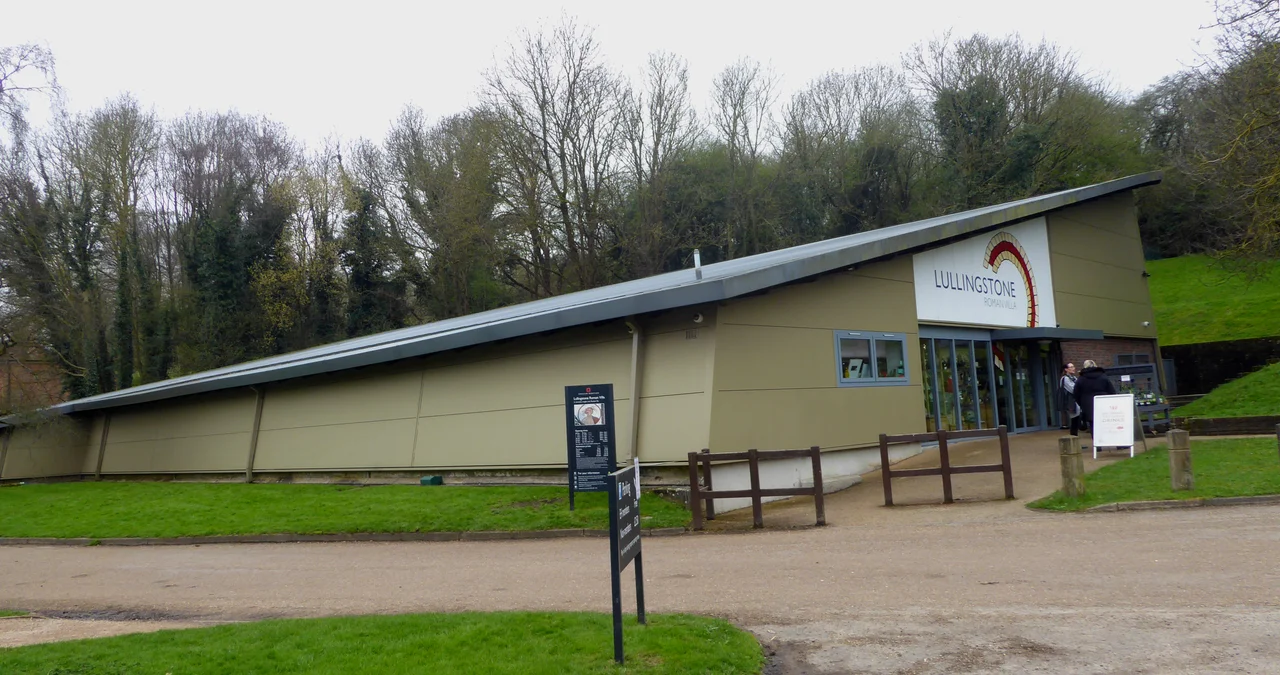

Lullingstone Roman Villa
In a small valley in Kent, on a slope above the River Darent, archaeologists in the mid-twentieth century uncovered something extraordinary. A Romano-British villa, abandoned and forgotten after a fire in the early 5th century, had been sealed beneath the soil for almost 1,500 years. When they swept away the chalk fill, the floor of the dining room came into view: a Bellerophon astride Pegasus, slaying the Chimera, framed by personifications of the four seasons. Next door, the god Zeus, disguised as a white bull, abducted the princess Europa. Above that pagan dining room, in a separate room reached by its own outside stairs, lay something rarer still: painted plaster bearing the Chi-rho symbol of early Christianity, the oldest such painted Christian chapel found in any Roman house in Britain.
A House Built and Rebuilt
The first villa here went up in the 1st century, perhaps around AD 80 to 90, only a few decades after the Roman invasion of Britain. It was a modest country house, but its location, beside the Darent and close to Watling Street and the Channel ports, made it valuable. Around AD 150 the building was substantially enlarged, with a heated bath block warmed by a hypocaust system, the Roman under-floor heating that piped hot air through hollow brick channels beneath the floors. Two sculpted marble busts from this 2nd-century rebuild, found by excavators in the cellar, may show Pertinax (governor of Britannia in 185 to 186 and briefly Roman emperor in 193) and his father-in-law Publius Helvius Successus. If so, Lullingstone may have served at this period as the country retreat of the provincial governor.
The Mosaics in the Dining Room
The villa was abandoned for nearly a century and then reoccupied around AD 290. The 4th century brought further wealth and renovation. In the dining room, the triclinium where the family reclined to eat, two large mosaics were laid in the middle of the century. One panel shows Bellerophon, the Greek hero, mounted on the winged horse Pegasus, plunging a spear into the chest of the three-headed Chimera. Around him, in the four corners, busts personify winter, spring, summer, and autumn, each with their attributes: bare branches, flowers, ripe wheat, fruit. The second panel shows the abduction of Europa: a white bull carrying the princess across the sea, surrounded by dolphins and other sea creatures. The mosaics are some of the finest figured floors yet found in Britain. Standing on the modern viewing platform looking down at them, you are looking at a 4th-century dinner party host's idea of cultured taste.
Pagan Cellar, Christian Chapel
Beneath the main house was a room, accessed through the cellar, that had served as a shrine to water deities, painted with figures of nymphs. At some point in the late 3rd or early 4th century the niche was covered over and the room repainted with red bands, and the two marble busts were placed there. Some scholars think this marks a shift from public worship of water gods to private veneration of household deities and ancestor spirits. Above this room, reached by an external staircase, was a separate suite that in the mid-4th century was converted into a Christian house-chapel. Painted plaster on its walls showed a row of standing worshippers with arms raised in the orans posture, and the unmistakable Chi-rho monogram of Christ. Some of the paintings are now in the British Museum. They are the earliest evidence of Christian worship in any Roman house in Britain, dating from a moment when Christianity had only recently become legal across the Empire.
Fire and Forgetting
Sometime in the early 5th century, as Roman authority across Britain collapsed and provincial life began to fragment, fire destroyed the villa. The building was abandoned and never substantially reoccupied. The site became farmland. The mosaics lay buried beneath a metre of accumulated soil. The chapel walls collapsed inward over the cellar shrine, sealing both. Whoever the last occupants were, whatever they took with them as they left, they left enough that excavators a millennium and a half later could still read the household's tastes, its religion, its prosperity. Some bones discovered in a mausoleum suggest the site may also have served briefly as a burial ground in the early Anglo-Saxon period. Then even that use ended, and Lullingstone slept.
Discovery and Display
Local antiquaries had noticed Roman material here from at least the 18th century, but serious excavation only began after the Second World War. Lieutenant-Colonel G.W. Meates led the dig that uncovered the mosaics, the chapel, the busts, and the great Cornelian intaglio gem, measuring 23 by 19 millimetres, that is one of the largest gems ever found in Roman Britain. The site is now maintained by English Heritage. A modern building shelters the ruins, with raised walkways that let visitors look down into the dining room from above, walking around the edge of the mosaics. From the air, the modern hangar-like structure stands out against the green of the Darent Valley. Inside, the villa is back on view, lit and labelled, much as its owners would have wanted: a place to entertain, to worship, and to be remembered.
From the Air
Located at 51.364 degrees north, 0.196 degrees east, in the Darent Valley near Eynsford, Kent. The villa sits on a low slope above the river, with Lullingstone Castle just to the south. London Biggin Hill (EGKB) is about 9 nautical miles west-northwest. The modern hangar-style shelter over the excavation is visible from low altitude. The Darent Valley itself, a narrow green corridor heading south from the Thames toward the North Downs, is the best navigational reference.
Nearby Stories
- Hampton, London 1.1 km away
- Queenborough Castle 3.2 km away
- Groombridge Place 4 km away
- North Weald Airfield 4.9 km away
- Kings Langley Palace 8.3 km away
- White House Farm murders 11 km away
- Port Lympne Mansion 22 km away
- Amberley Museum & Heritage Centre 31 km away