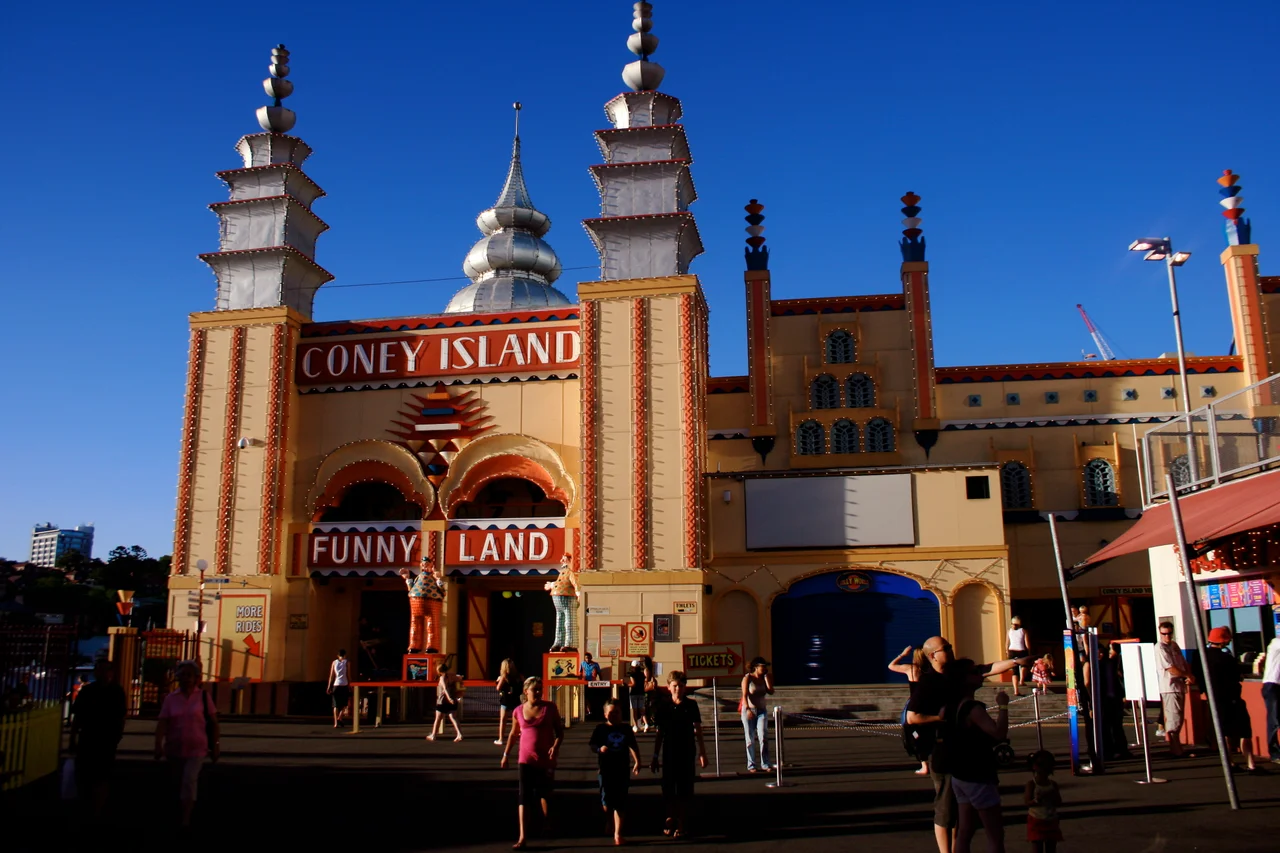

Luna Park Sydney
The face never stops smiling. Nine metres wide, flanked by Art Deco towers that borrow their scalloped crowns from New York's Chrysler Building, it has grinned out over Sydney Harbour for almost the whole of the park's life. Step through the gaping mouth and you enter Luna Park, wedged onto the narrow shelf of Milsons Point just 600 metres from the northern footings of the Harbour Bridge. The bridge throws its shadow across the rides at certain hours. Ferries cross the water below. And the face keeps smiling, even though the story it presides over has never been entirely a happy one.
Just for Fun
The slogan reads "Just for Fun," and Luna Park has tried to live up to it since 4 October 1935. The park was an import. When Luna Park at Glenelg in Adelaide went into liquidation that year, its rides were bought, dismantled, shipped across to Sydney, and reassembled at Milsons Point in roughly three months. Crowds arrived almost immediately. The site itself had been a working yard during construction of the Harbour Bridge, a patch of harbourside industry transformed into a place of fairy floss and noise. From the start, the resident artist Arthur Barton painted the murals and the great face, work that successors would repaint and replace eight times over the decades. The amusements changed, the coasters came and went, but the formula held: a small acreage of engineered joy beside one of the most photographed stretches of water on Earth.
The Ghost Train
On the night of 9 June 1979, fire tore through the Ghost Train, a dark ride that had carried passengers since 1935. Seven people died: three members of the Godson family, John and his sons Damien and Craig, and four boys from Waverley College, Richard Carroll, Michael Johnson, Jonathan Billings, and Seamus Rahilly, most of them only twelve or thirteen years old. They had gone to the park for an evening of fun and did not come home. The official finding blamed an electrical fault, though firefighters at the scene doubted it, and in the decades since, persistent claims have pointed instead to arson and a police cover-up. No one has ever been charged. The park closed in the fire's wake, and the wooden Big Dipper that had stood since 1935 was demolished and burned in 1981. The smiling face came down. For a time it seemed Luna Park might vanish entirely.
The Friends Who Saved It
What rescued Luna Park was stubbornness. In 1981, an action group called the Friends of Luna Park bought the threatened Coney Island amusements for $9,200, on the strict condition that they stay inside the heritage building where they belonged. That single act of preservation mattered enormously, because Coney Island, first built in 1935 and also known as Funnyland, is now the only operating example of a 1930s funhouse left anywhere in the world. Its giant slides, revolving barrels, and moving walkways survive almost exactly as they were. For decades afterward the Friends fought development proposals and lobbied for the park's reopening; two high-school students once gathered a 5,000-signature petition. In 2010 the park was added to the NSW State Heritage Register. In 2023, the Friends gathered at Coney Island for a reunion, and a plaque was unveiled to honour their long campaign.
The Neighbours and the Noise
Luna Park's modern history is a running argument between thrill and quiet. After the park reopened on 4 April 2004, residents in the apartment towers that had risen around it complained bitterly about the screams and rattle of the rides. Lawsuits followed, demanding the relocation or closure of certain attractions. When the park installed the Hair Raiser drop tower in 2013 without full planning approval, the dispute flared again over noise, light, and the sheer visual impact of a 50-metre tower beside people's bedroom windows. Court rulings briefly threatened to make every new ride subject to neighbours' objections, until planning changes in 2018 eased the constraint. The tension is almost philosophical: an amusement park is meant to be loud, and a smiling face on the harbour cannot whisper.
Still Standing
Luna Park has reinvented itself again and again. The park closed in early 2021 and reopened in October with eight new rides, and the ninth — the Big Dipper, an Intamin Hot Racer billed as the world's first launched single-rail coaster and the first single-rail coaster in Australia — opened in December 2021. Older favourites endure too: the wooden Wild Mouse, first opened in 1963 and restored yet again in 2025, still clatters along its track. In June 2024 the lease, which runs until 2044, changed hands once more, sold to the Oscars Group. Through every closure, fire, lawsuit, and sale, the face has remained the constant, a piece of 1930s showmanship that has become one of Sydney's most recognisable landmarks, smiling out across the water as it always has.
From the Air
Luna Park occupies the Milsons Point foreshore on the north shore of Sydney Harbour at 33.85°S, 151.21°E, roughly 600 metres west of the Sydney Harbour Bridge's northern pylons. From the air it reads instantly: the giant grinning face and its twin Art Deco towers sit directly on the water's edge, with the Ferris wheel and Big Top behind. The Harbour Bridge and, just across the water, the Sydney Opera House make this one of the most navigable urban scenes on Earth. Best viewed from 1,000–2,000 feet on a clear day. The nearest major airport is Sydney Kingsford Smith (YSSY / SYD), about 12 km south; Bankstown Airport (YSBK) lies to the southwest. Note that Sydney Harbour sits beneath busy controlled airspace serving YSSY.
Nearby Stories
- Royal National Park 28 km away
- Jervis Bay 107 km away
- Hive shipwreck 149 km away
- Apsley Falls 283 km away
- Smoky Cape Lighthouse 316 km away
- South West Rocks Pilot Station Complex 346 km away
- Roxy Theatre and Peters Greek Cafe Complex 413 km away
- 2003 Fiordland Earthquake 1774 km away