.jpg)
Lung Tsun Stone Bridge
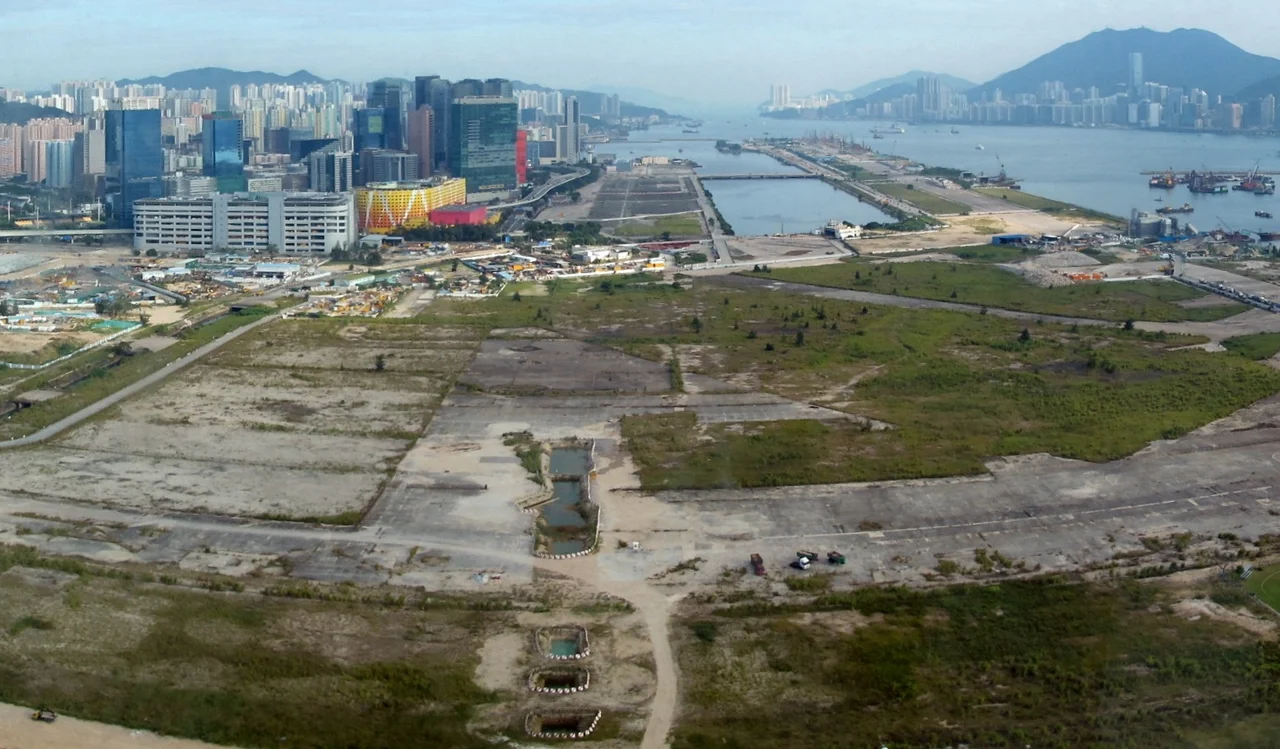
For decades, the old Kai Tak Airport runway jutted into Kowloon Bay like a concrete tongue, and below it something waited. In April 2008, as engineers began excavating the decommissioned airport site for redevelopment, they found granite beneath the fill. It was the Lung Tsun Stone Bridge — a pier completed in 1875, once the longest and most substantial stone structure of its kind in Hong Kong, buried so completely during World War Two that its very existence had become a matter of historical record rather than physical fact. The dig brought it back.
Built for Customs, Claimed by Gamblers
The bridge's origins lie in a problem that plagued the Pearl River Delta throughout the mid-nineteenth century: opium and contraband moving on Chinese junks under cover of a chaotic, multi-jurisdictional waterway. European merchants were the main operators, and the Viceroy of Liangguang — the governor responsible for Guangdong and Guangxi — ordered a checkpoint established in the channel between Hong Kong and Macau to intercept them. The customs ships stationed there needed resupply, which required a pier. The structure was named after the Lung Tsun River nearby.
Construction began in 1873 and the bridge was completed in 1875, built from granite and stretching into Kowloon Bay. It was divided into a north section and a south section, and when mud deposition extended the shoreline, the original stone structure was lengthened to 300 metres using timber. Its primary purpose was official, but a secondary use arrived quickly. Gambling had been legal in Hong Kong between 1867 and 1871; when the prohibition came in 1872, the casinos relocated to the Kowloon Walled City, which sat beyond colonial jurisdiction. The Lung Tsun Stone Bridge, reaching toward the bay just beside the Walled City, became the natural arrival point for foreign gamblers crossing to reach the tables.
The Airport Buries Everything
The Lung Tsun Stone Bridge stood beside the Kowloon Walled City for decades, connecting the enclave to the water. Maps from 1915 show both clearly — the dense block of the Walled City in the upper right, and the slender projection of the pier stretching south into Kowloon Bay. Then came the Japanese occupation of Hong Kong during World War Two. The Japanese military expanded Kai Tak Airport aggressively, filling in Kowloon Bay and burying whatever lay in the way. The bridge, the Lung Tsun Pavilion that stood beside it (a structure built in 1875 for greeting officials), and the surrounding geography were swallowed under the expanding airfield. When the war ended, the airport continued to grow on the filled land, and the bridge was forgotten. For more than sixty years, hundreds of thousands of passengers arrived and departed over ground that concealed it.
Rediscovery and Preservation
Kai Tak Airport closed in 1998, replaced by Hong Kong International Airport at Chek Lap Kok. The former runway site then sat as one of the largest urban redevelopment plots in Asia, a subject of years of planning debate. The archaeological excavations that began in 2008 changed the conversation. Engineers and archaeologists working at the Kai Tak site identified the bridge remnants in April of that year. Subsequent excavations in 2009 produced a fuller picture of what had survived. The Antiquities and Monuments Office published detailed reports through the Antiquities Advisory Board, and the decision was made: the remnants of the Lung Tsun Stone Bridge would be preserved in place, as an archaeological feature within the Kai Tak Development redevelopment plan. What the airport buried, the city chose not to re-bury.
What the Stone Still Carries
The bridge touched three distinct eras of Hong Kong's complicated history: the Qing-dynasty customs apparatus trying to control colonial smuggling; the peculiar legal limbo of the Kowloon Walled City, which drew gamblers and later housed an entire city-within-a-city beyond colonial law; and the Japanese military's transformation of the landscape during World War Two. Its granite came from local quarries, its dimensions were shaped by bureaucratic necessity, and its disappearance was incidental to a runway. None of that was planned. The stone simply absorbed what the decades brought. Preserving it in-situ at the Kai Tak site means future visitors to what will become a major urban district can stand above the same granite that customs officers, gamblers, and wartime laborers once walked.
The View from Kowloon Bay
The Lung Tsun Stone Bridge site sits at approximately 22.3289°N, 114.195°E, on the former Kai Tak Airport grounds in the Kowloon City District. The old runway — once one of the most photographed approaches in aviation, threading between apartment blocks before touching down at the water's edge — is now gone. From the air at 1,000 to 1,500 feet, the Kai Tak development site is visible as a broad open swathe cutting into the urban density of Kowloon, bounded by Kowloon Bay to the east. Hong Kong International Airport (VHHH) is approximately 35 kilometres to the west across the harbour. The location that once held Southeast Asia's most dramatic approach path now holds, quietly beneath it, a nineteenth-century granite bridge waiting to be properly seen.
From the Air
The Lung Tsun Stone Bridge site is at 22.3289°N, 114.195°E in Kowloon City District, on the former Kai Tak Airport grounds. View at 1,000–1,500 ft to see the Kai Tak development site against Kowloon Bay. Hong Kong International Airport (VHHH) is approximately 35 km to the west. The curved former runway footprint remains visible in the urban layout.
Nearby Stories
- Chapel of St. Francis Xavier 3.5 km away
- Cuiheng 4.1 km away
- 2015 Shenzhen Landslide 16 km away
- Shunde 31 km away
- Wanshan Archipelago 37 km away
- Nanxiong Formation 96 km away
- Heyuan 149 km away
- Checheng Fu'an Temple 629 km away