
Lustleigh
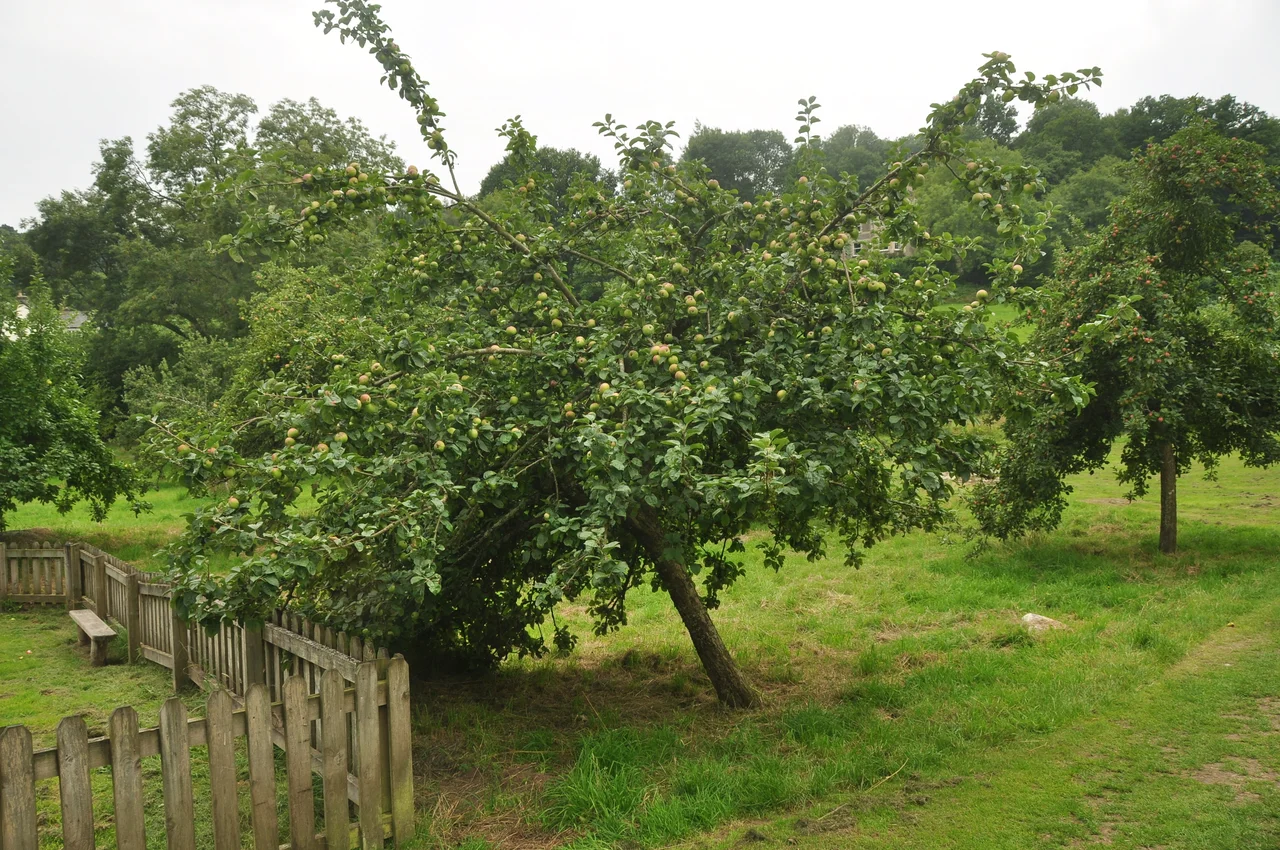
There is a granite throne in the village orchard. Every year on the first Saturday in May, a girl is crowned May Queen on it, and her name is added to the rock where every other May Queen since 1954 is inscribed. An older rock, on a hillside above Greyland, carries the names of all the May Queens from 1905 to the start of the Second World War. In May 2000 they unveiled a new throne, cut from granite at Blackingstone Quarry, designed by Doug Cooper and carved by Warren Pappas. It is inscribed simply with the Roman numerals MM. Lustleigh, population 579, holds its traditions in granite because granite outlasts almost everything else.
Luvesta's Clearing
The name comes from Old English. Legh or leigh means a clearing in a wood. The first part is a person's name, and scholars are not sure which. Possibly Luvesta, the "dearest one" in Middle English, a surname recorded at Ermington in 1333. Possibly Leofgiest, an Old English name. Either way, it is someone's clearing, eleven or twelve centuries old, sheltered in the Wray Valley between Bovey Tracey and Moretonhampstead. The spellings of the village name have wandered cheerfully over the centuries: Leuesteleg in 1249, Lustelegh in 1276, Luuastelegge in 1282, Lisleigh in 1672. The 14th-century manor house on Mapstone Hill, now divided into three properties, may have been built by William Prouz, heir to Gidleigh Castle, who added the south chapel to the parish church and is buried inside it with his effigy in place. Datuidoc's Stone, carved between 450 and 600 AD, was once the door sill of the church. It is now displayed inside, the village's oldest known artefact.
The Most Expensive Village
Various publications have called Lustleigh the prettiest village in Britain. The Daily Telegraph put it on a list of "30 greatest villages, all untouched by mass tourism." The Times listed it among the twenty best villages in Britain. MyLondon called it one of the prettiest villages in the UK that you might struggle to find. All of these accolades have a price. Devon Live reported in 2020 that Lustleigh had become the most expensive rural location in the UK in which to buy a house. Some of this is the thatched cottages, clustered around the parish church of St John the Baptist with its squat granite tower. Some of it is the Wray Valley itself, deep and wooded and crossed by paths that lead nowhere in particular. Some of it is the fact that only two buses a day serve the village from Newton Abbot - leaving at 10:00, returning at 13:50 - which makes Lustleigh both gloriously remote and slightly impractical.
The Railway That Came and Went
From 1866 to 1959 the village had a railway. The Moretonhampstead and South Devon Railway branch line ran past Lustleigh railway station, bringing summer tourists, sending farm produce out, supplying the village pub and the Wray Valley nurseries. Gatehouse Farm, conveniently placed by the line, became the Cleave Hotel - which is still the village pub today. Traffic peaked in the 1930s, fell after the war, and could not cover rising costs. The last passenger train ran in February 1959, the line closed completely in 1964, several years before the Beeching report formalised what was happening to rural railways everywhere. The old station building is now someone's home. The trackbed has become the Wray Valley trail, part of National Cycle Route 28, suitable for walking, cycling, and horse-riding. The 1931 film of "The Hound of the Baskervilles" used the station, with the station name temporarily changed. In 2025 the Harry Potter TV adaptation filmed in the village, using its thatched cottages as Godric's Hollow.
Cecil Torr Revives the May
By 1905 the Lustleigh May Day had lapsed - no one was sure for how long, no one was sure if it had ever existed in quite the form being claimed. Cecil Torr revived it. Torr was the village antiquarian, author of "Small Talk at Wreyland" (three series, 1918-1923), a writer whose three slim volumes of village reminiscence became minor classics of English country writing. He chose a granite boulder above Greyland for the first crowning, and the names of the early May Queens were carved into its surface. The celebrations moved to the Town Orchard in 1954, with a new May Queen rock. Then again in 2000 the present throne was unveiled. The August Bank Holiday Lustleigh Show, going since 1887, draws over 4,500 people - more than seven times the village population - to a single field at Kelly Farm. The show funds village projects: in recent years more than fifteen thousand pounds has been reinvested locally. The village shop nearly closed in 1995, and the villagers raised £86,000 to buy the freehold. Lustleigh maintains itself by collective effort. The granite throne is one face of that work.
An Aging Village
Lustleigh's parish population peaked at 679 in 1951 and has declined ever since: 553 in 2011, 579 in 2021. The wider Moretonhampstead, Lustleigh and East Dartmoor district has a median age of 55, and nearly a third of residents are over 65 - three times the national average. Less than 14 percent of residents are under 16. The primary school opened in 1876 and closed in 1963. The Royal Mail sorting office closed in 2009. The Cleave Hotel still pours pints. The Primrose Tea Rooms still serve cream teas. The Dairy is shop and post office combined. The dipper still wades the Wray Brook. In early June the slopes of Lustleigh Cleave fill with bluebells and foxgloves, and the deer come down from the moor in the evenings. The village is small. It will probably get smaller. But the May Queen is still crowned every spring, and the throne is granite.
From the Air
Lustleigh lies at 50.6178 N, 3.7202 W, in the Wray Valley on the eastern edge of Dartmoor National Park in Devon. View from 1,500 to 3,000 feet to take in the thatched village clustered around the church tower, with Lustleigh Cleave's wooded valley to the west. Nearest airport is Exeter (EGTE), about 12 nautical miles east-north-east. The village shows as a small cluster of pale walls and dark thatch against the green of the Wray Valley. Lustleigh Cleave's deep, narrow valley climbs sharply to the west. The A382 runs past to the east. Best light is morning, when mist often lies in the valley while the higher ground catches the sun. Dartmoor's larger granite tors form the western horizon.
Nearby Stories
- Torcross 2.8 km away
- Cotehele 4.6 km away
- HMS Formidable (1898) 9.1 km away
- Holsworthy 9.4 km away
- Eddystone Lighthouse 11 km away
- Tiverton Castle 18 km away
- 1890 Norton Fitzwarren Rail Crash 24 km away
- Lyme Bay Canoeing Disaster 26 km away