
Luxor Temple
Most Egyptian temples were built to house a god or to honor a dead king. Luxor Temple was built to make kings. Standing on the east bank of the Nile in the heart of ancient Thebes, it was dedicated not to a deity in the usual sense but to the renewal of royal power itself — the mysterious force the Egyptians called the Royal Ka, the divine essence of kingship that passed from one pharaoh to the next. This may well be where rulers came to be crowned, or to have their right to rule confirmed each year. They called it ipet resyt, "the southern sanctuary," and unlike the sprawling chaos of nearby Karnak, it has an unexpected elegance: a long, processional spine of soaring columns marching beside the river, designed to be walked through in ceremony.
Built to Renew a King
The temple as we see it was raised largely by two of Egypt's great builders. Amenhotep III of the eighteenth dynasty laid out its core around 1400 BC — the graceful sun court and the towering colonnade of papyrus columns. Two centuries later Ramesses II added a vast forecourt and the great pylon entrance, fronting it with colossal seated statues of himself and a pair of red granite obelisks. Only one obelisk still stands here; its twin was given to France in the nineteenth century and now rises in the Place de la Concorde in Paris, a sliver of Thebes marooned among Parisian traffic. The whole temple was cut from golden Nubian sandstone quarried upriver at Gebel el-Silsila and floated down the Nile. To an Egyptian, the building was not a representation of the sacred — it simply was sacred, a machine of stone for keeping the kingship eternally renewed.
The Avenue and the Feast
Luxor Temple did not stand alone. A ceremonial road ran arrow-straight for nearly three kilometers north to Karnak, lined the whole way with hundreds of human-headed sphinxes — the Avenue of Sphinxes, recently excavated and reopened along much of its length. Once a year this road came alive for the Opet Festival, the most important celebration in the Theban calendar. The cult statue of Amun was carried in a gilded ceremonial barque from Karnak down to Luxor, escorted by crowds, music, and clouds of incense, resting at way-stations along the avenue. Inside the southern sanctuary the rites renewed the bond between the god and the living king. For the people of Thebes it was part religious procession, part public holiday — a moment when the hidden god came out among them and the streets filled with celebration.
Thirty-Four Centuries of Prayer
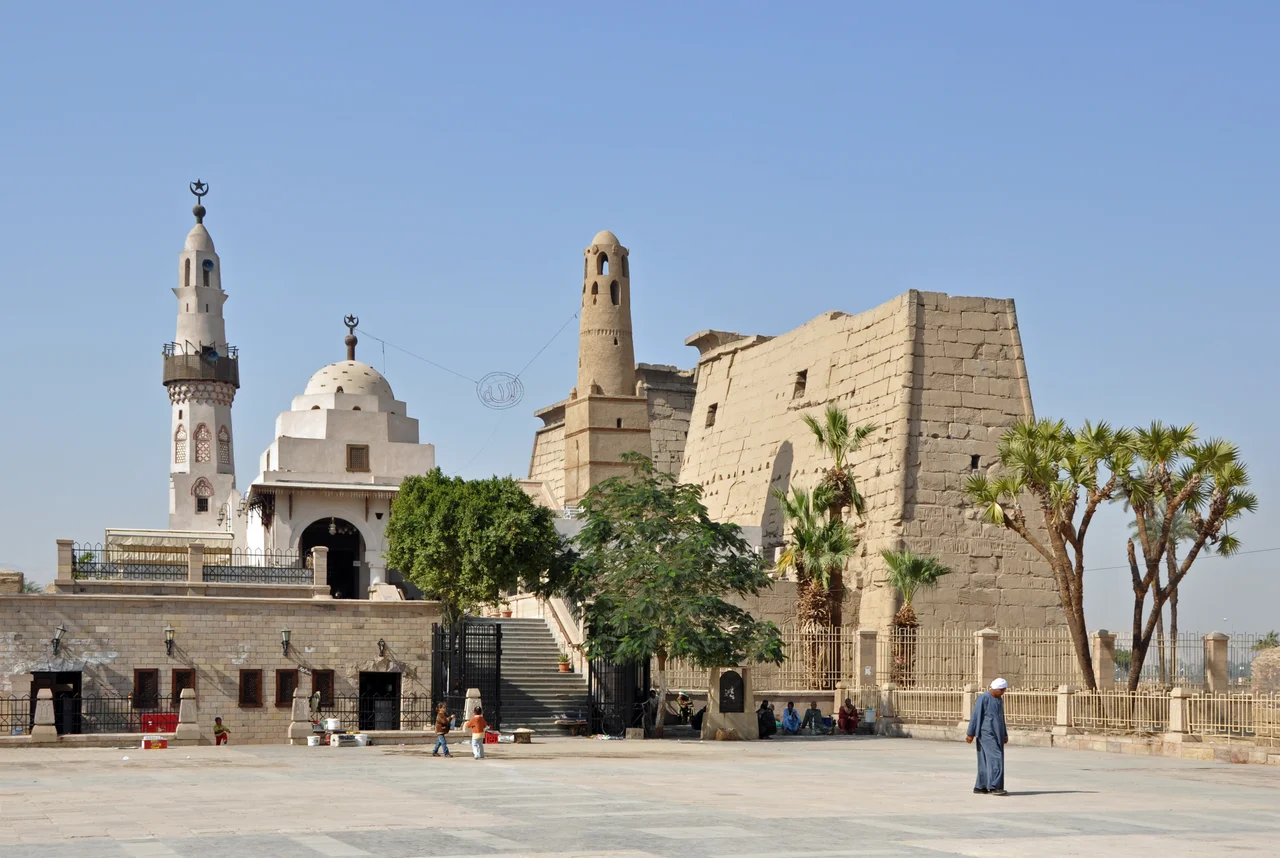
Few buildings on Earth have been prayed in continuously for as long as this one. The Egyptians worshipped here for over a thousand years. When Rome ruled Egypt, the temple became a legionary fortress and a chapel inside it, once dedicated to the goddess Mut, was rebuilt for the imperial cult and later turned into a Christian church. Around 640 AD, after the Arab conquest, part of the temple became a mosque — and it is still in use today. The mosque of Abu el-Haggag rises directly atop the ancient columns, its medieval foundations resting on stonework already three thousand years old. That single corner of Luxor Temple has hosted Egyptian, Roman, Christian, and Muslim worship in turn: more than 3,400 years of unbroken devotion on one patch of riverbank, each faith building literally upon the last.
A Living Layering of Faiths
The most remarkable thing about Luxor Temple is that its layers are not frozen relics but a living continuity. For much of its history the ancient courtyard lay buried under centuries of silt and rubble, and the town of Luxor grew up over it; when archaeologists dug the temple out, the mosque of Abu el-Haggag was left standing high on its mound, now floating improbably above the excavated columns. And each year the people of Luxor carry the boats of the local holy man Sheikh Yusuf al-Haggag through the streets in his mawlid festival — a Muslim celebration that echoes, across more than three millennia, the ancient barque procession of the Opet Feast that once passed this very spot. Few places make the long, unbroken human relationship with the sacred so visible, or so moving.
From the Air
Luxor Temple stands on the east bank of the Nile at the center of modern Luxor, at 25.70 degrees N, 32.64 degrees E. From the air it is unmistakable: a long, narrow temple of pale sandstone running parallel to the river, with the great pylon, the standing obelisk, and the colossi of Ramesses II at its northern end, and the medieval Abu el-Haggag mosque rising from within the courtyard. The Avenue of Sphinxes can be traced leading north toward Karnak. Recommended viewing altitude is 2,000 to 4,500 feet AGL; the riverside setting and surrounding city make it easy to locate, with generally excellent visibility apart from occasional spring dust. The nearest airport is Luxor International (ICAO HELX), about 5 km to the east; Aswan International (HESN) lies roughly 200 km to the south.
Nearby Stories
- Temple of Seti I (Abydos) 20 km away
- Dendera Temple complex 21 km away
- Esna 22 km away
- Abydos, Egypt 49 km away
- Mersa Gawasis 116 km away
- Kharga Oasis 147 km away
- Hurghada 184 km away
- Wadi El Gemal National Park 238 km away