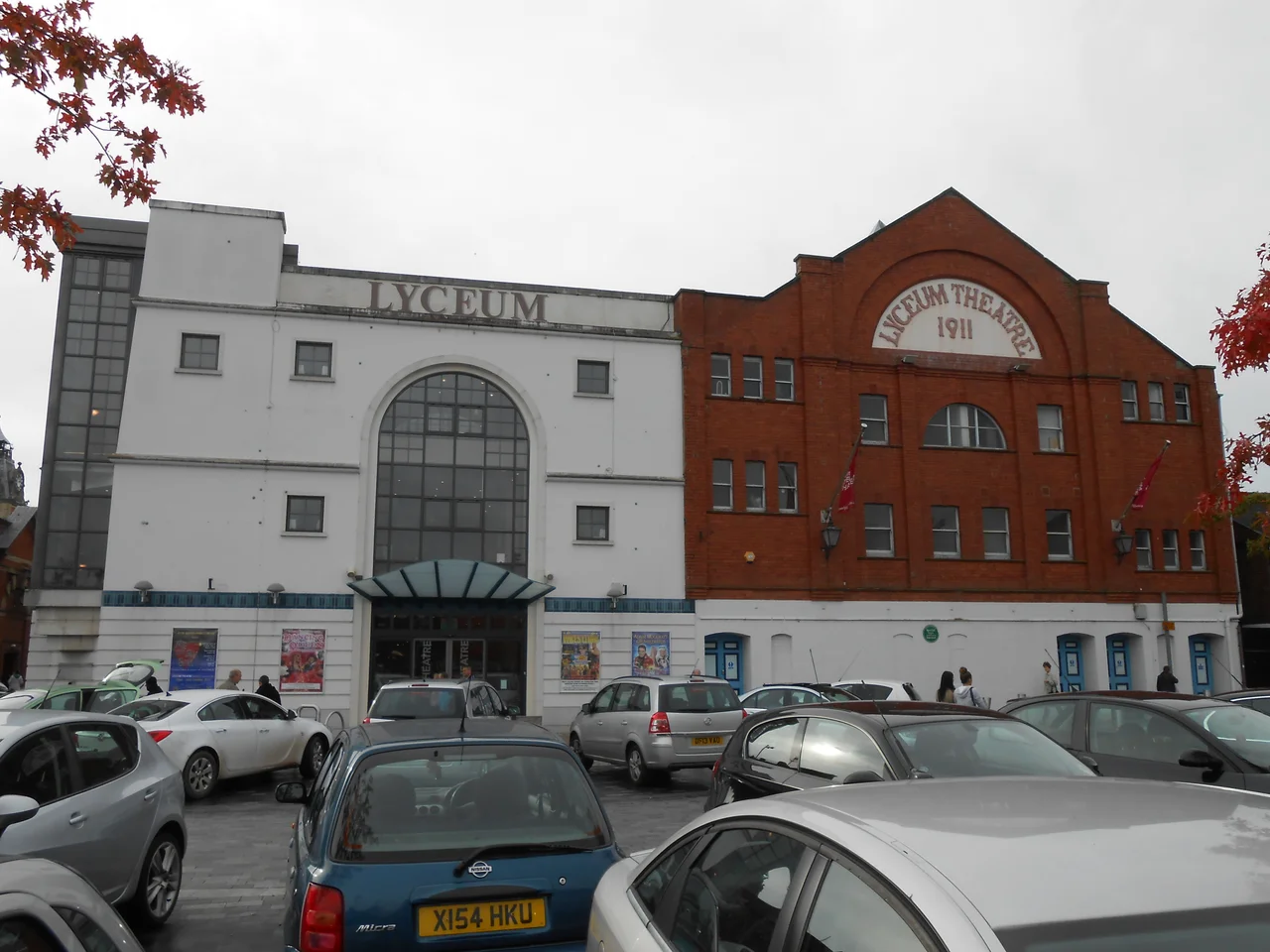

Lyceum Theatre, Crewe
Behind the Accrington brick facade on Heath Street there is a particular kind of layered history that working towns produce. The building started its life as a chapel for Irish migrants laying track for the new railway, and ended up an Edwardian theatre with reclining plasterwork figures decorating the dress circle. The congregation moved out in 1876. The actors moved in soon after, and they have not really left.
From Chapel to Stage
Crewe in the middle of the nineteenth century was a railway town in the rawest sense. The London and North Western Railway works pulled thousands of workers in from across the British Isles, and a large Irish Catholic community formed quickly around the lines. A Roman Catholic church was built on Heath Street to serve them. In 1876 the congregation outgrew the building and moved into a larger church elsewhere in the town. The site was acquired by Thomas Cliffe, a local farmer, who gave permission to Henry Taylor, a Crewe printer with theatrical ambitions, to convert the church into a venue for plays. Taylor was not satisfied with conversion. He wanted a proper theatre, and on 21 November 1887 the purpose-built New Lyceum Theatre opened on the same ground.
Burned and Rebuilt
In 1910 the theatre burned down. Fire was the great hazard of nineteenth-century playhouses, with gas-lit stages and timber roofs and audiences packed into galleries that could empty only by narrow staircases, and the Lyceum was lucky in that the disaster came at night. The building that replaced it the following year is the building that stands today, an Edwardian structure of Accrington-type brick with a slate roof. The 1911 reconstruction gave Crewe a three-storey theatre with a gabled facade divided into five unequal bays, an auditorium with a dress circle, gallery and boxes, and an entrance and offices in an adjoining two-storey four-bay block. Recorded in the National Heritage List for England as a Grade II listed building since 6 July 1976, it was refurbished in 1994, and as of 2022 it operates as part of the Trafalgar Theatres group.
Cartouches and Reclining Figures
The interior is where the Edwardian Lyceum announces itself. The fronts of the dress circle, gallery and boxes carry plasterwork decoration that includes cartouches and the reclining figures that were a stock motif of late Victorian and Edwardian theatre design, conjuring an atmosphere somewhere between a classical fresco and a music hall. More plaster ornament works across the proscenium arch and the ceiling rose. The materials are practical: Accrington brick, the hard red brick that became a default for industrial Lancashire and Cheshire because it weathered the soot and acid rain of mill towns better than softer stocks, paired with a slate roof from the quarries of north Wales. The combination is unglamorous from outside, but inside the plasterwork lifts the room into a different register.
A Town That Kept Its Theatre
Crewe is unusual among railway towns in still having a working theatre at all. Many smaller English cities lost their late-Victorian and Edwardian playhouses to bingo halls, cinema conversions, or demolition in the 1960s and 1970s. The Lyceum survived in part because the bones were good, in part because Crewe kept enough of an audience to support it through the lean years, and in part because successive operators have invested in restoration rather than reinvention. Today the theatre runs touring shows, musicals, drama, comedy, pantomime and exhibitions, and stitches into Crewe's cultural life as the principal stage between Manchester and Stoke.
An Echo on Heath Street
Stand on Heath Street and look up at the gables and the unequal bays, and the layers of the building are visible at once. There is the original site of the Catholic chapel that gathered the Irish railway workers under one roof in the 1850s and 1860s. There is the ghost of the 1887 New Lyceum that Henry Taylor commissioned out of pride. There is the 1911 rebuild, which preserves the ambition while learning from the fire. And there is the working theatre of today, with its plasterwork cartouches and its programme of touring shows, still pulling people in off the Crewe streets to sit in the dark together.
From the Air
The Lyceum Theatre stands on Heath Street in central Crewe at 53.10N, 2.44W, around 50 metres elevation on the Cheshire Plain. Crewe itself is identifiable from the air by the vast railway junction immediately to the north of the town centre, where the West Coast Main Line meets lines to Chester and Manchester. Nearest airports: Manchester (EGCC) 40 km north, Hawarden (EGNR) 40 km west, and Liverpool (EGGP) 65 km northwest. The town sits in unrestricted airspace below the Manchester Class D zone.
Nearby Stories
- Battle of Rowton Heath 1.1 km away
- Knowsley Hall 1.7 km away
- Old Trafford 2.9 km away
- Tutbury Castle 7.2 km away
- Haddon Hall 7.5 km away
- Whittington Castle 14 km away
- Stafford Castle 16 km away
- Wentworth Castle 19 km away