
Lycosura
Her true name cannot be spoken. The goddess worshipped at Lycosura held a title — Despoina, meaning simply The Mistress — because her real name was known only to those initiated into her mysteries, and they kept their oath. For two millennia, the secret held. It still holds today. This is the peculiar gravity of Lycosura: an ancient site in the wooded mountains of south Arcadia where the most important fact about the most important deity was systematically suppressed, and where the second-century traveler Pausanias arrived, looked around, and declared it the oldest city in the world.
What Pausanias Saw
When Pausanias visited Lycosura around 170 CE, he was already centuries removed from the city's peak. He recorded that it was founded by Lycaon, son of Pelasgus — the primordial founder-figure of Arcadia — and that it predated every other human settlement. There is no archaeological evidence for the city before the fourth century BCE, so his claim almost certainly reflects myth rather than history. But Pausanias was not merely repeating legend; he was also making careful observations. He described the sanctuary of Despoina in specific detail: the temple, the stoa, the altars, the painted panels depicting Zeus with the Fates and Hercules wrestling Apollo for the Delphic tripod. He noted the distance from Megalopolis, the side doorway in the south wall of the temple, the mosaic floor, the stone roof. His account remains the only extended ancient description of the site — and it was tested against the ground when the Greek Archaeological Service excavated the sanctuary beginning in 1889.
The Goddess and Her Colossal Group
At the rear of the temple's cella, on a massive stone podium roughly a meter high, stood a sculptural group unlike anything typical of Greek religious practice. Most temples had a single cult statue. Lycosura had four: Despoina and Demeter seated together on an ornate throne, with Artemis and the Titan Anytos standing on either side. All were acrolithic — meaning the bodies were draped in fabric or metal while the heads, hands, and feet were carved from Pentelic marble. The figures were colossal, significantly larger than life. Pausanias attributed the group to the sculptor Damophon of Messene; scholars now generally accept that Damophon was active in the second century BCE, which would place the group roughly two centuries after the temple's construction. Damophon's attribution rests almost entirely on Pausanias's word, and Pausanias himself admitted, however indirectly, that the statues would have been three hundred years old or more when he saw them — well beyond anyone's living memory of who made them. The throne was decorated with tritonesses, sea-nymphs appropriate to Despoina's parentage: she was considered the daughter of Poseidon and Demeter, rather than of Zeus and Demeter as Persephone was.
The Veil That Tells the Ritual
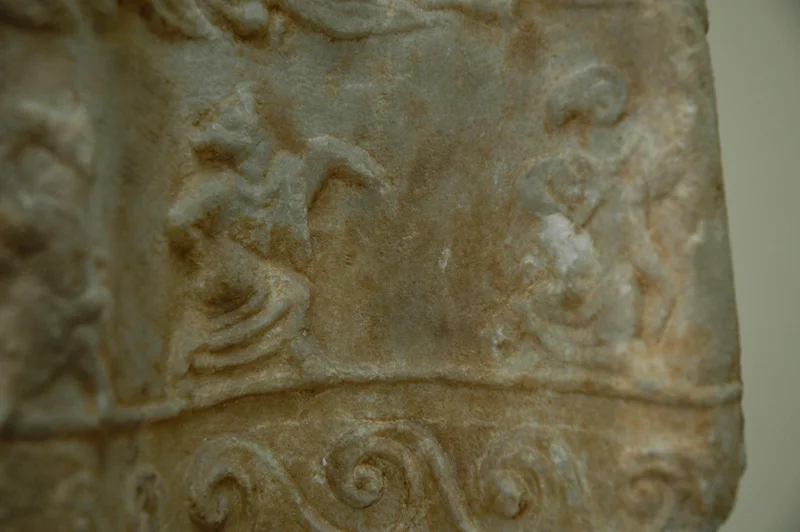
Of all the fragments recovered from the sanctuary, the veil of Despoina is the most studied. Carved from marble in extraordinary detail, it preserves multiple registers of ornament stacked from crown to hem: rays, eagles, winged thunderbolts, olive sprays, Nereids riding sea-horses alongside Tritons and dolphins, Nikai carrying censers, and — most striking — a frieze of dancing women with the heads of sheep and cows. More than 140 terracotta figurines with animal heads were found near the Megaron, the monumental altar-like structure to the west of the temple; the majority were female figures closely resembling those dancing figures on the veil. The connection between the figurines and the carved veil suggests something about the mystery rituals performed at Lycosura — though exactly what that something is remains, appropriately, unclear. The mode of sacrifice at the Megaron was also unusual: worshippers hacked a limb from the sacrificial animal rather than cutting its throat. The mysteries kept their secrets through practice as much as through silence.
The City That Refused to Move
In 368 or 367 BCE, the newly founded city of Megalopolis began absorbing the towns and villages of the surrounding region — sometimes through persuasion, sometimes through force. The citizens of Trapezus resisted and were massacred or driven into exile. The citizens of Lycosura also refused to relocate. They were spared. The reason, according to ancient sources, was the sanctuary: the Arcadians revered Despoina too deeply to risk sacrilege by harming those who had taken refuge in her precinct. Lycosura survived as a city in technical terms — Pausanias still found people there — but it fell under the political control of Megalopolis, which managed the sanctuary. The Megalopolitan coins of the early third century CE appear to depict the cult statue group, evidence of the city's continued pride in what lay nine kilometers to its west. The sanctuary itself was visited by the emperor Hadrian in the second century CE, who left a dedicatory statue. Then, gradually, the visits stopped.
What the Hill Holds Now
The site of Lycosura occupies a hill 632 meters above sea level in the forested mountains south of the Plataniston river. The sanctuary has been excavated thoroughly; the urban area of the city has barely been touched. The temple foundations remain: limestone walls capped with fired brick, six Doric marble columns across the facade, the podium where the colossal group once stood. The stoa to the northeast measured 14 by 64 meters; its painted panels are gone, the bas-reliefs Pausanias described have never been found. Fragments of the sculptural group — the veil, the draped bodies, the separately carved marble heads — are divided between the small on-site museum and the National Archaeological Museum in Athens, where the busts of Demeter and Artemis are displayed. The bust of Despoina herself is not preserved. Her true name remains unknown. The sanctuary is nine kilometers west-southwest of Megalopolis, reached by a winding road through oak and pine.
From the Air
Lycosura lies at approximately 37.390°N, 22.031°E, on a wooded hill in the mountains of southern Arcadia. The site is 9 km west-southwest of Megalopolis, whose power plant cooling towers provide an unmistakable aerial landmark to the northeast. The nearest major airport is LGKL (Kalamata International), roughly 55 km to the southwest. Recommended viewing altitude is 5,000–8,000 feet. The hill occupied by the ancient city is forested; the cleared sanctuary area on its northeastern slope is most visible from the northeast at low altitude. Morning light from the east best illuminates the terrain.
Nearby Stories
- International Flight Training Center, Kalamata 5.3 km away
- Karyes 6.8 km away
- Barony of Akova 11 km away
- Agios Andreas, Katakolo 13 km away
- Diocese of Amyclae 14 km away
- Larisa (Argos) 19 km away
- 2023 Messenia Migrant Boat Disaster 26 km away
- Panagia Skafidia Monastery 40 km away