
Lyme Regis
She was twelve years old when she and her brother Joseph pulled the long skull of an ichthyosaur out of the cliff at Lyme Regis. The year was 1811 - a year before Napoleon marched into Russia, three decades before anyone in England would even use the word 'dinosaur'. The girl's name was Mary Anning, and the creature whose bones she had just uncovered had been swimming in a Jurassic sea two hundred million years before any human being was alive to wonder about it. Lyme Regis is a small place. About four thousand people. A curved harbour wall, a steep main street, fossil-shaped lampposts. But what Mary Anning quarried from these crumbling cliffs - and what the cliffs have continued to give up since - changed how every generation after her thinks about the age of the Earth.
The Cobb
The wall that makes the town possible is older than the records. The first written mention of the Cobb dates to 1328, when a document notes that storms had already damaged it. It was originally made of oak piles driven into the sea bed, with boulders floated into the gaps between empty barrels and dropped into place. No mortar at all. A 1685 writer marvelled that "no one stone that lies there was ever touched with a tool... but all the pebbles of the see are piled up, and held by their bearings only." That improbable demi-lune of stone has been swept away, rebuilt, and reinforced again and again - most catastrophically in 1377, when storms took the Cobb, fifty boats, and eighty houses in a single night. By 1780, the artificial harbour it created made Lyme a port larger than Liverpool. Today it is best known as a place where the actress Meryl Streep stood in a black cape, watching the sea in The French Lieutenant's Woman, and as the spot where Jane Austen's Louisa Musgrove fell - Tennyson, arriving in town, demanded to be shown the exact place.
Mary Anning's Cliffs
Mary Anning was born in 1799, the daughter of a poor cabinetmaker who supplemented his income by collecting and selling 'curiosities' to tourists - the strange spiral stones and dragon-bones that the Blue Lias cliffs east of town routinely surrendered. He died when she was eleven, leaving the family in debt. Mary kept hunting fossils. The discoveries she made over the next thirty-five years - the first complete ichthyosaur skeleton, the first plesiosaur (which Cuvier in Paris initially refused to believe was real), the first British pterosaur, the first coprolite ever recognised as fossil dung - rewrote the history of life on Earth. She was barred from the Geological Society of London because she was a woman; it did not admit women until 1904, fifty-seven years after her death. But the men who did her science published her discoveries, and slowly the world worked out that the Earth was older, stranger, and more populated by extinct monsters than the comfortable theology of Anning's day had imagined.
A Coast That Will Not Sit Still
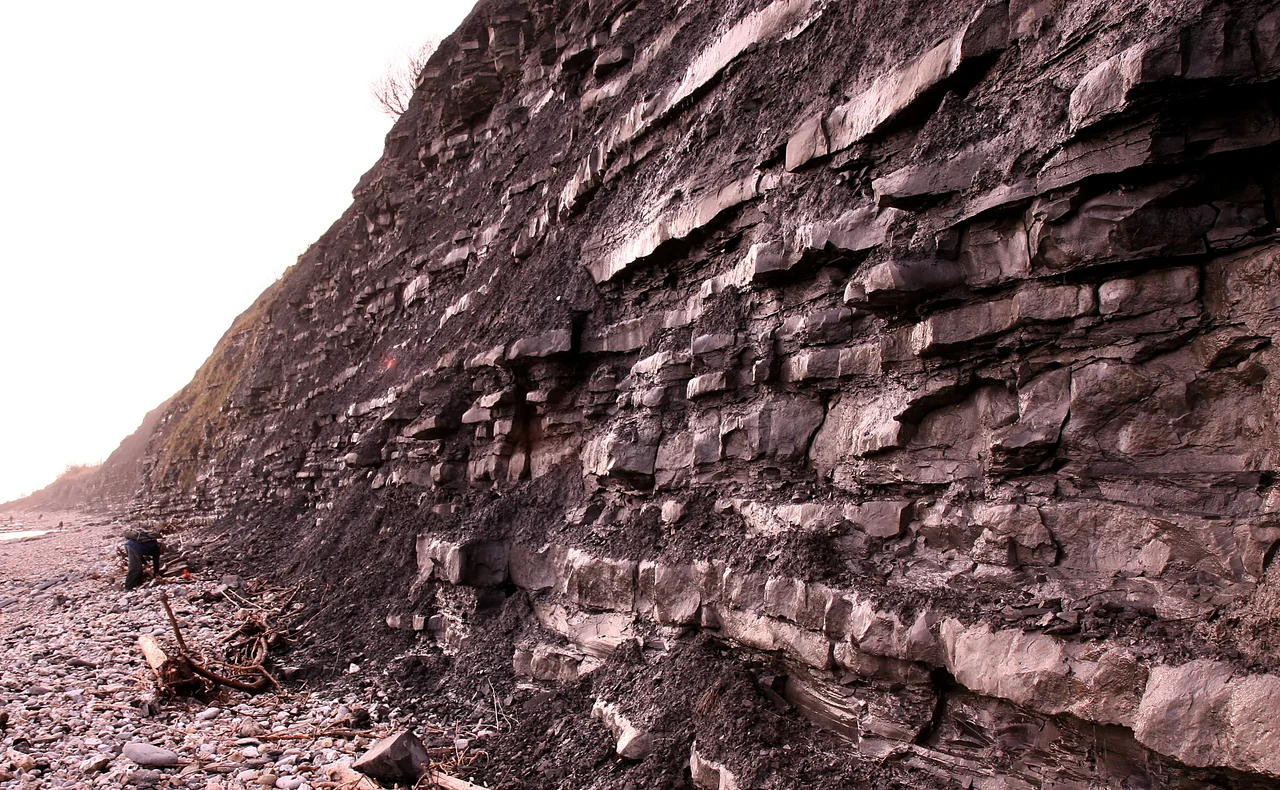
The reason Lyme Regis is a fossil town and not just a pretty one is that its cliffs are actively falling down. The Blue Lias and Charmouth Mudstone formations that hold the Jurassic remains are notoriously unstable; the coast crumbles into the sea on a regular schedule, exposing new specimens with every winter storm. On Christmas Eve 1839, the Dowlands Landslip a few miles west tore open a chasm three hundred feet across and a hundred and sixty feet deep, leaving a patch of wheat field stranded on what the locals named Goat Island. Farmers charged sixpence to see it. In May 2008 a four-hundred-metre section of cliff collapsed onto the beach between Lyme and Charmouth, described as the worst landslip in a century. A £16 million sea-defence project completed in the 2000s buys the town time, but everyone here knows it is only time. The Jurassic Coast does what it has always done.
A Pearl, a Sloop, a Lassie
Lyme Regis carries its history lightly. Edward I added the 'Regis' to its name in 1284. Admiral Sir George Somers, a former mayor, was shipwrecked in 1609 and founded the English colony that became Bermuda - the two towns are now twinned. On New Year's Day 1915 the bodies of sailors from a U-boat-torpedoed ship were brought into the Pilot Boat Inn, where the owner's dog Lassie reportedly licked one believed dead back to life; that dog became the inspiration for a hundred films. Jane Austen called the town her "happiest spot for watching the flow of the tide." J.R.R. Tolkien took family holidays at the Three Cups Hotel. Banksy stencilled an origami crane on a wall by the River Lym in 2012. In 2022, a bronze statue of Mary Anning - twelve years old, hammer in hand, dog at her feet - was unveiled at the bottom of Long Entry, exactly where she would have walked down to her cliffs.
From the Air
Lyme Regis sits at 50.73 degrees north, 2.94 degrees west, on the western edge of Lyme Bay where Dorset meets Devon. From the air the Cobb is unmistakable - a curved breakwater enclosing the small harbour at the south-west end of town, with the High Street climbing steeply inland. The Blue Lias cliffs run east toward Charmouth. Cruising altitude 2,500-5,000 feet gives a clean view of the entire Jurassic Coast UNESCO site. Exeter International (EGTE) lies thirty nautical miles west; Bournemouth (EGHH) about forty nautical miles east. The Channel coast carries Atlantic weather - clearest conditions usually follow a northerly airflow.
Nearby Stories
- Exeter Cathedral 1.5 km away
- Dorset Museum 1.7 km away
- English Riviera Geopark 2.6 km away
- Sieges of Taunton 9.1 km away
- Stourhead 18 km away
- HMS Warrior (1917) 20 km away
- Exmoor 24 km away
- HMS Formidable (1898) 26 km away