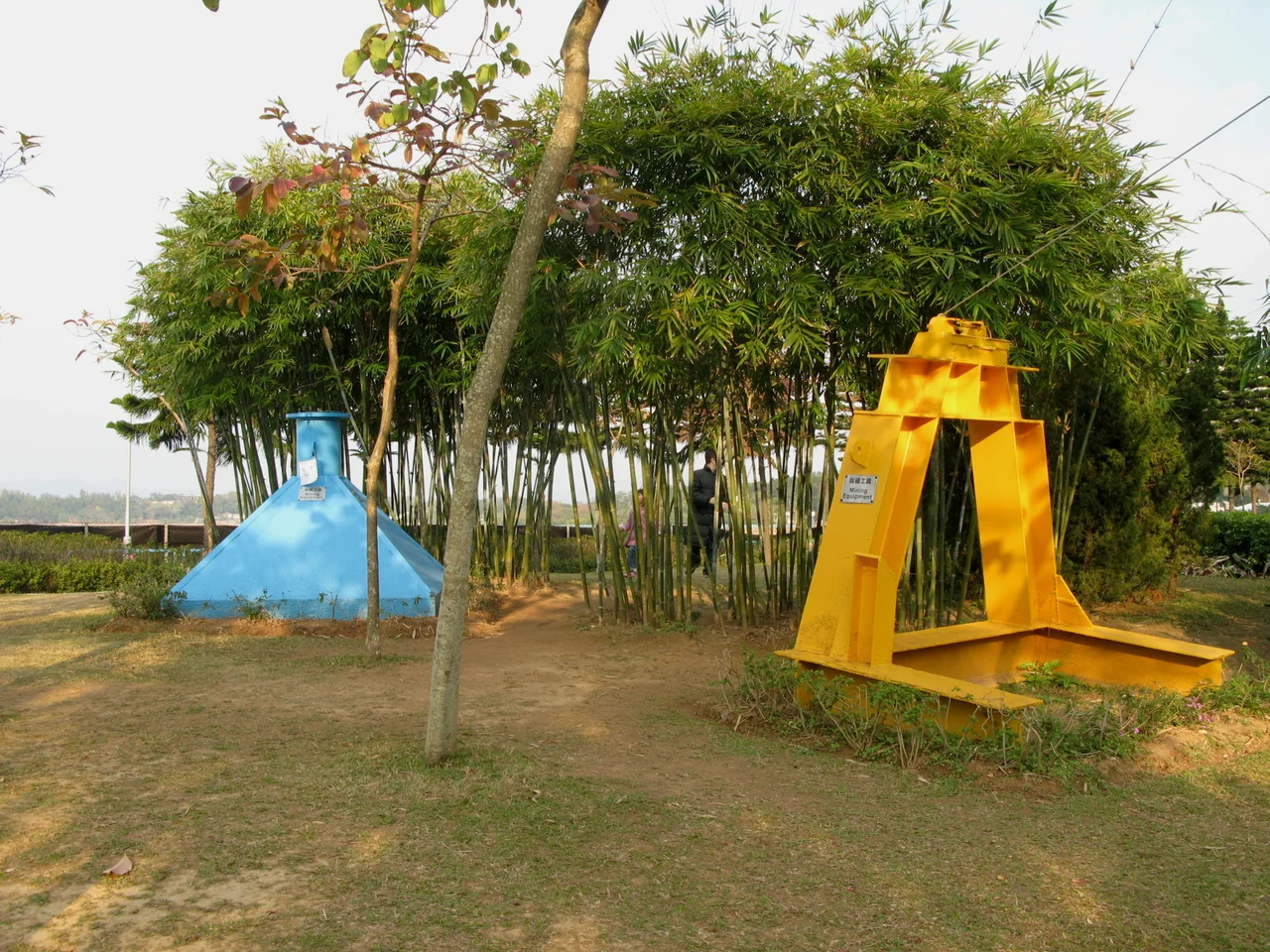

Ma On Shan Iron Mine
When the mine closed in 1976, 400 workers were laid off at once. They had no warning beyond the economic signals that had been building for years — Japan was pivoting from steel to oil tankers, and the iron extracted from these hills was no longer worth pulling out of the ground. Families packed up and left the hillside village that had grown around the workings. Schools shut. The churches locked their doors. In Hong Kong's relentless forward rush, the Ma On Shan Iron Mine became something the territory rarely tolerates: a ruin.
Sir Paul Chater Opens the Ground
The mine began in 1906, when Sir Paul Chater — one of colonial Hong Kong's most influential merchants and co-founder of Hongkong Land — put the Hong Kong Iron Mining Co. Ltd. to work on the Ma On Shan hillside. The first method was open-cut: surface rock stripped away, ore scooped from exposed seams. For over two decades, this opencast operation ran under Chater's company. After a gap in operations in the 1930s, a succession of operators kept the workings going through the chaos of the 1940s, including the years of the Japanese occupation from 1942 to 1945, when extraction continued under different management. The hillside held iron, and whoever controlled Hong Kong found a reason to dig.
Going Underground
In 1949, the Mutual Trust Co. Ltd. took over, and within four years they had fundamentally changed the character of the mine. Starting in 1953, the tunnels went horizontal, then deeper. By 1959, all mining had moved underground entirely. A joint venture with Japan's Nittetsu Mining Company began that same decade, creating a direct economic thread from the hillside in the New Territories to the Japanese steel industry. The tunnels multiplied. Miners spent their shifts underground in conditions that left their lungs full of dust and their bodies marked by hard physical labor in confined, dark spaces. Above ground, their families lived in Ma On Shan Village, which swelled to over 10,000 inhabitants at its peak — a community shaped entirely by what happened beneath the hill.
The Human Weight of the Work
Mining communities carry a particular kind of solidarity forged by shared risk. The men who went down into the Ma On Shan tunnels each day understood that the mountain held dangers no surface farmer ever faced. Two churches — the Lutheran Yan Kwong Church and St. Joseph's Catholic Church, both inaugurated in 1952 — gave the village its social anchors. Schools were built, a clinic established. The community had its own small universe on the hillside, separated from the city below by distance and by the rhythm of shift work. When the mine faltered and then stopped, the social fabric went with it. The primary school closed in 1976. The Catholic church held its last regular Sunday service in 1981. By 1999 it was abandoned entirely.
The Oil Tanker That Closed a Mine
The mine's end was shaped by forces thousands of miles away. In the 1970s, Japan restructured its heavy industry, shifting resources toward building supertankers rather than refining iron into steel. Demand for iron ore from Ma On Shan collapsed. The 1973 oil crisis compounded the pressure on global shipping and manufacturing, squeezing margins further. The Nittetsu joint venture became uneconomic. The government mining lease survived until 1981, but the real closure came five years earlier, in 1976, when the last workers walked out of the tunnels and 400 jobs ceased to exist. Estimates suggest that even after seventy years of extraction, 30,000 tonnes of iron ore remained in the rock — ore that was simply not worth the cost of reaching.
What the Mountain Kept
The structures left behind have gradually earned recognition. In April 2016, Hong Kong's Antiquities Advisory Board graded several mine remnants: the exterior walls of the 240 ML and 110 ML tunnel entrances achieved Grade 2 status; the Mineral Preparation Plant and the Site Structures at the Mining Settlement both received Grade 3 listings. These grades mark them as historically significant, requiring documentation and some form of preservation. Engineers have also proposed that the abandoned tunnels could serve a new purpose entirely — as underground chambers for compressed-air energy storage, a technology that captures surplus electricity as pressurized air and releases it on demand. The mountain that once fed Japan's steel mills might yet power Hong Kong's grid.
From the Air
The Ma On Shan Iron Mine sits at 22.4034°N, 114.2448°E, in the hills above Ma On Shan on the eastern shore of Tolo Harbour in the New Territories. From the air at 3,000 to 5,000 feet, the saddle-shaped twin peaks of Ma On Shan are the dominant landmark to the southeast. The remnant mine structures are tucked into the forested hillside below the ridgeline. Hong Kong International Airport (VHHH) lies approximately 35 nautical miles to the southwest. The area sits within the Ma On Shan Country Park boundary. Tolo Harbour stretches to the west, offering a clear geographic reference for coastal navigation.
Nearby Stories
- Chapel of St. Francis Xavier 3.5 km away
- Cuiheng 4.1 km away
- 2015 Shenzhen Landslide 16 km away
- Shunde 31 km away
- Wanshan Archipelago 37 km away
- Nanxiong Formation 96 km away
- Heyuan 149 km away
- Checheng Fu'an Temple 629 km away