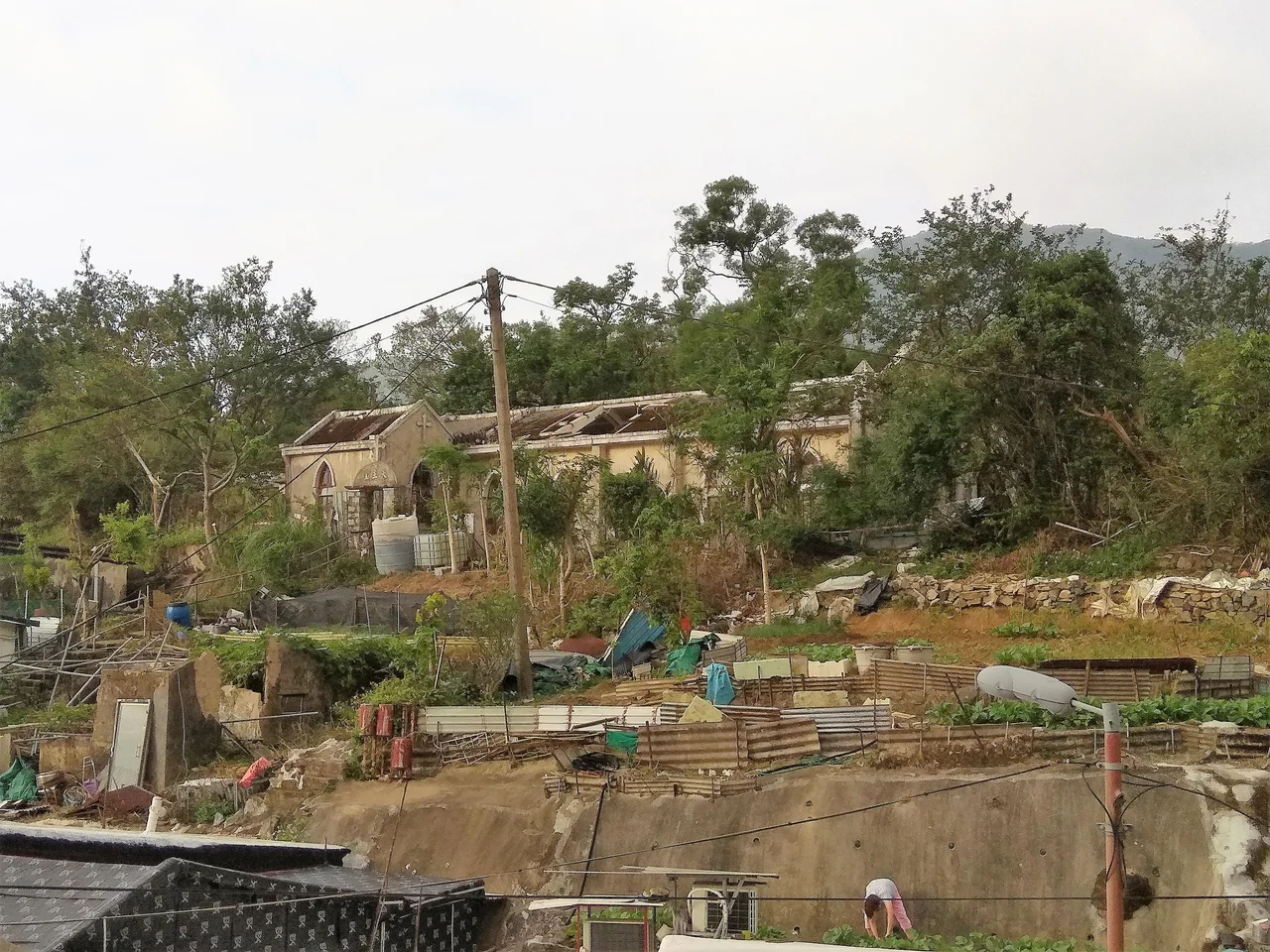

Ma On Shan Village
Two churches opened their doors within a month of each other in the spring of 1952. St. Joseph's Catholic Church was inaugurated on 25 April; the Lutheran Yan Kwong Church on 22 June. Their near-simultaneous founding tells you something about the speed at which Ma On Shan Village was growing: fast enough that two different denominations saw a community worth building for, arriving almost simultaneously on the same hillside.
A Village Built by Iron
Ma On Shan Village — Ma On Shan Tsuen in Cantonese — grew because of what was underground. The iron mine that gave the hillside its economic reason for being had opened in 1906, but it was in the 1950s, when mining went fully underground and a Japanese joint venture expanded the operations, that the village truly exploded in size. Workers flooded in, bringing families. The population climbed past 10,000 at its peak, a remarkable concentration of people on a hillside in Sha Tin District that had previously been quiet rural territory. The village was not planned in any formal sense — it accreted around the mine's needs, filling whatever space the slope allowed.
The Churches on the Hill
Both churches built in 1952 became anchors for communities within the community. The Lutheran Yan Kwong Church was part of a five-building complex; a primary school joined it in 1961. The Catholic St. Joseph's complex was more elaborate still: church, primary school, kindergarten, a small clinic built between 1952 and 1954, and a convent, all arranged on the top of a small hill within the village. The church was rebuilt in 1962, reflecting the confidence of a congregation expecting to stay. These institutions offered something the mine itself could not: continuity, community ritual, a place where people could mark births, marriages, and deaths with ceremony rather than the shift roster.
When the Mine Stopped
In 1976, the Ma On Shan Iron Mine closed. The workforce of 400 was laid off; the families who depended on those wages began to leave. The primary school and kindergarten attached to the Lutheran church closed the same year the mine did — their student population had simply walked away. St. Joseph's held Sunday services until 1981, when regular worship became unsustainable. A priest named Father Wu continued occasional missionary visits afterward, but the congregation had scattered. By 1999, the church complex was vacant. The village did not disappear entirely — around 80 families still live there — but the dense, humming community of 10,000 that had built this place was gone.
Traces and Continuities
The Lutheran primary school relocated rather than simply closing. It moved to Heng On Estate in the Ma On Shan new town and was renamed Ma On Shan Lutheran Primary School in 1987, carrying the institution's identity into a different kind of community. The Yan Kwong Church itself was revitalized in 2015 — under the name ELCHK Grace Youth Camp, following a restoration project that began in 2014 — as a centre for preserving the history and culture of the old mining village, giving the building a new purpose rooted in the past it witnessed. St. Joseph's Church achieved a different kind of afterlife: in 2009, the director Law Wing-cheung used its vacant buildings as a location for the film Tactical Unit — Comrades in Arms, the empty complex standing in for spaces that feel both institutional and abandoned. The Ma On Shan Country Trail now runs from the village to Tai Shui Tseng, passing through the landscape that miners once crossed on their way to work.
From the Air
Ma On Shan Village sits at 22.4019°N, 114.2436°E, on the lower southwestern slope of Ma On Shan mountain, above the Ma On Shan new town and Tolo Harbour in Sha Tin District. The hillside location is visible from the air at 2,000 to 4,000 feet, set against the distinctive saddle-shaped peak above. Hong Kong International Airport (VHHH) lies approximately 35 nautical miles to the southwest. The village sits within Ma On Shan Country Park territory; the forested slope above it is protected parkland. The MTR Ma On Shan station in the new town below provides the closest rail access.
Nearby Stories
- Chapel of St. Francis Xavier 3.5 km away
- Cuiheng 4.1 km away
- 2015 Shenzhen Landslide 16 km away
- Shunde 31 km away
- Wanshan Archipelago 37 km away
- Nanxiong Formation 96 km away
- Heyuan 149 km away
- Checheng Fu'an Temple 629 km away